Saildrone Wins Court Challenge to USN’s New Procurement Evaluation Program
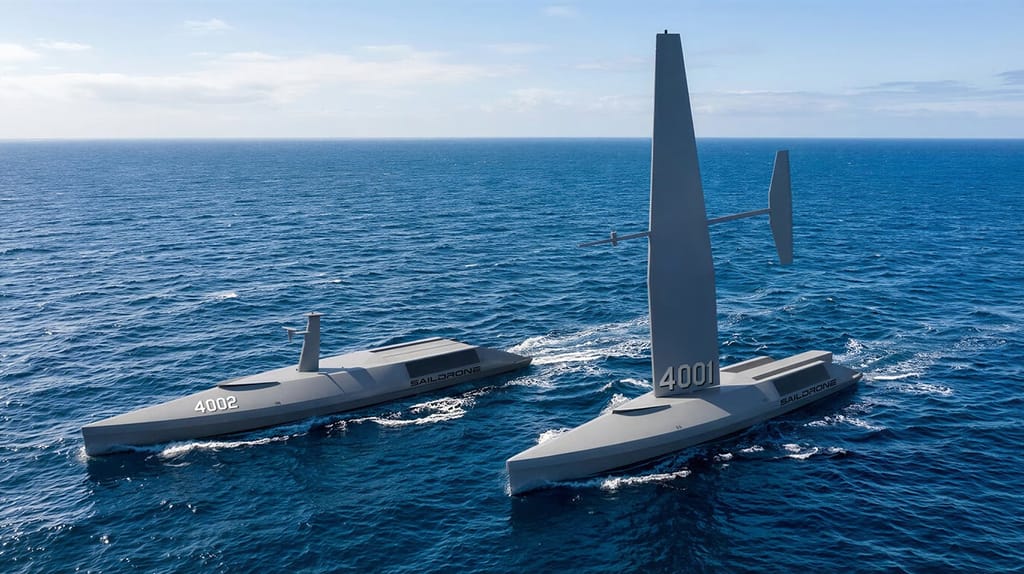
Saildrone, a manufacturer of unmanned surface vehicles, prevailed in court after it challenged the U.S. Navy’s new procurement evaluation program touted by the Pentagon to speed up the process. It is seen as a rare example where a supplier was able to prevail against the government and, according to lawyers, shows that the government can’t place a major procurement beyond judicial review.
The case stemmed from the U.S. Navy’s competitive program for the development of a new Medium Unmanned Surface Vessel (MUSV). The Navy has increasingly developed and deployed these drones, and this new program envisions a class of medium-size vessels,
The Pentagon has sought to modernize and speed up the procurement process, reports The New York Times. The newspaper wrote about the selection process for this program, reporting last summer about the problems and calling the process “messy from the start.” It said participants had been left confused and frustrated. In September, the Navy reported it had awarded initial orders for 10 vessels each from Galliano Marine Services, HII, and Saronic Technologies following successful at-sea testing.
Saildrone sued, alleging that it had been unlawfully excluded after the Navy deemed Saildrone’s entry non-compliant across all three of the evaluation criteria. Saildrone was excluded from the final demonstration phase and challenged the Navy, arguing that it was being falsely deemed non-compliant.
Two of the three determinations were dropped reports Saildrone after it filed the challenge, but a third remained as a disqualifier. Saildrone took it to court along with another competitor, Blue Water Autonomy, which was also denied the right to conduct its demonstration.
Judge Philip S. Hadji of the United States Court of Federal Claims agreed with the company, finding that the Navy “engaged in disparate treatment” and had “acted in an arbitrary and capricious manner in its review of Saildrone’s proposal.” The judge in his ruling set aside the Navy’s decision to eliminate Saildrone from the competition.
The court determined that Saildrone was unlawfully excluded and ordered the Navy to promptly reevaluate Saildrone’s proposal using the same criteria it applied to other competitors. Until it does, the Navy cannot commit more than $1.5 billion of the program’s $2.1 billion budget to production.
Reporting on the case, The New York Times highlights that it was an “unusual victory for the industry.” It notes that most companies protesting government bidding decisions do not prevail and that it was rare for a small defense contractor to overturn a decision.
The lawyers at the firm Selendy Gay, which represented Saildrone, commented that it is “a decision with implications far beyond a single competition.” They note that the judge rejected the government’s claim that the court “had no power to hear challenges to Other Transaction (OT) competitions,” which the lawyers note now steer billions of dollars in defense spending.
“The government argued that the Navy’s prototype competition fell outside the court’s bid-protest jurisdiction. Judge Hadji disagreed, holding that the competition was sufficiently connected to the Navy’s ultimate procurement of the vessels,” writes Selendy Gay partners Laura King and Faith Gay, who represented Saildrone, along with Corey Stoughton, Gabrielle Kanter, John Juenemann, and Samuel Axelrod, and co-counsel Carla J. Weiss of Nichols Law.

that matters most
Get the latest maritime news delivered to your inbox daily.
Saildrone’s founder and CEO Richard Jenkins highlighted that the ruling is a win for fair competition, for taxpayers, and for national security. In a prepared statement, he, however, said, “The future of naval warfare will be fought on the water, not in a courtroom. We are eager to move beyond this litigation and return our entire focus to delivering world-leading maritime autonomy for the US Navy.”
The judge, however, also decided that the Navy’s evaluation of Blue Water Autonomy was “reasonable.” Blue Water’s protest was denied.