


Op-Ed: Royal Navy Still Stuck in the Doldrums
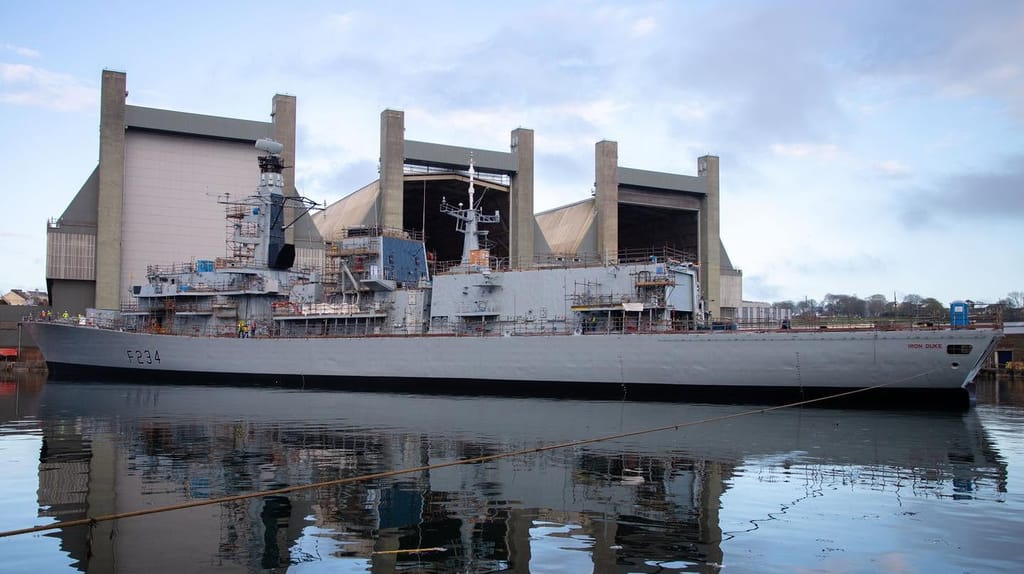
There has been no appreciable change in the Royal Navy's dire financial situation, which has seen its capability sink below what is operationally necessary in several important areas.
There had been some hope that the resignation of John Healey as Minister of Defense over the lack of commitment to raise UK defense spending to 3% of GDP by 2030 would finally bring about a commitment from the UK’s government to achieve the target. Hopes rose further when Healey was subsequently put in charge of the nation’s finances after new Prime Minister Andy Burnham appointed Healey as Chancellor of the Exchequer.
But it now appears that the resignation of John Healey as Minister of Defense was less a matter of principle regarding defense spending and part instead of maneuvers to unseat Sir Keir Starmer as Prime Minister and replace him with Andy Burnham. There have been no additional funds allocated to defense since the government reshuffle, and a decision as to when spending should be increased to fund the 3% of GDP target by 2030 has apparently been further delayed, pushed from the budget and spending review this year into some time later next year.
Furthermore, the new prime minister has made it clear that welfare spending is a higher priority than defense. Defense did not get a mention in the Prime Minister’s recent keynote political strategy speech at the annual convention of his party.
The delay – if indeed it is a delay – has serious strategic implications, as it demonstrates to the UK’s adversaries that not only is there a continuing capability gap, but also a lack of resolve and will to put effective deterrence in place. In the short term, this increases the likelihood that the UK will be subject to incrementally-increasing hybrid attacks, which might expand from unattributable drone attacks on airbases in the UK to ballistic missile attacks on overseas bases such as RAF Akrotiri in Cyprus.
Of all the services, the shortfall in current operational capability is being felt the hardest in the Royal Navy. The lack of immediate additional funding is lengthening the delay before equipment currently in the build pipeline will be delivered, extending the period before capability is restored to the bare minimum. The Ministry of Defence is already struggling to fund its existing program, leading to in-year cuts to training and ammunition expenditure.
The Royal Navy is believed currently to have no operational attack submarines, vital both for defending the UK ballistic missile submarines and for tracking those fielded by Russia. These are also the only platforms which can fire Tomahawk cruise missiles.
Of the seven boats in the Astute Class fleet, as of this week HMS Achilles is still being built, three are non-operational at the Faslane Naval Base (HMS Astute, HMS Ambush and HMS Artful), two boats are under maintenance in Devonport (HMS Audacious and HMS Anson), and HMS Agamemnon is on pre-delivery sea trials.
Of the ballistic missile submarines, HMS Vanguard (S28) completed a record-breaking 208 day patrol in April. Her relief, which appears to been escorted out to sea by a French Navy Suffren-class nuclear attack submarine in the absence of a British submarine to do the job, is still out after about 180 days.
The frigate fleet is down to five ships, all well past their planned end of service dates, of doubtful reliability and in danger any moment of falling out of the fleet.
The situation with the Daring Class destroyers is slightly improved: three out of six are currently operational, with their Sampson radar and Sea Viper air defense missiles providing a thin but critical national counter to the ballistic missile threat.
The Royal Navy is managing to maintain operational availability of its Queen Elizabeth-class aircraft carriers, albeit HMS Prince of Wales (R09) is operating in the Atlantic with an air wing of less than ten F-35Bs. The Navy is also restoring its dry stores at sea replenishment capability by bringing RFA Fort Victoria (A387) into service.
These capability gaps have been around for some time. What is causing concern is that the lack of funding is causing delays and cutbacks to the ships in the program which are intended to alleviate the problem and are still to be delivered.
Frigate and destroyer capability will be extremely thin for at least the next five years. The Daring Class destroyers are being extended in service, with the successor class of ships canceled. The first two Type 31 frigates, intended to plug the frigate shortage, are both launched; but in-service dates for HMS Venturer (F12) and HMS Active (F08) have slipped from 2027 to sometime beyond 2030 because of construction requiring reworking. Meanwhile HMS Glasgow (F88) and HMS Cardiff (F89), the first two Type 26 frigates, are currently fitting out and may be the only new frigates to join the fleet before 2030. But the third and fourth Type 26s look now as if they will be allocated to the Royal Norwegian Navy.

that matters most
Get the latest maritime news delivered to your inbox daily.
The government has not yet confirmed the 12 boat commitment for nuclear attack submarines to succeed the Astute Class, which formed part of the AUKUS agreement.
The UK government clearly does not regard these gaps as a serious problem, given the lack of any remedial action and notwithstanding an increasingly volatile global security situation. All the indications are that the capability and deterrence shortfalls will persist.
The opinions expressed herein are the author's and not necessarily those of The Maritime Executive.
