
Op-Ed: Guam's Logistics Capacity Must Be Increased
[By Crispinus Lee and Joe Schwartzstein]
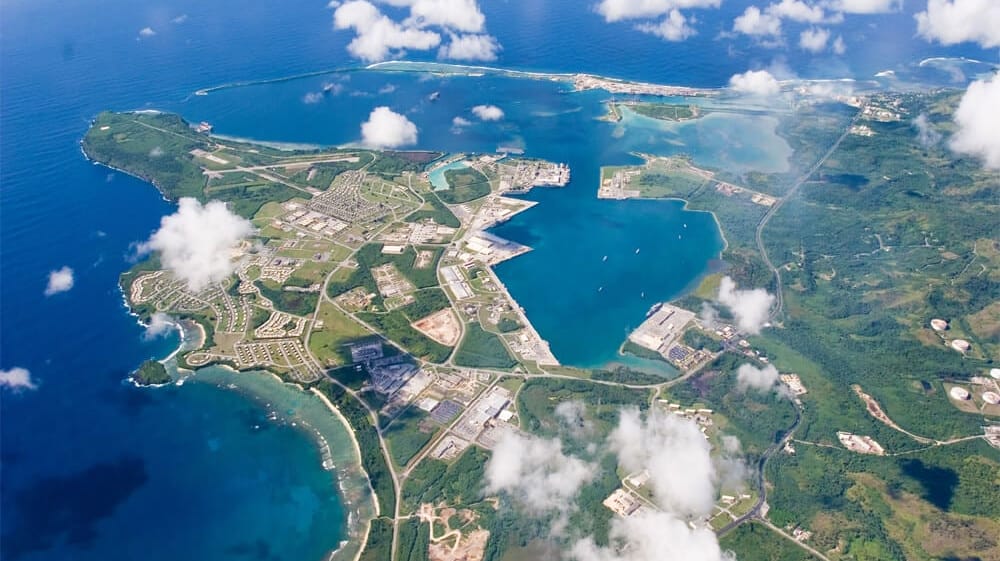
Guam is the westernmost territory of the United States in the Pacific region. The Congressional Research Service notes that Guam is closer to Beijing than Hawaii, making it vital to the United States’ national defense for air and naval operations in the Indo-Pacific region. The Port of Guam is designated as one of eighteen National Port Readiness Network commercial seaports. Military and civilian logistical experts believe that Guam will be a critical logistical hub for any conflict in the Asia-Pacific. Despite the geographic importance of the island, Guam’s logistical capacity is far below the needs of the United States in the event of a conflict in the Indo-Pacific region.
Peacetime Capacity
The island’s only deep-water port, the Port of Guam, handles almost 90 percent of all the island’s imports and serves over 500,000 residents of Guam and Micronesia. The port moves approximately 85,000 containers annually and maintains 40.5 acres for storage. There are three 40-year-old rail-mounted gantry cranes with a spreader of 120-foot reach and a maximum reach height of 85 feet, seven top lifters, two 20-ton heavy-lift forklifts, and 32 tractors.
Berthing consists of four piers with a 2,700-foot linear wharf space dredged to between 28 and 35 feet and 40.5 acres of storage. Fishing vessels and tenants utilize pier F-3; container ships general cargo, and cruise ships utilize piers F-4 through F-6. The port also has 858 chassis-mounted container stalls and 124 refrigerated container stalls. The port plans to develop a new F-7 pier, adding 900 feet of additional space.
Cargo Capacity in Wartime Conditions
Would this be enough to support military operations? For comparison, the Gulf War and Operation Iraqi Freedom provide insight into the scale of logistical movement that would have to occur during a conventional war. To combat Iraq, the United States had to move 400,000 tons of ammunition for conventional fires, 117,000 wheeled vehicles, and 12,000 tanks and armored vehicles to ports in Saudi Arabia where its forces were deployed. To move these materials, the United States employed 385 vessels (foreign-flagged vessels carried 22.6 percent of all dry cargo), averaging 4,200 tons of cargo daily.
While the Gulf War ended in a victory for the U.S. led coalition, this military success overshadowed logistics being strained in a primarily land-based war. Foreign-flagged ships made 17 shiploads of ammunition delivery, an amount equal to the deliveries by the ready reserve force and three times more than that made by US-flagged shipping. Then Commander-in-Chief of U.S. Transportation Command (TRANSCOM) General Johnson stated, “Our ability to lift more than ten million tons of material by sea in seven months of operations to the Persian Gulf region has … depended heavily on the contributions of organic, allied, and friendly shippers. In the future, however, we may find ourselves in a contingency that may require us to accomplish a deployment by relying on a mix of U.S. sealift resources. One of our greatest concerns, then, is the state of the U.S. maritime industry.”
Almost a decade later, the United States initiated Operation Iraqi Freedom (OIF). From 2002 to 2011, vessels enrolled in the maritime security program moved an astronomical 18,540,965 containers over 9 years. This was done to combat a primarily land-based foe whose capacity for war was largely destroyed within the first year of conflict. In both cases, Iraq had virtually no control over its air and sea lanes of communication. With an average 1,545,080 containers moved a year during the Gulf War and Operation Iraqi Freedom, the wartime need for a deployed American force during that conflict alone dwarfs Guam’s average annual capacity. Even if the Port of Guam modified its activity to handle more cargo volume by tenfold, it would not be able to handle what the United States moved in a year during the two wars in Iraq.
In a contested maritime environment, logistics face the additional challenge of protecting isolated sea lines of communication that span vast distances. While the wars against Iraq had multiple developed allied ports on the European mainland, the Pacific is a vast stretch of ocean with a scattering of small islands.
The Falklands War provides more insight into this particular challenge. Argentina, with a formidable Air Force and Navy, faced a significantly diminished Royal Navy. The United Kingdom was forced to tackle an 8,000-nautical mile supply chain. During the conflict, the British utilized 50 merchant marine ships to support 30,000 marines, sailors, airmen, and mariners. Ascension Island, sitting 4,000 nautical miles from Britain, served as the only possible forward support base. With no port except for a small jetty and an anchorage, Ascension Island served as a key hub for strategic airlift. The British military conducted 10,600 helicopter flights and 2,500 fixed-wing flights, airlifting more than 7,000 tons of ammunition, vehicles, and other cargo. In addition, the island base flew over 6,500 personnel. During that time, the British military moved one million ration packs, 12 million meals, 10,000 tons of ammunition, 1,260 tons of fuel, 3,880 tons of ordnance, and more than 38,000 tons of equipment. The loss of one ship, the MV Atlantic Conveyor, severely impacted British logistical efforts. On board were six Wessex helicopters, three CH47 helicopters, and equipment for 10,000 service members – only a single CH47 helicopter survived. The British successfully fought a war over 8,000 nautical miles from home, supporting over 30,000 service members, but the war required a significant logistical footprint.
Guam’s Shortfalls
A war in the Pacific would far outstrip the British experience, with Taiwan playing the role of the Falklands and Guam the role of the Ascension Islands. The difference is that Chinese conventional and nuclear missiles are capable of striking both Taiwan and Guam, among several other facilities across the Pacific. The distance from one friendly port to another, such as San Diego to Honolulu, is 2,607 miles, and another 3,800 miles from there to Guam. This eye-watering distance would be strung together by a fleet of 44 ready reserve vessels, assuming prospective allies or friendly states during this contest would be willing to risk their assets.
It is essential to understand the Port of Guam’s supply chain limitations compared to recent military logistical operations requirements. In 2023, the Port of Guam handled 86,000 containers, 215,000 tons of non-containerized/breakbulk cargo, and 6,821 roll-on/roll-off cargo. These cargo figures may seem impressive in a vacuum, but they must be compared to recent annual military logistical operations. U.S. Central Command handled 1,124,612 tons of breakbulk and Roll-on/Roll-off (RORO) and 2,428,616 tons of containerized cargo in 2011. Now, imagine a war in the Indo-Pacific region requiring full military mobilization. During the Gulf War, U.S. sealift moved 945,000 pieces of equipment, totaling almost 32.7 million square feet, covering the equivalent of 681 football fields or 898 acres. Finally, utilizing the Port of Guam for wartime operations would effectively shut down all civilian operations, leaving the population without the necessary supplies, food, and items for daily living. If it was not painfully evident yet, to say that the Port of Guam is incapable of meeting Indo-Pacific sealift logistical requirements is an understatement.
All this is compounded by the fact that the Port of Guam is in range of Chinese strike assets. Facilities may be damaged by missile and drone attacks, aerial bombardment, and sabotage. There will be degradation to the Port of Guam’s expected operational capabilities.
Currently, the federal government plans to expand the port to accommodate four Ultra Large Container Vessels (ULCVs), at least four ROROs, and 3 product tankers simultaneously. This would involve a 500-acre expansion for ROROs and 250 acres for container storage to meet the minimum for sealift operations. Additionally, sufficient petroleum storage is available to handle military operations. To support large-scale operations, the port will require sufficient capacity for both military and commercial operations, as well as large-scale storage and robust infrastructure to meet national security requirements.
Prepositioning Stocks in Guam
The abysmal port capacity is even more concerning when considering the use of Guam as a base to use for prepositioning forces. The Department of Defense maintains prepositioned military essential stocks around the globe for rapid deployment for national contingencies. These prepositioned stocks provide enough equipment and supplies to allow the DOD to quickly deploy forces around the globe, rather than waiting the weeks necessary to ship supplies and equipment to the theater. This essential policy enhances U.S. global military readiness of any combatant commander to meet any national security challenge. Could Guam support a force that may require deployment for 30 days? The answer is a resounding no.
The Department of Defense, in its report to Congress, noted that Guam requires significant investment to upgrade its deteriorating infrastructure to support future military expansion and meet U.S. national strategy in the Indo-Pacific region. Prepositioning stocks require significant infrastructural support for both the equipment and personnel.
Leghorn Army Depot in Livorno, Italy, is a typical example of a base that maintains prepositioned supplies. It consists of “60 maintenance bays in 16 warehouses with over 749,000 square feet of humidity-controlled storage.” Guam falls short yet again in almost every category. Currently, the U.S. military utilizes about 20 percent of the island’s electrical power. Guam’s Power Authority concluded that the island faces challenges in “keeping its aging, owned plants reliable and in good working condition.” Any adhoc expansion could cause rolling blackouts on the island. Prepositioned stocks also require a significant investment in personnel to manage and monitor stock readiness, which in turn requires major reworks to water treatment and wastewater removal. Guam Waterworks Authority (GWA) recently settled with the EPA over violations of the Clean Water Act, which included untreated sewage, and its poor condition sanitary sewer system. Even something as basic as roads are lacking. The DOD report highlighted several issues, including inadequate bridges, road flooding, tight corners, and poor roads. The military would face significant challenges in moving equipment, supplies, personnel, and associated waste without infrastructure improvements.
Finally, returning to the Port of Guam itself, afloat prepositioning stocks require either pier space or anchorages. The Port of Guam does not have the pier space to berth prepositioning ships. Apra Harbor would need to be enlarged and deepened to accommodate afloat prepositioning ships. Commercial ships require access to the port’s anchorage that prepositioning ships would take up. Further, the port would require the construction of piers and dredging. Naval Base Guam supports over 30 tenant commands in support of Pacific Command. Prepositioning ships would take up vital pier space or anchorages required for the U.S. Pacific Fleet, Seventh Fleet, and Fifth Fleet. Unfortunately, Guam would not be able to host DOD prepositioning stocks, either shoreside or shipboard, without a significant financial and physical investment.
Why Prioritize Guam?
While it would be advantageous for the military to rely on non-U.S. ports for logistic support, assuming that these ports would be available for U.S. use during an Indo-Pacific conflict could prove disastrous. China holds considerable economic and military influence in the Asia-Pacific region that can be leveraged to exclude the United States from ports and supply chain hubs. Aside from the fact that most major ports in the Indo-Pacific lie closer in range to Chinese military assets, most Asian Pacific ports operate at capacity to supply some of the largest import-oriented economies in the world. This configuration would force the DOD to compete for port access, berthing, cargo operations, storage, and transportation of containers, rolling stock, and break-bulk materials.
Further complicating the supply chain is the spread of the DOD’s logistical footprint across multiple ports. Diversifying across multiple ports complicates the DOD’s logistical footprint and supply chain, making the military’s supply chain vulnerable to disruptions. There is no guarantee that a port can meet TRANSCOM’s sealift requirements.
Port cybersecurity vulnerabilities are another area to contend with in ports in the Pacific theater. China’s dominance in port infrastructure across the Pacific region places cybersecurity at the top of defense concerns.
There is also concern about Anti-Access/Area Denial (A2/AD) vulnerabilities at allied and non-allied ports. Asian-Pacific ports are vulnerable to Chinese missile attacks, submarines, and subsea cable infrastructure attacks. It is unlikely that the United States would be able to prevent attacks on foreign ports by an adversary seeking to disrupt U.S. sealift, particularly for the number of U.S. assets over the largest maritime theater on Earth.
Guam serves as Maritime Prepositioning Stock Squadron 3’s center. This makes it the center of America’s military Pacific posture for sustainment and a vital intermodal conduit for U.S. forces. As such, the Port of Guam must be the priority for upgrades to support U.S. power projection in the Indo-Pacific. This requires extensive infrastructure upgrades and the acquisition of land for container and RORO stockyards aligning with most continental U.S. strategic seaports.
To these ends, the container berths require massive expansions and upgrades. At a minimum, the Port of Guam should be able to handle four ULCVs with four to six cranes capable of working each ship. The berths must be dredged to a depth of forty-five feet. The container yard should be expanded to accommodate marshaling and storage of wartime logistical needs, with a minimum of 250-300 acres and sufficient Rubber-Tired Gantry Cranes (RTGs) to facilitate container movements.
The Port of Guam should also have sufficient RORO berthing to handle four ROROs dredged to a depth of thirty-seven feet. TRANSCOM RORO marshaling and storage footprint will require between 500 and almost 900 acres. In comparison, during the Gulf War, TRANSCOM moved enough equipment and supplies to cover 680 football fields, about 897.6 acres.
Further, the Port must have sufficient tanker berthing and storage to perform cargo operations on at least two to four tankers at any time, dredged to thirty-seven feet, and storage capacity for one week to handle DOD’s requirements of 12.6 million gallons of fuel per day. The Port of Guam will require sufficient break-bulk berthing to accommodate two to four ships dredged to a depth of forty-one feet. Ports require tugs to facilitate vessel movements. Assisting in the ships in the port requires enough tugs to handle multiple ship moves per day. An average U.S. port could have between six to eight tractor tugs in the range of 60 to 80 bollard tons. The Department of Defense should also consider six azimuth stern drive (ASD) tugs for port operations.
Finally, to ensure the vessel movement in the Port, the DOD must provide familiarization training to all members of the U.S. Navy Reserve’s Strategic Sealift Officer Force Harbor Pilot Detachment, a group of highly trained and skilled civilian harbor pilots whose sole responsibility would be to facilitate the movement of sealift vessels within the port.
The Port of Guam serves as the key strategic sealift port in the Indo-Pacific region and, with the proper investment, can fulfill its potential as the critical supply chain strong point for the department.
Crispinus “Cris” Lee is a Surface Warfare Officer and Lieutenant in the U.S. Navy Reserve. He works as a Program Management Specialist for Booze Allen Hamilton. Prior to this, he served as an Assistant Operations Officer onboard USS Cole and as Weapons Officer aboard USS Gladiator.

that matters most
Get the latest maritime news delivered to your inbox daily.
Joe Schwartzstein is a Commander in the U.S. Navy Reserve Strategic Sealift Officer Force and serves as a Maryland State Pilot. A dual-licensed graduate of the U.S. Merchant Marine Academy at Kings Point, he holds master’s degrees from the California State University Maritime Academy and the U.S. Air Force Air Command and Staff College. Commander Schwartzstein is also a U.S. Coast Guard licensed First-Class Pilot, Master of Oceans, Unlimited Tonnage, and First Assistant Engineer of Steam, Motor, and Gas Turbine Vessels.
This article appears courtesy of CIMSEC and may be found in its original form here.
The opinions expressed herein are the author's and not necessarily those of The Maritime Executive.
