


Nine Killed in Toxic Gas Accident at HKC-Certified Shipbreaking Yard
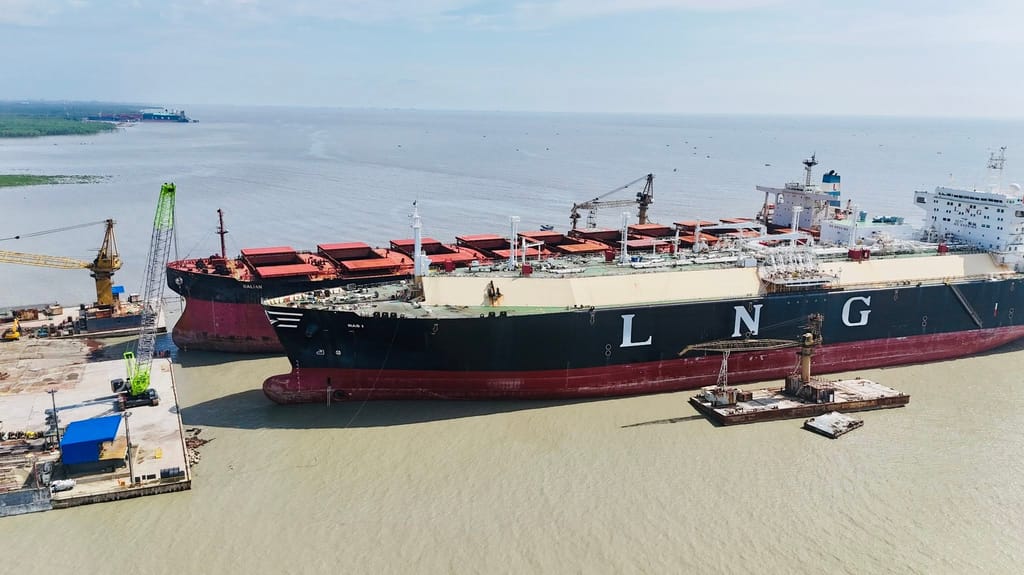
On Friday, nine shipbreaking workers were killed and six more injured by exposure to hydrogen sulfide gas at the Ferdous Steel shipbreaking yard in Chattogram, raising questions in Bangladesh about safety at "green"-certified ship recyclers. It was the largest fatal shipbreaking accident in recent memory, approaching in scale the dramatic explosion at Gadani, Pakistan in 2016, which killed an estimated 27 people and injured 58 more.
The casualty occurred aboard the LNG carrier Rasi (formerly Ras Laffan, IMO 9176008). Ferdous Steel reported the ship as beached at Chattogram in July 2025, indicating that it has been undergoing demolition at the yard for more than a year.
At 0830 hours on Friday, workers were cutting a hole into a ballast tank aboard the Rasi when a large volume of H2S gas leaked out of the ballast tank and into the enclosed compartment they occupied. First responders found high concentrations of ammonia and methane as well, according to Bangladeshi paper TBS. H2S concentrations inside the ship remained dangerously high three days after the casualty.
Hydrogen sulfide gas is formed by anaerobic bacteria during the decomposition of organic matter, and is best known as the compound that gives pipeline natural gas its distinctive rotten-egg odor. It is considered unhealthy at concentrations above 50 ppm, dangerous at concentrations above 100 ppm, and has an immediately deadly "knockdown" effect above 700-1000 ppm.
The ballast tank implicated in the casualty appears anomalous: three other ballast tanks had already been cut up without incident. The ship had been certified gas-free before work began last year, according to union representatives of the Shipbreaking Workers Trade Union Forum, which has accused the yard of safety problems and violations of health & safety regulations. Ferdous Steel had previously been cited by the Department of Inspection for Factories and Establishments for alleged safety lapses and nonpayment of wages.
A local government committee has been formed to look into the matter at the district level, but union leaders called for a higher-level investigation, according to the Business Times.
For now, Ferdous Steel has been ordered to suspend operations.
Though unusual in its scale, the occurrence of a deadly casualty was not in itself rare, according to a tally by the Daily Star. The paper counted 84 accidents at Bangladeshi yards since the HKC entered into force in June 2025. 15 workers died and 81 were injured over this period. A third of the accidents occurred at one facility, KR Steel Yard, according to the Daily Star's tally.
The Bangladesh Environmental Lawyers' Association drew a connection between Friday's fatal accident and the relative merits of the Hong Kong Convention (HKC). BELA (and others) have long argued that the HKC does not provide the same degree of protection as the Basel Convention, which the shipping industry views as an unfavorable alternative for regulation of shipbreaking.
"We continue to see how compliance with the weaker Hong Kong Convention has done little to improve the occupational health and safety of workers who continue to face death in the industry," BELA said in a statement.

that matters most
Get the latest maritime news delivered to your inbox daily.
HKC certification has strong uptake among Bangladeshi breakers: 23 out of 31 shipyards in Bangladesh are now HKC-certified, Ferdous among them, and all remaining as-yet-uncertified yards are nearing completion of the review process, according to the Bangladesh Ship Breakers and Recyclers Association.
The deceased have been named as Sani Das, Palash Das, Mansur Ahmed, Md Nasir Uddin, Rana Mia, Habibur Rahman, Khokon Mia, Abdul Alim Sujon and Matiur Rahman Sazzad. Each victim's family will receive compensation of about $8,000, per TBS.
