


MAIB: Lost Trawler's Crew Couldn't Isolate Source of Flooding
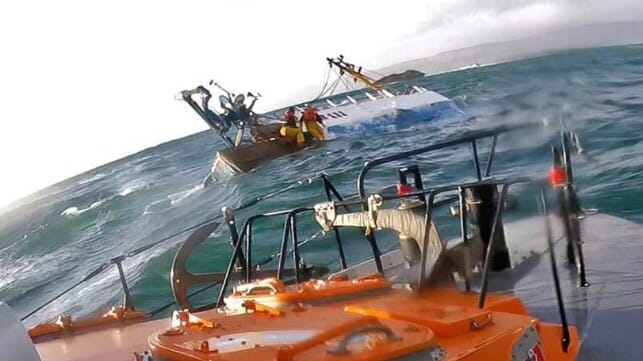
The UK’s Marine Accident Investigation Branch (MAIB) is yet again putting the spotlight on safety standards in the fishing industry after publishing the investigation report on the flooding, capsizing and foundering of a fishing trawler in Scottish waters in 2024.
The prawn trawler Freedom II suffered engine room flooding at a position about 11 nautical miles southwest of Oban, Scotland, on February 21, 2024. The four crewmembers could not correctly identify the source of the flooding, and they had to be rescued by a Royal National Lifeboat Institution all-weather lifeboat.
According to investigators, a vibration-induced fracture of the seawater suction pipe for the deck wash pump was the most likely source for the flooding. The rate overwhelmed the available bilge pump, and the other pumps were disabled. Rising water caught by the main engine's flywheel sprayed the electrical panel for the auxiliary engine, preventing it from starting up and providing electrical power to the self-priming bilge pump and submersible pump. A portable salvage pump was deployed, but it failed to restart after it was shut down once for repositioning.
The investigation found that the pumping capacity available was not enough to combat the volume of water; if all the pumps on board had been functional, it is possible that they could have bought enough time to allow for the transfer and use of another dewatering pump from the RNLI lifeboat, MAIB concluded. Other contributing factors included the lack of an effective response plan and the crew's mistaken conclusion about the likely source of the flood (they incorrectly believed it to be a stern tube seal leak) which may have distracted them from a more thorough search.
On the fateful day, the vessel departed the port of Crinan at about 0400 to fish for prawns in Loch Linnhe. Due to weather, the skipper decided to head west through the Gulf of Corryvreckan to fish in the Firth of Lorn. By about 0700, the crew had deployed their fishing gear for the first trawl of the day and at about 1000, they started to recover the gear.
At about the same time, the skipper noted a strong vibration coming from the propeller shaft. Though he tried to clear the fouled propeller by pulsing it ahead and astern about five times, the vibration did not improve, and he decided to head to Oban at low speed for repairs.
The vessel could not complete the four-hour transit because of significant flooding, despite efforts at containment by the crew. By 1302, the water level in the vessel’s engine room had reached halfway up the side of the engine, forcing the skipper to shut down propulsion. At 1535, Freedom II rolled to port and sank beneath the surface. While all the crewmembers were rescued, the vessel could not be located.

that matters most
Get the latest maritime news delivered to your inbox daily.
According to MAIB, the incident involving Freedom II was the latest in a long line of fishing vessels lost to engine flooding. Over the period between 2013 and 2022, the agency received 230 reports of fishing vessel flooding, including 78 that resulted in the loss of the vessel. The engine room was the most common location for fishing vessel flooding casualties.
“Without effective guidance on the management of floods, fishing vessels remain at significant risk of foundering should uncontrolled flooding occur,” stated MAIB in the report.
