


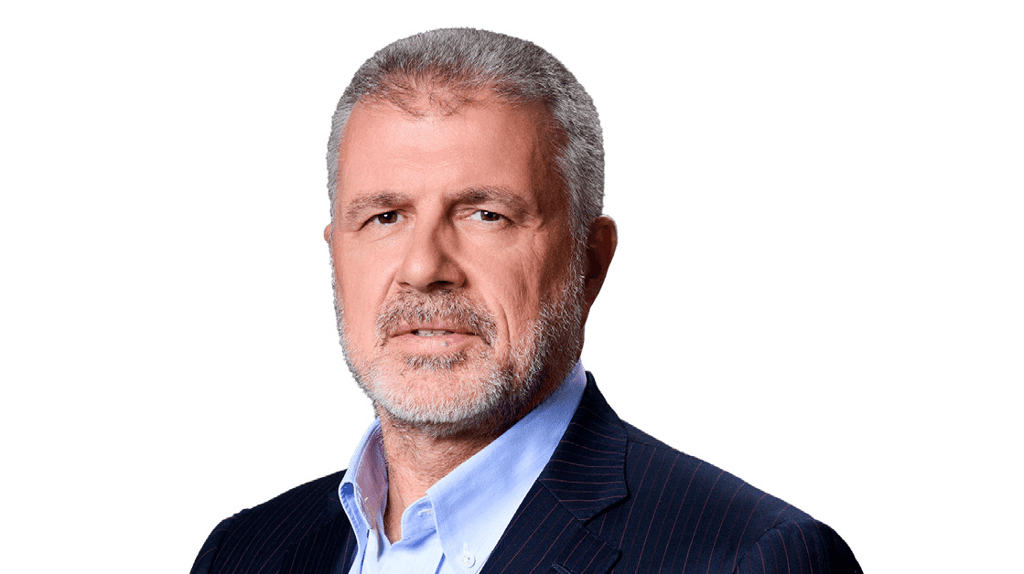
Interview: John Rowley, CEO, Wallem Group
Rowley has been all over the world, first as a paratrooper in the British Army and then as a globe-trotting executive with leading international firms. Now he's running Wallem, the company that invented the ship management business more than 123 years ago
(Article originally published in July/Aug 2026 edition.)
Welcome, John, great to have you! Let's start with your background and education. Tell us about yourself.
Yes, thank you, I'm British. I was educated at the University of Reading in the U.K. and then the Royal Military Academy, Sandhurst, and eventually the Tuck School of Business at Dartmouth College in the U.S. I'm married, have two daughters and live in Hong Kong, where Wallem is headquartered. I previously lived in Singapore, Shanghai and Sydney, so have spent most of the last 30 years or so in the Asia-Pacific region.
Impressive. Tell us more about Sandhurst and your military career.
When I left university, I took some time off, earned some money and went traveling around India and Sri Lanka for about four months. I went all over backpacking and basically just exploring. And then I went to Sandhurst and joined the military and became an infantry officer.
I spent most of my time in Northern Ireland and Bosnia, then ended up being based here in Hong Kong. About five years total in the infantry and really enjoyed it.
How did you make the transition from military to civilian life?
It's always quite a difficult transition. One of the pieces of advice I give people is you either leave quite early or leave late, but not in the middle. I left after five years. I was still under 30, still young. I wasn't institutionalized. I wasn't indoctrinated. I wasn't "army barmy," if you like, unable to see anything else.
I was almost like a university graduate when I restarted in civilian life, and I accepted that. But you back yourself with your experience and skills and rise quickly, which is what I did. You also have to respect the need for new learning. Don't be arrogant. In fact, you've got to make sure you're humble when you go into civilian life. You use the leadership skills you learned in the Army but respect the need for learning and to be humble.
How did you find your way to Wallem, and what were some of the stops along the way?
Most of my time post-military was in quality and safety management but not necessarily in the maritime industry. So 14 years at Ecolab, then head of the Food & Assurance Divisions at NSF and CEO of SAI Global Assurance – a lot of quality and safety and supply chain experience in the food, water treatment and healthcare industries.
My maritime experience before joining Wallem came from Lloyd's Register, the well-known classification society, where I spent eight years and was President of Asia-Pacific and then CEO of LRQA, their global quality and assurance business. That was my first exposure to the maritime industry, and I had learned about Wallem while based in Hong Kong.
Wallem was a well-known brand with a good name, so when I was approached to become the next CEO, I thought, "Sure, why not? They're a great company with a great history and I'd like to be part of that." It was a long process with a lot of other good leaders in the running, but I was fortunate to be appointed CEO in January 2024.
You rose to the top pretty fast. What are some of those skills?
There's a lot written about skills learned in the military, and there's some obvious ones and some not-so-obvious ones. One of the key things I learned is the ability to handle people who are senior to you, equivalent to you and junior to you, and to respect authority but also expertise and experience because in the military you have a lot of people who are junior to you in rank but have more experience and expertise, and you have to respect that. So you've got to know how to lead from the front when necessary but also from behind when necessary.
The military can teach you both, and leading from behind can be a very effective way to lead. You don't always have to lead from the front.
Dealing with pressure and complexity is something else you learn. You might be getting shot at or in dangerous situations. You need clarity over complexity, decision-making skills and the ability to prioritize. Those things you definitely learn in the military.
If you can combine all that with the ability to understand and respect people who may be junior to you but have more expertise and experience so you can lead from the front as well as lead from behind, then I think you can really take the military learnings and apply them in civilian life.
Tell our readers a little about Wallem's history. It was actually the world's first ship management company, wasn't it?
Yes, it was. We have a storied history, something we're very proud of. We go back to 1903, which is 123 years ago. A Norwegian, Haakon Wallem, moved from Bergen, in Norway, to Shanghai – a rare event in those days – and set up his own ship brokering business. And then in 1908 he took on the third-party management of his first ship and became the world's first ship manager.
He moved himself and his business to Hong Kong in 1925 where we've been based for just over 100 years. And starting with him and then through his successors, the company evolved to encompass not just ship management but also ship agency and commercial services and then an IT business and a lifeboat inspection business.
So we now have five divisions, and we continue to fulfill his legacy of focusing on high-quality service, transparent and long-lasting client relationships and always safety. And not just the safety of the crew. It's also the safety of our employees on land, the safety of the asset that we're managing and the safety of the environment around it.
But the safety of the crew and human life is paramount, which for me ties in nicely with what I did at Lloyd's Register and also, in fact, what I did in the military. Often the military is there as a deterrent and to protect life – that was certainly my experience in conflict areas.
What does a ship manager do?
We look after the asset for the asset owner.
The world of shipping is getting very complicated with increasing regulation, increasing complexity, increasing government involvement and increasing need for new fuel types as the industry moves toward carbon-zero fuel emissions. It's becoming very onerous and potentially expensive and potentially dangerous if the wrong decisions are made.
We look after the crew – finding them, training them and making sure they know exactly what they're doing on the ship to keep themselves safe, to keep the ship safe, to keep the environment safe and to make sure the ship is operated optimally for the owner.
I have a favorite analogy. It's like the shipowner is giving their godchild to the godparent, and we are the godparent. The owner gives their godchild to us to look after while they focus on other matters, and they need to be sure we will treat their ship as if she were our own. Our role is to look after her as if she were our own so owners are confident their ship is in good hands.
That includes crewing her. It includes navigating her. It includes provisioning and stocking her. It includes maintaining short-term requirements, midterm requirements, long-term requirements for drydocking and inspections. It's a highly technical and skilled operation to manage a ship, and more and more owners are seeing the benefit of trusting third parties to do that for them.
Who owns Wallem?
We're 123 years old, and for over 100 of those 123 years the Wallem family has owned or had an ownership stake in the company. For the last 20 years, we've been owned 50 percent by Tom Steckmest of the Wallem family and 50 percent by Nigel Hill, a London-based ship investor and a close friend of the Wallem family.
So we are 100 percent privately owned. We have no external investors. We have no private equity investors. We have no debt. So we're in a very strong financial position. We don't only focus on the monthly or quarterly results; we can look towards the long term and ensure we always do the right thing for our owners, our people, our clients and the market in general. We're not trying to beef the company up to be sold at a future date for the maximum amount.
Tom Steckmest and Nigel Hill intend to keep the company long-term in their families. So I'm secure in that knowledge and can focus on long-term goals, making sure this company is providing excellent service to our clients. It's really looking after the brand and making a difference to maritime society. That's a really nice place to be, and I think the people here love being part of that.
What makes Wallem different?
Everyone likes to think they're the best, and we have very strong competition who would also quite rightly say that they're very good or the best at what they do. So there's a few things we try and differentiate ourselves with.
First, we're the oldest, but we have to back up our heritage with great service and market knowledge, and we're known for our wide range of technical and seamanship skills.
Second, as I've noted before, we're privately owned. We're not under pressure from private equity to meet short-term goals. We can think and plan long-term. Our customers can be assured that it's going to be the same Wallem tomorrow as it is today.
Then there's our crew, which is a real strength. We've been in the Philippines, India and China for a long time. We've got a really good reputation in the places where 80 percent of our crew comes from. So we're really good at finding the right people, retaining them and looking after them and their welfare. We have the highest crew retention rate in the industry at over 95 percent.
It's almost like we get first choice in choosing our crews – that's how well-respected the Wallem name and brand are. And without good crew, we're nothing. We can't provide our value proposition to clients without good crews.
And because of all those things – our experience, services, ownership and crews – we're able to focus on quality growth, and by that I mean we can choose our growth. We can choose clients who share our values, who share our safety and quality objectives as opposed to chasing growth just for growth's sake.
It's really a two-way street. We need to convince our clients that we're a great supplier for them, and they need to convince us that they'll be great clients for us. And if you have that two-way mutual respect and trust, then that generates a partnership that is much more powerful than just a supplier-client relationship.
What's your biggest challenge right now?
We've had two years of really good results. We've grown 15 to 20 percent in each of the last two years, which is phenomenal. I'm going to make sure we continue to grow. Maintaining this rate of growth will be a significant challenge.
But the real challenge is making sure our service and quality keep up with the growth and the growth doesn't outpace our safety and quality and service levels. We have to grow, but never at the expense of the service levels and the safety and the quality because that's the foundation of the Wallem brand.
Another main issue has to be making sure our crew are safe in a dangerous world, where events like the situation in the Strait of Hormuz are becoming more frequent. We have to make sure we work closely with our owners to look after the safety of the crew and, beyond that, the safety of the ship and the safety of the environment around it but always starting with the crew. And you can never be anything more than 100 percent focused on that.
What do you like most about your job?
There's two things, actually. One is to make sure I'm working for a company that genuinely adds value to society. In our case, that's the maritime society and the wider world too. But you've got to make a difference and add value. Otherwise, you're only doing it for yourself and that's not good enough. And second is something I've always enjoyed, which is watching people grow and succeed, whether by getting promoted, earning more money, adding to their skills or doing more to add value to society themselves.
that matters most
Get the latest maritime news delivered to your inbox daily.
All of that combines into making my job not only enjoyable but meaningful for both me and others.
Jack O'Connell is the magazine's Senior Editor.
The opinions expressed herein are the author's and not necessarily those of The Maritime Executive.
