


Unexplained Ship Clusters Anchoring off Taiwan
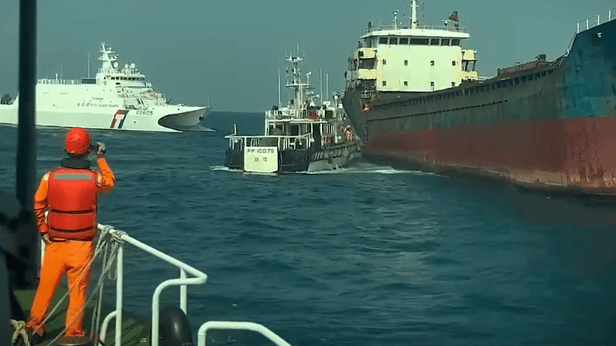
TaiwanPlus TV’s investigative journalist Cadence Quantara has filed a report on an unexplained cluster of shipping which is lingering a short distance off the southwest coast of Taiwan, adjacent to the cities of Tainan and Kaohsiung. On average there are 75 ships maintaining position in the area, with a familiar list of vessels arriving, lingering, departing and then returning, but with the overall number of ships in the cluster remaining roughly constant.
Further out to sea, a smaller number of ships are also gathered, and separately off Taiwan’s northern tip there is another anchorage area within Internal Waters where ships also tend to gather. These concentrations of ships have become more pronounced since March.
The Taiwanese authorities, and the Coast Guard Administration in particular, are perplexed at to what is the common purpose of these groups of ships, and are speculating why this pattern of behaviour has emerged in the last six months. Most of the ships are either cargo vessels or oil/chemical products tankers, and are on the elderly side; of the 75 ships regularly seen in the area, 65 fall into the pan-Asian Tokyo MOU’s High Risk category because of their age and degraded seaworthiness.
The majority of vessels either anchored or on the recurring visitor list are flying fraudulent flags, or flags of convenience from six states: Cameroon, Comoros Islands, Mongolia, Tanzania, Togo and Sierra Leone. Most are Chinese-crewed and appear to be owned or managed by companies registered on the Chinese mainland. Only a small number of these vessels are formally sanctioned.
Examples of some of the dubious vessels on the recurring visitor list include product tankers, the Sierra Leone-flagged Huixin (IMO 9175133) and the Tanzanian–flagged Athena (IMO 9063811). Cargo vessels include the Comoros-flagged Midas or Magician 66 (IMO 9020637), and Tanzanian-flagged Long An (IMO 9140255) and Bao Shun or Ada (IMO 8359081), plus the Pioneer or Win or Shunjia (IMO 9078543) currently Sierra Leone-flagged, the unflagged Chang Shun (IMO 8964056) and the Togo-flagged Hong Tai 58 (MMSI 671756000). Several of the ships have been noted trading with North Korea, or have been designated by the Taiwan authorities as a security risk for having lingered over internet cables.
The ships appear to be neither idling to take on cargo, to discharge cargo, nor even awaiting orders. Most are unladen, prompting questions as to how owners can afford to keep these vessels crewed and at sea without revenue-earning tramp work. To be incurring such losses, the owners are either being compensated for deploying ships into these areas, or there is some form of covert or illicit revenue stream. The ships themselves have almost no capital value sufficient to justify the cost of keeping them afloat.
The Taiwanese authorities at first thought that the ships might be positioned for some hostile security or intelligence purpose. The south-west cluster is within about 15 miles of three major Taiwanese airbases, at Pingtung, Tainan and Chiayi, plus a number of hidden highway airstrips, as well as the Tsoying Naval Base. The Taiwanese armed force mounted Exercise Han Kuang in this area in August, a major air and naval test of Taiwan’s ability to respond to a surprise attack.
But with few constraints, the Taiwanese Coastguard can board and inspect those vessels which are anchored close in and within Internal Waters, and neither regular PLA personnel nor military surveillance equipment have been found on board the vessels. Possibly the ships are trying to normalize a Chinese presence in Taiwanese waters, innocent for the moment but capable of being exploited for some military purpose sometime in the future, as part of an invasion or blockade.
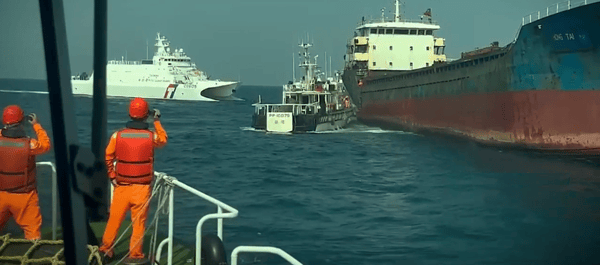
The Bao Shun being boarded by the Taiwanese Coastguard on suspicion of cable-tampering (Courtesy Taiwan Coast Guard Administration)

that matters most
Get the latest maritime news delivered to your inbox daily.
In the meantime, the vessels can possibly be prompted by Chinese authorities to inflict unattributable damage to internet cables, as a small number have been identified doing by the Taiwanese authorities. A regional security consultancy believes some of the vessels may belong to Chinese mainland organised crime groups and be involved in illicit food smuggling into mainland China, in particular of frozen meat, or of pharmaceuticals; this view is supported by the location of the cluster – inside Taiwanese Internal Waters – where Chinese authorities cannot intrude to board them, and also by the short duration of the trips vessels in the cluster make before returning. Some are known to have conducted illicit trading into North Korea.
No one explanation appears to cover the purpose of the clustered group as a whole, unless it is a gathering of ships whose owners are all losing money by remaining afloat while their revenues have sunk. The Taiwanese authorities appear to be at a loss to know what is going on too, because they would have the legal right to board or seize ships should they have cause or a suspicion to initiate such action. The Coastguard report they have frightened off 240 of these ships – but they keep coming back.
The opinions expressed herein are the author's and not necessarily those of The Maritime Executive.
