

Iran Ponders How to Break the US Naval Blockade – and Concludes it Can’t
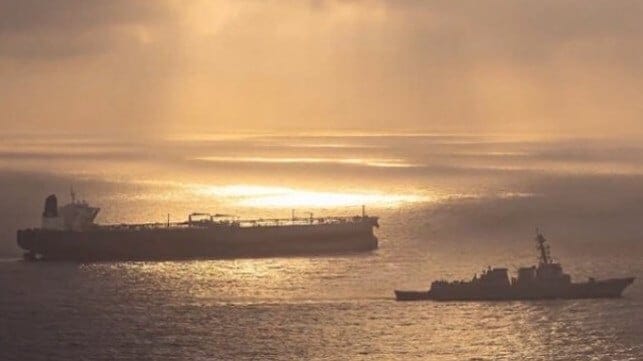
In an extraordinary piece of journalism, considering how tightly the press is controlled in Iran, an editorial published on the WANA News Agency website has concluded that there is no feasible way to break the U.S. naval blockade of Iranian ports and ships in the short- to medium-term.
WANA is a privately owned news agency but is generally pro-regime and invariably reflects government thinking. The opinions it disseminates therefore reflect thinking within some, but not necessarily all, quarters of the ruling political elite.
The WANA analysis asks, “How Does a Naval Blockade Work, and How Can It Be Broken?” It first considers how the U.S. Navy implements its blockade – through wide-area surveillance and the deployment of warships in several layers, to first detect, then deter, and, if necessary to fire warning shots.
It then considers that direct attacks on U.S. assets are impractical. Detection of where U.S. ships are in a vast sea area is very difficult given the limitations of Iranian surveillance systems. Mounting a direct attack is challenging, as over open waters detection and response favors the defender, and can only be overcome by firing barrages of missiles and drones. Firing barrages at U.S. naval vessels then leaves Iranian coastal defence units open to counter-attack. Iranian barrage attacks could only be successful if repeated frequently, so as to run down U.S. stocks of defensive missiles – and if that situation ever arose, U.S. ships would simply withdraw so as to become out of range, and then conduct replenishment at sea. Iranian barrage attacks would lead not only to counter-battery attacks, but probably also to escalatory attacks against a wider set of targets. But the Iranian author identifies that a successful attack against a US ship at sea would be a high-casualty event with political impact, and therefore must always be kept open as an option should an opportunity present itself.
The analysis concludes with only one practical option – a slow grinding down of U.S. resources by maintenance of a constant but low level of attacks, while always searching for innovative ways to improve the chances of achieving a successful hit.
This conclusion that attrition is the way to defeat the U.S. Navy does not raise the prospect that there will be relief any time soon from the increasingly severe impact of the naval blockade – now being reinforced by Task Force Iron Gate directed at land borders and the U.S. Treasury’s Operation Economic Outcast.
What this particular WANA analysis does not cover is the favorite Iranian tactic – widening their attacks on infrastructure targets in Gulf countries, in the hope that the Gulf countries will in turn pressure the United States to pack up and go home. This tactic has already been introduced, with attacks also against shipping across a wider area of the Gulf and the UAE East Coast. But so far, this particular tactic has had limited success, and indeed looks in some respects to be increasingly counter-productive – there have been clear indications from the United Arab Emirates, for example, that they are now prepared to accept some damage if it leads to a final dismantling of the threat posed by the IRGC’s regional expansionism. The Gulf countries have not yet given up on their alliance with the United States. Iranian media outlets are now also stressing the increased ranges of Iranian ballistic missiles, threatening targets within Europe.
The economic and social pressures being imposed by this coordinated U.S. approach are beginning to manifest themselves in a number of ways. In response to huge delays at borders, Iranian truck drivers are now on the fifth day of a strike in 18 cities – because they are being expected to bear the cost of delays and freight rates have not been increased to cover their disappearing profit margins. According to the Statistical Center of Iran quoted by Iran International, consumer prices in October were 88.7 percent higher than a year earlier, while food and beverage prices rose 112.6 percent year-on-year, with which consumers are having to contend without pay rises.

that matters most
Get the latest maritime news delivered to your inbox daily.
For those who believe the crisis will only end as a result of internal changes within Iran itself, there are the first serious indications that the differences between the hardliner and gradualist factions within the ruling elite can no longer be arbitrated – differences which in the past used to be settled by the Supreme Leader. But now that the invisible Supreme Leader is seen as less impartial than his late father and inclines towards the Saeed Jalili-aligned Paydari hardliners, this consensual approach is breaking down – to the extent that the Paydari faction is now being described by others within the ruling elite as extremists and an unauthorized opposition faction. As an indication of the state of affairs, Hamid Rasaei, a leading parliamentarian in the faction, has been given a 10-month prison sentence for attacking Chief Negotiator Mohammad Bagher Ghalibaf, and, along with other “obstructionists,” banned from voting in Parliament.
As always, waiting in the wings are the Israelis with unfinished business, and a resumption of the war possibly being an issue which the components of a new governing coalition government might all agree on, with or without U.S. permission.
The opinions expressed herein are the author's and not necessarily those of The Maritime Executive.