

Iran Continues to Assert Hormuz Transits Are Increasing Under Its Control
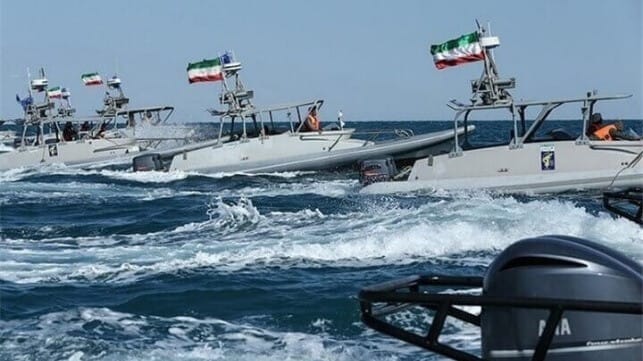
Iran continues to make unsubstantiated claims that under its control, transits are increasing in the Strait of Hormuz. It cites the “coordination and security provided by the IRGC Navy.”
“The Revolutionary Guard Navy has established a safe route for the continuity of international trade,” the public relations office of the IRGC said in a statement posted by media channels linked to the command. It is part of its ongoing effort to claim that it is providing stability as Iran also seeks to formalize its control of the waterway and establish its tolling system.
According to the IRGC Navy statement released on Friday, a total of 35 oil tankers, container vessels, and commercial ships had made the transit in the past 24 hours. This would be an increase from the 31 ships it reported on Thursday and 26 on Wednesday.
It says all of these ships had “permission to pass” and received security safety on a coordinated route. However, no details or substantiation were provided for the claims. There have been incidental reports of a few Chinese vessels making the transit, and the one South Korean tanker, but India, for example, continues to call for the release of vessels.
Maritime intelligence group Kpler posted a new tracking video showing only a handful of ships making the transit. It says on May 20, it confirmed 10 vessels, up from four the prior day. Most of the traffic observed was west to east, and it did not identify any new Iranian export loadings.
Iran’s Mehr News Agency, however, released a report claiming that Iran was exporting 1.4 million barrels of oil per day despite the U.S. blockade. In the same report, it cited data from the International Energy Agency reporting production was down a further 620,000 barrels per day in April to 20.18 million barrels per day from OPEC. It said this was after a 9.57 million barrel per day decrease in March. It highlighted that OPEC’s production was down by a third (32 percent) while writing that “other OPEC members outside the Persian Gulf region have not been able to effectively compensate for the drop in oil production from the region.”
U.S. Central Command, however, asserts that it remains vigilant in its enforcement of the blockade. As of Friday, CENTCOM is saying 97 commercial vessels have been redirected, and four were disabled.
Iran released its new boundaries for control of the area around the Hormuz Strait as it launched the Persian Gulf Strait Authority. At the same time, Bloomberg reported on Wednesday that Iran was having talks with Oman about control of the strait. It was reported to be proposing its scheme for charging fees, possibly sharing revenue with Oman.
France’s Foreign Ministry on Friday confirmed it has drafted a U.N. Security Council resolution as part of an international mission to reopen the Strait of Hormuz, reports Reuters. It says that France is prepared to launch a joint effort with Britain when conditions permit.

that matters most
Get the latest maritime news delivered to your inbox daily.
A separate U.S. resolution drafted with Bahrain, Reuters reports, remains bogged down after more than two weeks. China and Russia vetoed a U.S. effort in April and are believed to be opposed to the US-Bahrain draft. Reuters reports the United States has secured almost 140 countries as co-sponsors in hopes of avoiding a second veto.
U.S. Secretary of State Marco Rubio on Friday reiterated the U.S. position that the Strait needs to be open. He said it is not acceptable for Iran to be charging a fee, but said the talks were showing “slight progress.” Donald Trump has said he has no timeline and that the deal must be the right deal to end the conflict.