

Panama Canal Names First Female Administrator as Challenges Grow
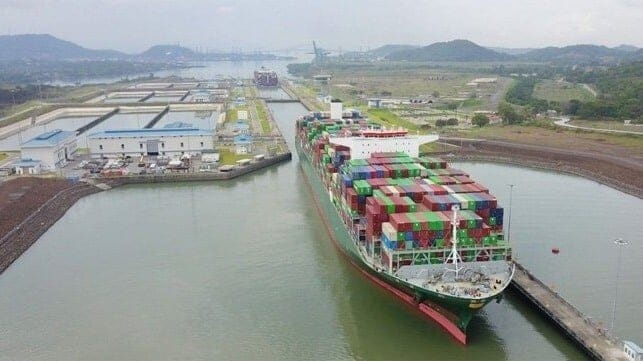
The President of Panama, Jose Mulino, announced on Thursday the decision of the Board of Directors of the Panama Canal Authority to appoint its first-ever female administrator for the vital waterway. An engineer and the current deputy administrator, Ilya Espino de Marotta, will officially assume the leadership position on October 1, taking the reins at a critical time as the operation is seeing increased traffic and potential impacts from a brewing El Niño weather pattern and the lingering pressure from the United States after Donald Trump asserted that China was controlling the operations.
A marine engineer, a graduate of Texas A&M University, with a master's degree in Economic Engineering from Santa María La Antigua University and executive training from INCAE and the Kellogg School of Management, Espino de Marotta, the authority highlights, was selected after a national international search, consultation, and evaluation process. It notes she has over 40 years of experience and is a 35-year veteran at the Panama Canal, having overseen major projects, including the expansion programs.
Espino de Marotta takes over as volume at the Panama Canal is increasing. The industry trade group BIMCO highlights that the disruptions in the Middle East and the closure of the Strait of Hormuz are contributing to the Panama Canal’s volumes. With oil and gas prices increasing, U.S. exports are growing, and Asia is seeking to make up the shortfall through U.S. imports.
BIMCO highlights an eight percent year over year increase in daily transits at the Panama Canal, with a current daily average of 38 vessels driven by the tanker sector. In the past five weeks, BIMCO reports there has been a 16 percent year-over-year increase in traffic at the Panama Canal.
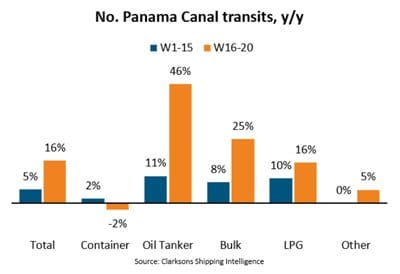
(BIMCO - Clarksons data)
“The daily maximum capacity of the Panama Canal is around 36 to 40 transits, meaning it is currently operating close to maximum capacity,” says Filipe Gouveia, Shipping Analysis Manager at BIMCO. “The recent spike in demand has inflated auction prices and caused a 50 percent year-over-year increase in waiting times, now sitting at a 47-hour average.”
The Panama Canal Authority’s online dashboard shows a total of 83 booked vessels and 10 non-booked vessels waiting as of May 21. It says the average wait for non-booked vessels is 3.9 days northbound and 8 days southbound.
The surge in volume has also sent prices skyrocketing for the slots the AMP auctions off to vessels without bookings. Earlier in the month, brokers reported a record $4 million price paid at auction for a slot, while the average is running around $400,000, up nearly three times from the average before the war started in the Middle East.
BIMCO highlights that container vessels, LPG, oil tankers, and bulkers make up approximately three-quarters of the transits. The rise in energy shipments, it notes, adds to the strain as many of these vessels operate in the spot market without schedules that permit advance reservations.
“Looking ahead, demand for Panama Canal transits could stay high for as long as disruptions in the Strait of Hormuz persist and U.S. energy exports stay strong. In the short term, congestion and waiting times could remain high and increase further in the medium term,” reports BIMCO.
The first challenge will come in June. Beginning at midnight on June 9, the canal will begin a dry maintenance process for the east lane at Gatun Lock, and it is scheduled to run through June 17. During that time, booking slots will be cut to just 16 vessels, with the authority warning that lockage will take additional time as the vessels share the westbound lane. It will be offering 10 fewer slots than normal during the maintenance period.
Also looming and expected to start this month or next is the weather phenomenon known as El Niño, which is likely to reduce rainfall on the isthmus. The authority highlights that it is better prepared than in the 2023-2024 season, when the lack of water forced it to cut transits to 22 vessels and reduce the maximum draught.
It reports monitoring began in late 2025 and that it has kept water levels at historically high levels in Gatun Lake, which serves as the main reservoir of the operations. They also point to an unusually wet season, which helped strengthen water reserves in the lakes, while they have also maintained water-saving measures at the locks. Currently, they do not anticipate being forced to renew restrictions in 2026, but the situation requires careful monitoring and management.

that matters most
Get the latest maritime news delivered to your inbox daily.
Longer-term, Espino de Marotta is likely to face renewed pressures from the Trump administration, which has also demanded free passage for U.S. government ships. The authority is also planning the development of two new port terminals, one at each end of the canal, with the tender expected in the coming months. It was announced to address U.S. concerns before Panama’s courts canceled the concession of CK Hutchison. The country remains locked in a brewing legal battle or arbitration with the Hong Kong company, while it also plans to tender for new concessions to operate the two existing terminals.
The Panama Canal Authority has announced other expansion plans, including a natural gas pipeline and improvements to the logistics corridor. It also has a long-term program to improve its reservoir system and water management.