


Houthi Blockade of Saudi Shipping Begins to Bite
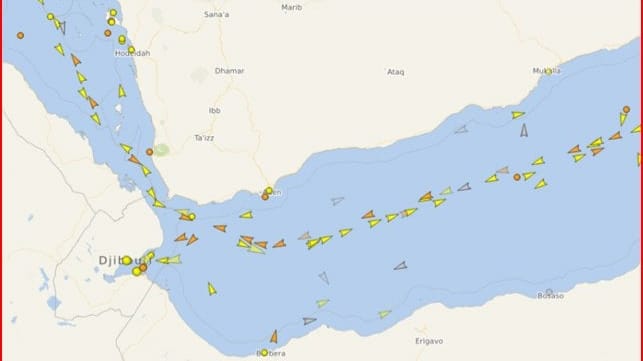
The first indications have been seen that the Houthi blockade declared against ships traveling to Saudi ports is beginning to have an impact. As yet, however, there have been no known Houthi attacks on shipping in the Red Sea, Gulf of Aden, or elsewhere.
Three tankers are believed to have altered their intended destinations, although none of the ships are believed to have been threatened directly.
The Singapore-flagged tanker, 333-meter (1,092-foot) VLCC Xin Long Yang (IMO 9761463), and the Liberia-flagged 250-meter (820-foot) tanker Rodos (IMO 1024948) had both loaded crude at Saudi Arabia’s Yanbu terminal, and were proceeding in a southerly direction down the Red Sea, before reversing course. The Xin Long Yang is still indicating its destination on AIS as China, arriving on August 10, whereas the Rodos is now declaring that its destination is Port Suez.
To get through the Suez Canal, a VLCC has to offload about half its cargo at the Ain Sukhna head of the Sumed Pipeline, travel through the Suez Canal lightly laden, and reload the balance of its cargo at the northern end of the Sumed Pipeline at Sidi Kerir.
Also changing course, according to Vanguard, has been the Hong Kong-flagged 333-meter (1,092-foot) VLCC New Prime (IMO 9799123), which had been heading empty for Yanbu. While still showing up on AIS as destined for the Suez Canal, she made a U-turn off Salalah and is now apparently heading East.
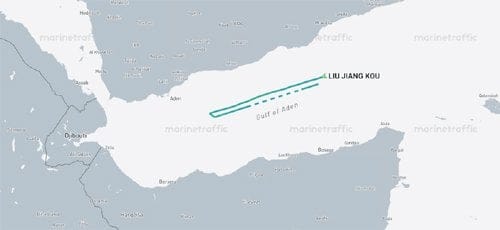
Chinese car carrier turning around after the Houthi threat (courtesy of Marine Traffic)
Lloyd's List Intelligence also spotted that a Chinese vehicle carrier, Liu Jiang Kou (19,000 dwt), made a U-turn in the Gulf of Aden. The vessel, operated by COSCO Shipping, turned away from the proceeding toward the Red Sea while it was still in the Gulf of Aden. The change is believed to be in response to the threat issued by the Houthis on July 20.
The course alterations follow generic email warnings sent to multiple shipping companies by the Houthi Humanitarian Operations Coordination Center (HOCC), the entity that in the past has presented itself as the communications medium with merchant shipping venturing into Yemeni waters. The HOCC website itself, unlike in the past, is still not showing the warning that has been sent by email to individual shipping companies.
In a non-statistical appraisal of the sea traffic using the IMO-delineated Maritime Transit Security Corridor (MTSC) through the Gulf of Aden and lower Red Sea, traffic using the MTSC, if anything, seems to be a bit heavier on July 21 than it was five days ago on July 16.

that matters most
Get the latest maritime news delivered to your inbox daily.
The Houthi blockade has been imposed in part to help out the IRGC who are facing increased pressure and a deteriorating situation in the Strait of Hormuz area, but primarily because of the impasse over flights into and out of the country generated by the blocking of a return flight from Tehran, bringing mourners home from the funeral of the late Supreme Leader Ali Khamenei; the flight to Sana’a instead had to land at Hodeida. In turn, the argument over the blockade of Houthi-controlled areas of Yemen is part of the stalled negotiations between the Houthis, the Saudis, and the Internationally Recognized Government of Yemen over a final concluding settlement of the civil war, which began in 2014. The Houthis are holding out in the negotiations for a $13 billion pay-off from the Saudis.
