

From Advice to Action: Earning Trust in Maritime AI
I have spent most of my career on the data side of this industry, and that makes me wary of AI framed as magic. It matches patterns in the data it is given, and it will produce a wrong answer as confidently as a right one unless somebody checks.
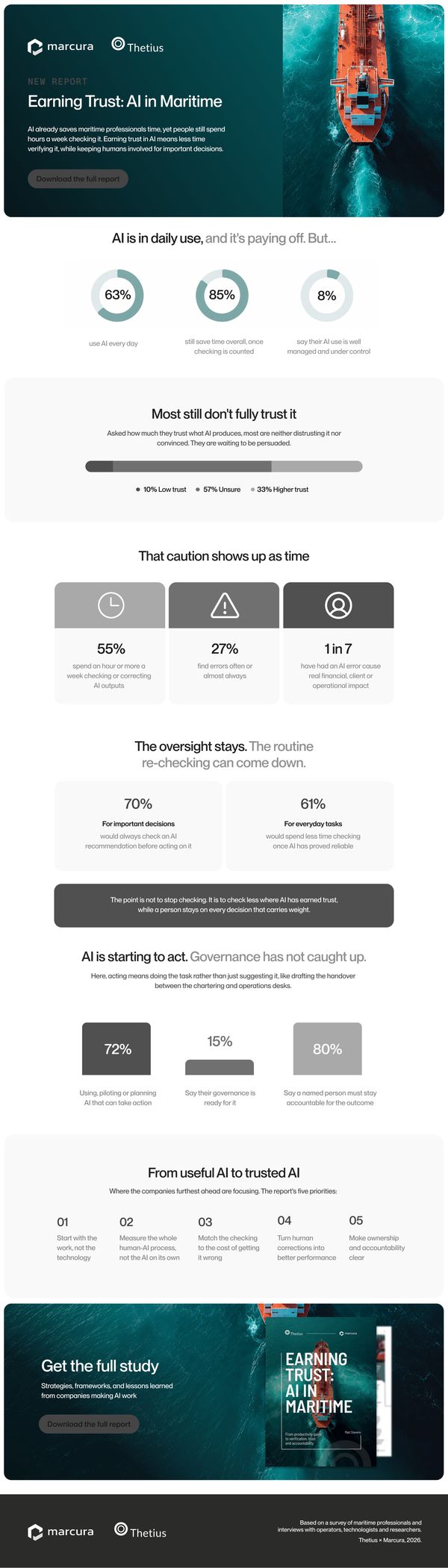
One finding in our latest research with Thetius, Earning Trust: AI in Maritime, stays with me: 57% of maritime professionals place their trust in AI outputs at the midpoint of a five-point scale, neither distrusting it nor convinced by it.
That hesitation matters now because AI is moving from advising to acting. 72% of respondents say their organizations are using, piloting or planning AI that takes actions rather than only making recommendations. Just 15% believe their governance is ready for it.
Trust has to be earned, task by task, through three things: an honest view of where an organization's AI stands, performance that can be measured and inspected, and a learning loop that turns every correction into an improvement.
Assess where you stand before moving forward
AI adoption rarely develops uniformly. Some teams already use specialist applications inside their workflows; others rely on general-purpose tools. Knowing where AI delivers value and what its limits are comes before any decision to extend it.
Governance lags use: 35% report having a formal AI policy. Only 25% say their organization has one that people actually follow.
The workflows where AI makes a real difference share a shape: large volumes of information, repetitive manual work, or decisions drawing on several sources. Data quality, measurable value and the consequences of an error should decide where it is deployed.
Trust must be earned through evidence
The research puts a name to the cost of checking AI's work: the verification tax, the time and attention spent checking and correcting AI-generated output before anyone is willing to act on it. 55% of respondents spend at least an hour a week on it.
Some of that checking is essential, particularly when a commercial decision carries financial, legal or operational consequences: 70% would always check an AI recommendation before acting on an important decision. Other checking reflects uncertainty about whether the system is right, and that kind falls as the system proves itself: 47% would check much less, or stop, once an output had proved reliable. Oversight stays where the stakes demand it; the checking that comes from uncertainty can come down.
Proving reliability is how it comes down. Reliability should be tested against real cases, task by task, rather than assumed for a system as a whole. At Marcura, we build evaluation metrics on real data from the end user for each use case, keep running those tests after deployment, and show the results in an audit dashboard so accuracy is visible rather than asserted.
Because checking is part of the cost, organizations should judge the complete human-AI workflow against the process it replaced, rather than the speed of the tool. Does it improve decision quality? Does it reduce total time, including the checking?
Charterparty review shows what the division of labor looks like. The clause that costs money sits among pages of standard wording and negotiated amendments.
One flag CP Optimiser raises on a typical dry bulk voyage charter makes the point. A demurrage clause requires “all supporting documents” within 90 days but never defines them, so one missing statement of facts could time-bar the whole demurrage entitlement.
The system flags the clause and the reason and brings it to the chartering professional before the decision is final. The chartering manager decides whether to tighten the definition before fixing. The judgment stays with the person.
Build the learning loop
Trust has to be maintained as well as earned, which means capturing feedback and improving the system.
This matters more in an industry where valuable knowledge sits with experienced individuals. A commercial manager may recognize a problematic clause because of a dispute years earlier, and the lesson may never reach a colleague in another office. AI can make that knowledge accessible and consistently applied, provided there is a working feedback loop between users, outcomes and the system.
In practice, organizations should record where AI recommendations were accepted, challenged or corrected, and why. Recurring corrections should trigger a look at the data, the retrieval or the workflow design, followed by a change and a retest. Without that, the same verification effort is repeated and the system never improves. The principle holds in procurement, claims handling and every other process where AI now sits.
Ownership matters as much as the loop. Someone has to judge whether a system still performs as intended and decide when its autonomy can expand. 80% of respondents believe a named person should remain accountable for every commercial decision, however capable the AI becomes.
As AI progresses from advice to action, a system might first prepare an action for approval, and only later earn the authority to execute defined, lower-risk tasks. Approval, escalation and monitoring should match the consequences of getting it wrong.
From adoption to sustained value
One caution I shared in the report bears repeating: don't replace muscle memory with AI. The person checking an output still has to know what a good answer looks like.
Advancing maritime AI requires a realistic understanding of existing capabilities, evidence-based evaluation, clear accountability and continuous improvement.
These foundations allow organizations to expand AI's responsibilities gradually, while retaining the human judgment needed for consequential maritime decisions.
The next step is to give AI greater responsibility only where reliable performance has earned that trust, and to keep testing whether it deserves it.
To download the full infographic highlighting the survey results, click here.
Explore the full findings and recommendations in Marcura and Thetius' 2026 report, Earning Trust: AI in Maritime.
Janani Yagnamurthy is Senior Vice President, Product, Strategic Growth, Marcura. This article is sponsored by Marcura.
The opinions expressed herein are the author's and not necessarily those of The Maritime Executive.