
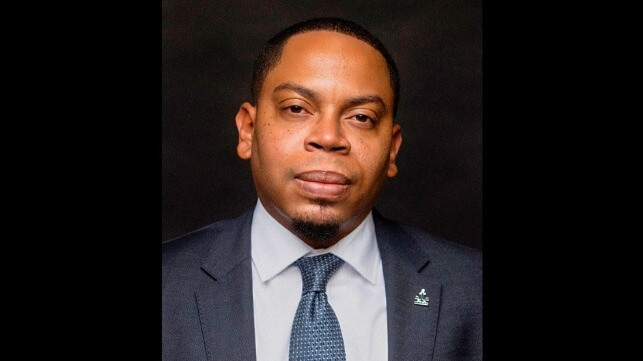
Executive Interview: Alexander Gumbs, CEO, Port St. Maarten Group
(Article originally published in Mar/Apr 2026 edition.)
Under Alexander Gumbs' leadership, St. Maarten has become the leading port in the Caribbean and a perennial tourist favorite.
Welcome, Alexander! Tell us about yourself.
My name is Alexander Gumbs, and I am a St. Maarten native. I hold a Bachelor's degree in Commercial Economics from the Netherlands and a Master's degree in Management/Leadership with a specialty in Project Management.
I started with the port as an intern in 2010 after completing my studies and eventually became head of Business Development & Marketing. Before transitioning to the role of CEO with the Port, I was the Director of Port Operations & Development for a major cruise corporation.
When did you become CEO and what are your responsibilities?
I was appointed CEO in August 2021. My responsibilities include overall strategic leadership, financial performance, infrastructure development and ensuring the port not only maintains safe, efficient and sustainable operations but also remains innovative and in tune with developing trends in both tourism and technology.
Is St. Maarten the biggest cruise port in the Caribbean? How many passengers does it handle annually and what major cruise lines are represented?
Port St. Maarten is consistently ranked among the busiest ports in the region, and we are frequently voted the #1 Cruise Port in the Caribbean, welcoming virtually all major cruise lines and homeporting various luxury lines. Annually, we welcome on average more than 1.5 million passengers.
Tell us about the Port St. Maarten Group. Are there cargo operations in addition to cruise? Which is bigger – the cruise business or the cargo business?
The Port St. Maarten Group is a state-owned enterprise operating as a privately managed LLC. It oversees the Port Authority, which is responsible for the three core pillars of cruise, yachting and, yes, cargo. And while we are best known as a premier cruise destination, the cargo business is essential to the island's supply chain and a pivotal transshipment hub for several neighboring islands.
Can you give us a brief history of the port – when it was founded, how it's evolved, when it first became a cruise hub?
The port dates back to 1964 when the first deepwater pier was inaugurated on June 3 and named the AC Wathey Pier. Between then and 1980, the tourism sector – land-based and cruise – slowly started to grow.
Between 1998 and 2008, further infrastructural development was executed with the completion in 2001 of an ultra-modern cargo facility and a four-berth cruise pier, which was the beginning of our transition to becoming a hub. In December 2007, the first pile was driven into the seabed for a second cruise pier that could accommodate two mega-size cruise ships, bringing total cruise ship berths to six. That second pier was completed in November 2008.
In 2002, cruise tourism reached the one-million mark and over a decade later the two-million mark in 2014, which also represented the 50th anniversary of our cruise facility. Over the decades of modern port development, we've expanded our various operations spanning cruise, cargo, yachting and real estate, and we celebrated our 60th anniversary in 2024.
St. Maarten is a hugely popular and prestigious destination for those of us in the U.S. and for tourists worldwide. Where do most of your passengers come from, and why is the island so popular?
The vast majority of cruise passengers originate from the U.S. However, we've also seen a shift where we find more passengers who come from Latin America, Europe and even within the region. I believe St. Maarten's appeal lies in its diversity. People experience multiple cultures and cuisines and easy access to neighboring islands, all within a compact welcoming environment.
How important is the port to the island's economy? How many jobs does it generate?
The port is a major economic driver and accounts for approximately 33 percent of St. Maarten's GDP and supports thousands of direct and indirect jobs across tourism, transportation, logistics, retail and services. Based on the most recent studies, cruise tourism injects roughly $104.5 million in total employee wages annually.
Explain for us how the island is governed. We know there's a French side and a Dutch side, and the port is in Philipsburg on the Dutch side.
Indeed, St. Maarten is a unique island shared by two nations where Port St. Maarten is located on the Dutch side. The southern Dutch side is a constituent country within the Kingdom of the Netherlands while the northern side is a French overseas collectivity, and they are governed separately in that regard.
Princess Juliana Airport is also in Philipsburg and is the island's other major gateway.
Do the airport and seaport work together to promote tourism and trade?
The coordination between Princess Juliana International Airport and Port St. Maarten Group is definitely essential as the two primary gateways for the destination, and it's particularly important for homeporting operations where passenger experience is concerned. In addition, we've recently focused additional attention on enhancing collaborative efforts to benefit not only the business but the wider community through engagement.
What's your vision for the future? Are there plans for further expansion on both the cruise and cargo side? Where do you see the port in, say, five years?
The vision is to ensure Port St. Maarten remains the "best-in-class" Caribbean port, which of course will require further investment and infrastructure development. This will go hand in hand with enhanced passenger experience, digitalization and sustainability efforts.
Over the next five years, I see the port further solidifying its role as a regional leader with more optimal operations and enhanced alignment with the island's economic strategy.
What's your biggest challenge right now?
Like many industries, we're navigating a rapidly changing environment. Managing growth while addressing sustainability, community and infrastructure demands are areas that presently require additional attention.
What do you like most about your job?
What I enjoy most is seeing tangible results. When an investment improves operations and people, enhances experience or creates jobs, you can see the impact immediately.
How would you describe your management style?
I would describe my management style as results-oriented. I believe clear expectations should be set out and accountability is very important.
What have we left out? Any final thoughts for our readers?
I think it's important to state the importance of partnership and collaboration. Port St. Maarten Group's success is a direct result of collaboration among various stakeholders – government, private sector partners, employees and the wider community.
As the industry evolves, we remain focused on responsible growth that benefits both visitors and residents alike.

that matters most
Get the latest maritime news delivered to your inbox daily.
Jack O'Connell is the magazine's senior editor.
The opinions expressed herein are the author's and not necessarily those of The Maritime Executive.