


Report Speculates US or NATO Sank Russian Ship Carrying Nuclear Equipment
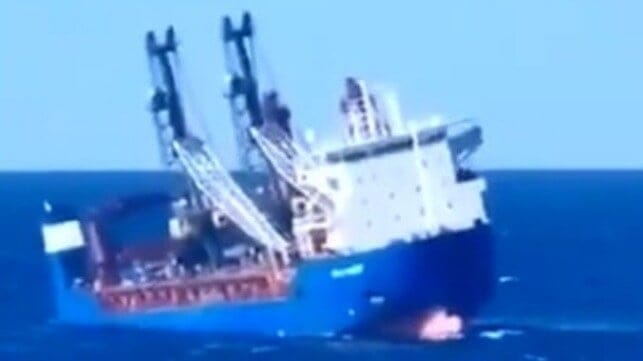
A new report from the US news outlet CNN, based on leaked information, is adding new speculation to the Russian claims that its cargo ship was attacked and sunk, possibly by the US or NATO. The heavy-lift cargo ship Ursa Major went down under mysterious circumstances off the coast of Spain in December 2024, with the vessel’s owners asserting it was the victim of a terrorist attack, while Russia has remained quiet about much of the incident.
CNN is citing data from the Spanish investigation into the sinking of the vessel. It also notes an unusual level of Russian activity at the site and also believes the United States sent two planes capable of detecting nuclear material over the site.
The vessel was well-known to military analysts, as it had been involved in moving Russian equipment out of Syria and was sanctioned by the United States. Built in 2009, it was acquired by the Russians in 2017 and first sailed as the Sparta 3 and, starting in 2021, as Ursa Major. The ship was 9,500 dwt and 142 meters (467 feet) in length.
According to the report from CNN, the ship loaded its cargo first at Ust-Luga and then at a Russian container port at the beginning of December 2024. The declared cargo was two deck-loaded cranes, containers which were said to be empty, and two “manhole covers” bound for Vladivostok. CNN reports that Spanish authorities were suspicious, noting that the cargo could have been more easily moved on the internal Russian railway network.
Portuguese naval forces were tracking the ship as it made its way along the coast and entered the Mediterranean. At times, it was also accompanied by two Russian military ships.
According to the investigations, Spanish authorities contracted the vessel on December 22 when they noticed it had slowed and basically stopped in the Mediterranean south of Cartagena. The captain reportedly radioed back that the ship was fine, but about 24 hours later, he issued a distress call.
The 14 surviving crewmembers went into a lifeboat and were picked up by a Spanish rescue boat. Two other crewmembers were said to have died in the engine room. The Russian military ships reached the scene and demanded the return of the crew and ordered vessels to keep two nautical miles away from the ship.
According to CNN, the Spanish refused and said they were conducting a rescue operation. They boarded the ship, and CNN saw a video that shows the ship being searched. The rescuers found the engine room locked and were unable to enter, but they searched the accommodations and containers and found mostly trash and items like fishing nets. They said the ship had a heavy list but seemed stable when they left, and they took the surviving crewmembers to Spain.
Four hours later, they report the Russian vessels fired flares over the Ursa Major, and then there were four explosions. The Spanish National Seismic Network told CNN the explosions were of a magnitude that they detected them.
The report by the Spanish says the captain was reluctant to talk, likely fearing for his safety, but finally said on the prior day the ship had slowed suddenly, and they were investigating. He claimed they found a large hole that was 50 cm by 50 cm (20 inches by 20 inches), and the metal was bent inwards, but felt no explosion.
Interviewing experts and reviewing the still confidential Spanish report, CNN speculates the explosion could have been caused by a Barracuda supercavitating torpedo. It notes that only the United States, several NATO countries, Russia, and Iran have these high-speed torpedoes. Sources told CNN the damage to the ship is consistent with this type of attack, while others told CNN it was more likely a limpet mine.
Elements of the Spanish report had previously been leaked, reporting that the captain admitted the ship was carrying components for two nuclear reactors “similar to those used in submarines.” Further, the captain reportedly said he expected the ship to be diverted to North Korea. CNN speculates that the deck-loaded cranes were to help the ship offload the components in North Korea.
It is impossible because of the 2,500-meter (8,200-foot) depth to search the remains of the ship and locate its data recorders.

that matters most
Get the latest maritime news delivered to your inbox daily.
CNN, however, reveals continued activity at the site of the wreck. A week after the Ursa Major went down, it claims a Russian spy ship was positioned over the wreck for several days. CNN reports there were four more explosions at the site. In addition, it says public records show the U.S. sent its sophisticated nuclear detection planes over the site in August 2025 and again in February.
Predictably, all the authorities declined to comment in response to CNN’s inquiries. It points out the strange nature of the incident but concludes the secrets of the Ursa Major rest on the sea floor.
