


Iran's Jask Oil Terminal: A Squandered $2 Billion Investment
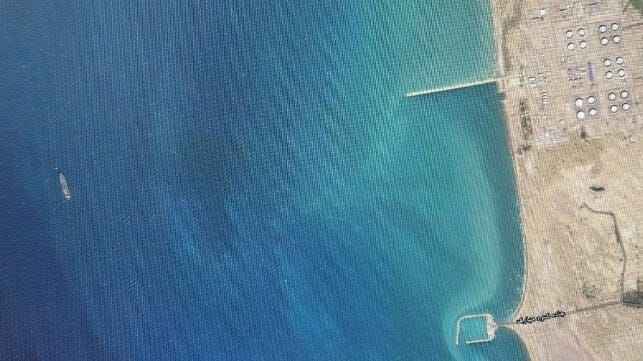
President Rouhani of Iran, in his last days in office in July 2021, declared the Jask oil terminal project completed. The $2 billion project involved the construction of a 685-mile, 42-inch pipeline to bring oil from the crude collection point at Goreh in Bushehr Province to a storage facility and oil export terminal at Kooh Mobarak, 33 miles north-west of Jask in the Gulf of Oman.
The opening of the project was premature, and in parliament the President was criticized for damaging the pipeline by bringing it into service before testing had been completed. When fully in service, the project was supposed to reduce a single point of failure dependency on Kharg Island, and to allow a third of Iran’s crude exports to be loaded at a terminal outside the Gulf - free from the risks associated with the Strait of Hormuz. Tankers were to load 1 million bpd from three Single Buoy Moorings (SBMs) off the Kooh Mobarak oil storage facility. The terminal lies just off the main shipping route out of the Straits of Hormuz heading east, which should have made detection-free breaking of oil export sanctions somewhat easier, as well as cutting sailing times.
After the opening in July 2021, only four of the 500,000 barrel storage tanks, and only one SBM was operational. For the rest of 2021 and then 2022, repairs interrupted operations. The one operational SBM was used periodically to load 300,000 bpd, primarily onto Medium Range tankers used for short-range shipments to the Indian subcontinent. All 20 storage tanks were only completed in mid-2025. There is still today only one SBM operational, and even this single SBM is leaking crude.
In the meantime, there were long periods when there were no loadings whatsoever. Nothing was spotted at the SBM buoy between October 2024 and April 2025 except for the oil slicks leaking from the SBM. A 252-meter VLCC was seen loading at the SBM on December 30, 2025, but the SBM does not appear to have been used at all in January and February this year.
Finally, after the start of the war on February 28, the US-sanctioned, Iranian-flagged shadow fleet VLCC Dore (IMO 9357717) was seen at the SBM on March 7 and through thick cloud on March 8, loading 1.77 million barrels. The Dore then set off for the Malacca Strait, where it conducted a Ship-To-Ship transfer of its cargo to the Aruba-flagged Lattafa (IMO 9245794), which is also US-sanctioned. The Lattafa then sailed to unload its cargo at Dongjiakou, in the teapot oil refinery district of Shandong Province in China at the end of April. Neither the Dore or the Lattafa have had their AIS transponder switched on since April 16.

that matters most
Get the latest maritime news delivered to your inbox daily.
Gulf states who have lost their direct access to the open seas by dint of the closure of the Strait of Hormuz will be looking for alternative export terminals outside the Gulf, to be serviced by newly-constructed pipelines. Saudia Arabia and the UAE will respectively be seeking to expand the throughput of the East-West and the Habshan pipelines respectively. Saudi newspapers have speculated that Aramco may wish to connect the Shaybah oilfield with a new pipeline to the Omani oil terminal at Ras Markaz on the Arabian Sea coast.
Planners would be well-advised, in the light of the Iranian’s squandered $2 billion investment in its Jask pipeline project, to reconsider critical vulnerabilities. This was something clearly not taken seriously by the Iranian business continuity team when building the Jask pipeline, whose continued operation depends on the survival of a single 17-meter-diameter SBM, well within the Circular Error Probable design of most in-service ship or air launched anti-ship missiles.
The opinions expressed herein are the author's and not necessarily those of The Maritime Executive.
