


Economic Fury Tightens Stranglehold on Iranian Dark Fleet
On June 2, the US Treasury's Office of Foreign Assets Control (OFAC) tightened its controls on Iranian dark-fleet activities by designating Iran's leading crypto trader, Nobitex, and the three next largest firms (Wallex, Bitpin and Ramzinex) operating in Iran. The move will not only complicate Iranian attempts to conduct financial transactions for its dark-fleet oil-trading activities, but also make it harder for the Iranian authorities to receive payments from shipowners seeking to use Iranian channels to enter and leave the Gulf using the so-called Persian Gulf Strait Authority (PGSA).
Nobitex, two of whose founders, Ali and Mohammed Kharrazi, are intermarried with the families of Ayatollah Khomeini, his successor, the late Ali Khamenei, and now Mojtaba Khamenei, has been particularly active in recent months. OFAC estimates that Nobitex processed "more than 50 percent of all Iranian digital asset inflows in 2025." It facilitated "payments tied to Iran's terrorist activities, sanctions evasion efforts, and IRGC-linked transactions." Nobitex has also provided payment channels for IRGC-sponsored criminal ransomware activities, according to OFAC.
The designation of Nobitex adds further layers of complication to Iranian government financial transactions, following the designation of the Hossein Shamkhani trading network on April 15, and the Babak Zanjani business empire on January 30. All three entities, run with huge profits by families all closely connected with leading religious figures in the Iranian political elite, made heavy use of apparently legitimate front companies operating in Turkey and the United Arab Emirates. But now that the UAE is abandoning transactionalism and regards Iran as an enemy, the previously relaxed approach of the Emirati authorities toward such activities has been replaced by a determination to tighten controls — as well as to avoid a return to the Financial Action Task Force's Gray List. The message was made very clear in a video conference on June 3 covering money laundering, convened by Deputy Prime Minister and Foreign Minister Sheikh Abdullah bin Zayed, a call that rounded up almost the entire Emirati leadership and business elite.
The Iranian authorities are skilled at rewiring networks and finding alternative channels when faced with sanctions. But it will take them time to do so, transactions will be delayed, and the costs of evasion will be higher as counterparties put a price on carrying out riskier transactions. The US Treasury claims its actions have already frozen nearly $500 million in regime-linked cryptocurrency. In its designation statement, the US Treasury made it clear it would also pursue foreign airlines and financial institutions that had dealings with the sanctioned entities. The PGSA itself was designated by OFAC on May 27.
As is apparent from its negotiating positions in talks through intermediaries with the United States, Iran is desperate for immediate financial relief, without which it will be unable to alleviate shortages of basic consumables and services that are deeply affecting the Iranian civilian population. Heavy-handed policing can confine politically motivated citizens to their homes. But shortages of food, water, fuel and heating will force people out onto the street and turn them against the government, whatever the consequences. Only subsidies and handouts can counter this — which is why money is desperately needed.
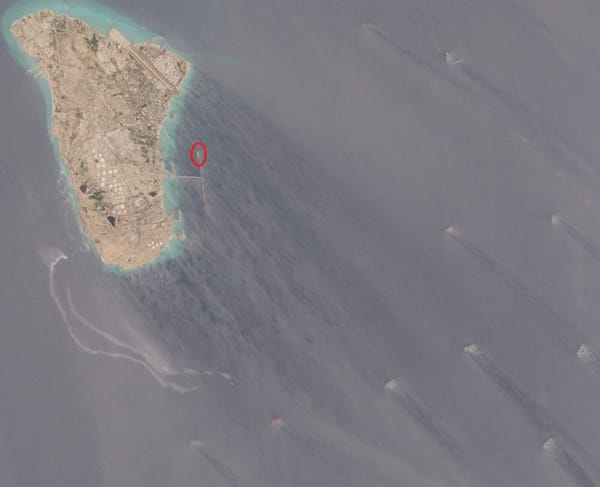
Standstill: with more than 20 tankers still anchored offshore, a 135-meter tanker seen (red) on the Kharg jetty on June 5, the first since two similar-sized tankers were seen loading on May 21 (Sentinel-2/CJRC)
For the moment, it is not clear where the Iranian regime will find that money. The Iranian dark fleet is loading very little oil, if any, from its main export terminal at Kharg, only small volumes from Kooh Mobarak, and not much, if any, is getting through the US Navy's blockade. On the basis of Kpler figures, nor are Chinese importers risking sanctions by drawing down much oil from the Iranian stockpile afloat, held off Eastern Malaysia and in Chinese waters.

that matters most
Get the latest maritime news delivered to your inbox daily.
There may still be some money coming in from shipments previously sold, but this is running dry, and even a ceasefire won't get the money flowing quickly enough in amounts anywhere near what is needed. The best that the Iranians can hope for is that, in negotiations, they manage to get bank deposits unfrozen — the only way the regime can get, quickly enough, what is needed to stave off widespread unrest.
OFAC offers handsome incentives (up to 30% of monetary sanctions collected) to eligible whistleblowers reporting Iranian sanctions violations.
