
Dominion Energy Makes Progress on Offshore Wind but Delays Completion Date
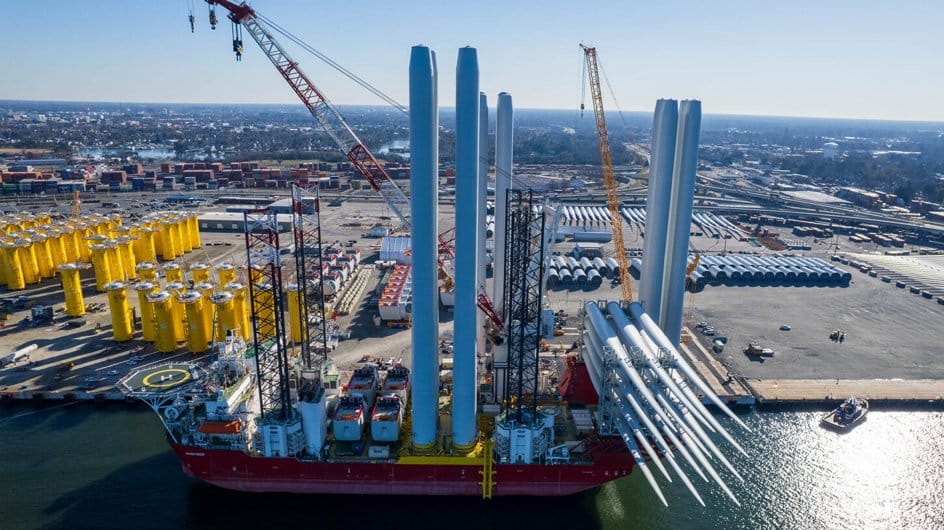
The largest offshore wind energy project in the United States, Coastal Virginia Offshore Wind (CVOW), continues to make good progress with its construction and installation, Dominion Energy told investors during its quarterly update. The company reports the project has passed the 80 percent completion mark and is generating a significant amount of electricity, but it has extended the target completion date to the end of 2027 and added approximately two percent to the budget.
“The strategic value of CVOW hasn’t changed,” said Bob Blue, Chair, President, and CEO of Dominion Energy, in response to an analyst’s question. “It remains one of the fastest ways to bring a lot of power to our customers; it also remains one of the most affordable sources of energy for customers.”
Blue noted that the project now has 31 turbines installed, with work progressing on the installation of number 32. The project delivered its first power in March, and currently, Blue notes, with 31 turbines installed, it has a capacity of 450 MW, which he said rivals the magnitude of some of the company’s fossil plants. Further, he points out that the project will continue to increase power capacity as they proceed with the installation of the remaining 144 turbines (176 total when completed).
Dominion Energy ticks off a long list of accomplishments for the project. All the monopiles and transition pieces are installed along with two of the three offshore substations. In addition, all the nacelles, 99 percent of the towers, and 85 percent of the blades have been fabricated. The last of the towers is days away, and fabrication of the blades will be completed by October.
While the project is making good progress, Dominion Energy said it is pushing back the target date for the last turbine installation to the end of 2027, versus earlier projections of mid-2027. The company reports the jackup time has remained consistent at about two days, but it is adding in contingencies for incremental weather, vessel maintenance, and says it anticipates that additional time will be required for the load out of materials from the Portsmouth Marine Terminal.
Another factor is that they anticipate longer-duration jacking operations for certain locations for the remaining turbines. They reported that an analysis has been performed based on the sub-sea geotechnical analysis.
Costs of the project have already been increased due to the impact of tariffs imposed by the Trump administration and the costs for steel and aluminum, as well as the delays from the Trump administration’s stop-work order.
Currently, they report an investment of approximately $9.8 billion for the project. The total cost estimate was increased by a further two percent, or a targeted new total of $11.65 billion. Stonepeak, as the investor, is bearing 48 percent of the cost while Dominion estimates it has to fund approximately $1 billion in the last phase of the project.

that matters most
Get the latest maritime news delivered to your inbox daily.
Blue emphasized that, unlike a traditional shore power project where they have to wait for completion to “flip the switch,” Coastal Virginia Offshore Wind adds to its capacity as each turbine is commissioned. “In recent weeks, as we’ve set new demand peaks, we’ve done everything possible at the request of system operators to deliver the maximum possible amount of power from CVOW,” Blue told investors.
Unlike the monopile installations, which had to be paused during the winter, the nacelle installation is continuing with no time restrictions. Dominion projects the next key milestone as the commissioning of the third and final offshore substation expected by year-end 2027. At that point, they note it will signify that approximately 50 percent of the project investment, adjusted for network upgrade costs, has achieved in-service status.
