
China Launches Antarctic Expedition
China has launched its 32nd Antarctic expedition with the research vessel and icebreaker Xue Long, or Snow Dragon, leaving a Shanghai dock on Saturday.
A team of 277 researchers will make the 159-day round trip of 30,000 nautical miles (55,500 kilometers).
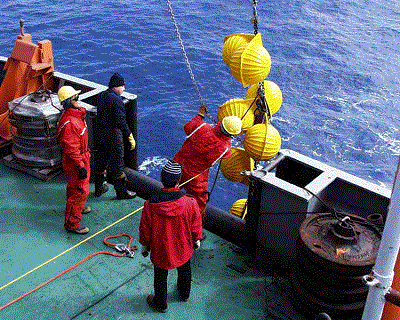 The researchers will conduct a final survey for the country's fifth Antarctic station site at Victoria Land on the Ross Sea, mapping the site and assessing the ecological and environmental impacts, according to the team's deputy chief Sun Bo.
Team members will also conduct research around Changcheng, Zhongshan, Taishan and Kunlun stations, as well as Prydz Bay, the Ross Sea, the Amundsen Sea and the Antarctic Peninsula, reports local media.
The vessel will also help Australia to ship cargo from the Australian port of Fremantle to Casey Station.
Joint Research Effort
Chinese and Australian scientists are partnering to develop new forecasting methods to aid the challenging task of navigating Antarctic sea ice.
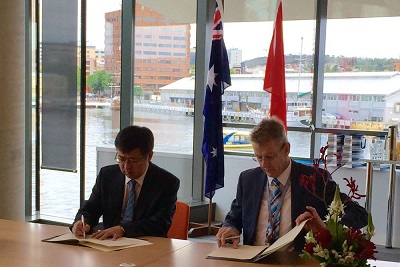 Australia’s Antarctic Climate and Ecosystems Cooperative Research Centre (ACE CRC) signed a Memorandum of Understanding on Monday with China’s National Marine Environment Forecasting Centre (NMEFC).
The Acting CEO of the ACE CRC, Mark Kelleher said the main focus of the agreement was cooperation to develop scientific methods for forecasting sea ice conditions in support of the Chinese and Australian Antarctic programs.
“Unpredictable sea ice conditions can create headaches for scientific and resupply operations in Antarctica, and the need for a more reliable method of forecasting has become clear,” said Kelleher. “We have also seen a number of private and commercial ships becoming stuck in the sea ice in recent years, which can lead to costly rescue operations that delay scientific work.
“Our new partners have a long reputation of excellence in marine environmental forecasting and remote sensing, and we bring considerable expertise and field experience in Antarctic sea ice. We believe this partnership places us in a strong position to take a lead in developing the models and techniques required to provide reliable sea ice forecasting to aid Antarctic shipping.”
In September last year, Antarctica’s sea ice exceeded 20 million square kilometers for the first time in recorded history.
“The patterns of sea ice distribution around Antarctica have been changing significantly. In some regions sea is ice disappearing, and in others we have seen it significantly expanding,” Kelleher said.

that matters most
Get the latest maritime news delivered to your inbox daily.
The agreement follows the signing of a Memorandum of Understanding by the Chinese and Australian governments during President Ji Xinping’s visit to Hobart in 2014.
“This agreement is another small step in a long and proud history of co-operation between Australian and Chinese scientists in Antarctica,” Kelleher said. “Chinese scientists first travelled to Antarctica on an Australian expedition in the late 1970s, and we are pleased that the bonds formed during that era are still very much alive today.”