


CENTCOM Denies Iran's Gulf Breakout Claims Saying Danger is Verbal Threats
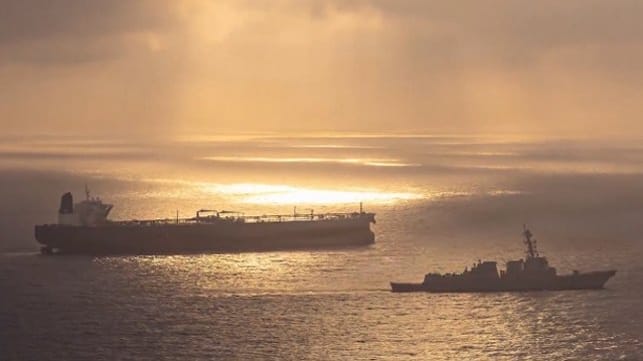
The war of words and claims continued after several days of relative calm, with no vessels attacked in the Strait of Hormuz. Iran is making bold claims about stopping all traffic and turning back tankers, while U.S. Central Command denied the claims that two Iranian ships have eluded the blockade.
It was being widely reported that the crude oil tanker Nora (298,414 dwt) had passed out of the Gulf. The shadow fleet vessel, which is under U.S. sanctions, has been dark for over 70 days. It falsely claims to be registered in Guyana with unknown management.
CENTCOM issued what it called a “fact check,” saying the blockade is “America’s steel wall” and that the tanker had not broken through. It did not say if the vessel was confronted or if the story was a total fabrication. It, however, said that 20 commercial vessels have been redirected since the blockade resumed in mid-July, with two others disabled, and two more boarded.
Wana (West Asia News Agency), which is closely aligned with the IRGC, also made the claim that an Iranian containership had become the first Iranian vessel to pass through the blockade on July 30. It claimed the Noura had broken through, moving from off Qeshm Island into international waters.
The independent analysts at Windward AI also disputed that an Iranian containership had made it past the blockade. It posted a route chart showing a vessel “reversed course on July 30 right at the edge of the active U.S. naval blockade zone in the Gulf of Oman.”
The IRGC made additional claims on Friday, July 31, saying that it struck two “non-compliant” tankers and turned back four others from the Strait of Hormuz. No details or names of vessels were provided, and the claims were not independently verified by UK Maritime Trade Operations or others.
The Iranians blamed CENTCOM and the United States, which the IRGC said had “misled” the vessels. Iran said the tankers were on an “undeclared route.” It further asserted the tankers were being escorted from the air by U.S. forces. It claimed that after it struck the first two tankers, which then halted their transit, four other tankers reversed course back deeper into the Persian Gulf.
An Iranian-flagged, OFAC-sanctioned container vessel reversed course on July 30 right at the edge of the active U.S. naval blockade zone in the Gulf of Oman. It had been heading east, deeper into the enforcement area, then turned back toward Iranian waters instead.
— Windward (@WindwardAI) July 30, 2026
The vessel… pic.twitter.com/OaO2LtstDO
At the same time, Iran’s so-called Persian Gulf Strait Affairs Authority posted a message saying that due to U.S. military actions, it was “not feasible” for any vessels to transit the Strait. It said it was holding applications that had been received and they would be “reviewed and permission issued progressively,” once stability had been restored.
CENTCOM scoffed at the reports, issuing its own statement saying the Strait of Hormuz remains open and that thousands of ships have sailed through the international waterway in the past four months. It said the dangers to commercial vessels and their civilian crews are “the IRGC’s verbal threats and attempted attacks.”

that matters most
Get the latest maritime news delivered to your inbox daily.
Tracking data, however, shows that merchant ships remain hesitant to approach the Strait of Hormuz. Kpler reports today, July 31, crossing fell to five vessels from 22 on Thursday, a 77 percent decline. It said the five had all used the Iranian route. Over the past seven days, Kpler has tracked only 18 tankers entering the Strait of Hormuz, of which it says five were related to Iran.
Two crude oil tankers, Sinokor’s Spain B (299,446 dwt) and the Chinese-owned Noble (318,440 dwt), were reported to have cleared the Strait of Hormuz today, according to Kpler’s data. Noble is displaying the message “Chinese crew owner” on its AIS. Reuters is also reporting that PetroChina has provisionally chartered the tanker Jamaica Prosperity (314,000 dwt) also from Sinokor to load next week in Iraq and travel to China.
Donald Trump, speaking at a cabinet meeting on Friday, asserted that the United States would continue to hit Iran hard but that most of Iran’s capabilities are gone. He said he believes Iran will at some point say it cannot take it anymore, but that right now Iran is just angering him.
