


Video: U.S. Navy Tests Out Drone Bomb Boat for the First Time
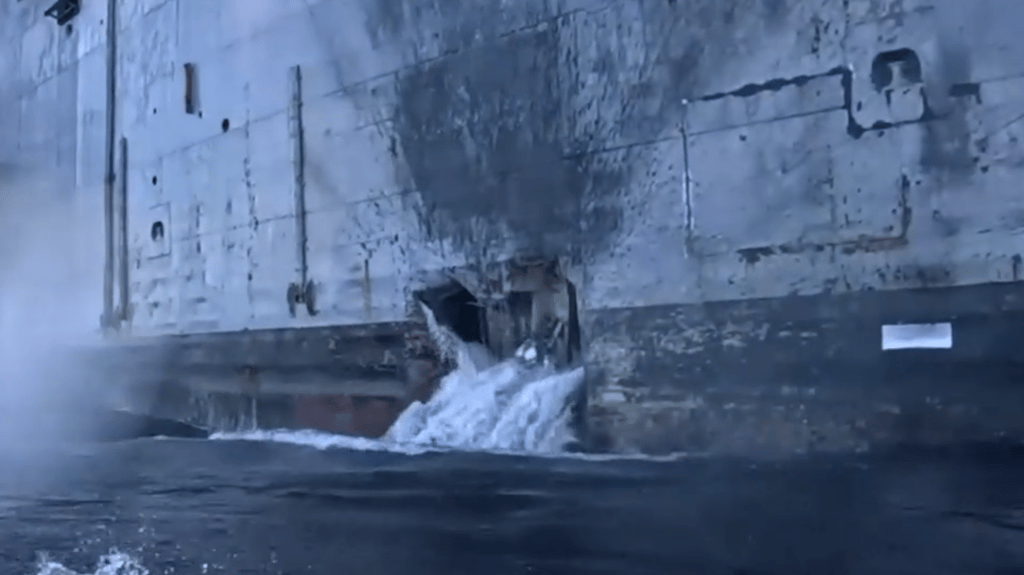
The U.S. Navy is beginning to show the capabilities of its unmanned vessels in higher-profile roles, including an appearance in a sinking exercise at Rim of the Pacific 2026 (RIMPAC). RIMPAC is the Navy's most-watched naval drill, and it is attended by dozens of partner nations every year; inclusion of a drone attack boat in the capstone sinking exercise signals that the service is beginning to accept the technology in an operational role, and not just for ISR purposes.
U.S. Navy one-way attack surface drones take part in a sinking exercise in the Pacific Ocean targeting the hulk of decommissioned Tarawa-class amphibious assault ship USS Peleliu (LHA 5) as part of Exercise Rim of the Pacific 2026, July 17, 2026. source?https://t.co/nUbZ2uoDLV https://t.co/Zyp4VcJM0U pic.twitter.com/HgcoD82xaz
— ???? (@lfx160219) July 25, 2026
Watch an onboard view of the USS Peleliu getting pummeled by US missiles during the Navy's latest SINKEX event pic.twitter.com/4DtWWJOumb
— J.D. Simkins (@simkins_jd) July 30, 2026
Un USV muestra los impactos que recibió el USS Peleliu durante el SINKEX realizado durante el RIMPAC 2026, en el que la fragata Álvaro de Bazán lanzó dos misiles Harpoon. pic.twitter.com/eiAFX81Rjh
— ? (@Xarco_21) July 27, 2026
The Navy's Unmanned Surface Vessel Division 32 (USDIV-32) was selected to perform the service's first modern, live-fire drone boat exercise using a specially-equipped variant of the Global Autonomous Reconnaissance Craft (GARC), a common platform for unmanned ISR. Navy Lt. Sarah Weinstein, commanding officer of USVDIV-32, oversees a team of the Navy's first designated Robotics Warfare specialists - the first enlisteds with this particular rate.
Earlier this year, her unit deployed to Poland to serve as an opposing force during the BALTOPS 2026 exercise, giving allied NATO navies the opportunity to attempt to defend against a simulated drone boat attack. Their next assignment was closer to the real thing: driving a GARC with an explosive warhead into the starboard side of USS Peleliu, a decommissioned Tarawa-class amphib. The device functioned as designed, and it left a substantial hole in Peleliu's hull at the waterline. A second GARC was on hand to film that strike and a series of subsequent Tomahawk missile strikes, providing rare close-up footage for battle-damage assessment - all without risking any sailors' safety.
GARC is one of many competing designs in the small USV segment, and has been widely employed. The design that performed the first-ever U.S. combat test in a one-way attack role - several days earlier, in Bandar Abbas - was a larger Saronic Corsair, and it was not under Navy control, according to USNI.

that matters most
Get the latest maritime news delivered to your inbox daily.
While these recent trials are the first published examples for the U.S. military in modern times, the idea of a radio-controlled bomb boat was fully developed and trialed in 1944-5, in the closing months of the Second World War. The highly secret "Project Campbell / Javaman" boat was conceptually similar to the Magura, capable of long-range over-the-horizon remote control, but it delivered the devastating terminal effects of a heavyweight torpedo. It carried a 4,000-pound explosive payload, and its main charge would detonate well below the waterline, after the time of impact. An initial test of the device put a 2,400-square-foot hole in a decommissioned freighter and sank the target vessel in two minutes. Bureaucratic infighting stalled its deployment, and the war ended before it could be used.
