
Captain Molly Kool, Maritime Trailblazer
A Canadian woman was the first North American female ship’s captain. Her name was Myrtle “Molly” Kool. She obtained her Master’s papers in 1939 when she was just 23 years old. The Washington Daily News wrote about her accomplishment on July 4, 1939 in an article entitled “Pretty Molly Kool, 23, Receives Her Papers as Sea Captain.”
Kool became a sea captain 37 years before Deborah Doane Dempsey graduated from Maine Maritime Academy in 1976. Dempsey was the first woman to graduate from a US maritime school. The first class of women at the US Merchant Marine Academy graduated in 1978. Two years later, the first class with women graduated from the US Naval Academy.
In 1937, Kool obtained her mate’s license after attending the Merchant Marine School in St. John, New Brunswick. She was following in the footsteps of her father, Paul Kool. He was a Dutch immigrant and a scow captain.
The summer of 1939 was tense. War was coming. The same Washington Daily News page that shared information on Kool’s accomplishments also included the headlines “House Aided Hitler, Roosevelt Believes” and “Hitler ‘Peace Plan’ Reported in Paris”. Hitler invaded Poland on September 1, 1939 and Canada declared war on Germany nine days later.
World War II didn’t stop Kool. She spent the war years transporting cargo between the Bay of Fundy and Boston. In comparison, US women weren’t permitted to join the US Navy until 1942 when President Roosevelt signed a law establishing a women's branch of the Naval Reserve (Women Accepted for Volunteer Emergency Service). US women could serve in fields such as intelligence, supply, and clerical work. None of them went to sea.
On August 13, 1941 Kool’s maritime service was highlighted in a cartoon published in the Tacoma Times - “Steamboat Mollie!...Mollie Kool, 25, is a licensed steamship captain!” The caption was clearly a reference to the Disney short film Steamboat Willie. (Canada was at war with Germany, and a female Canadian maritime captain transporting valuable cargo was being compared to an animated mouse.)
Kool left the sea in 1944 when her ship, the “Jean K,” burned. She married Ray Blaisdell and their marriage license denotes her occupation as master mariner. The couple moved to Maine where she lived for the rest of her life, dying in 2009.
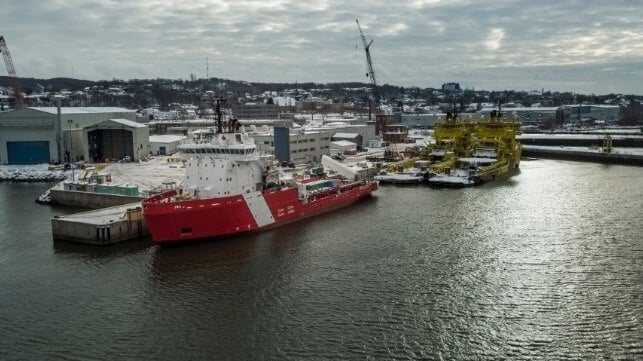
The Canadian government named an icebreaker after Kool in 2019. Kool’s sister, Martha Miller, attended the ship’s christening, reminding female attendees of Kool’s importance in maritime history: “Molly got the law changed so you can be a captain,” she said. Prior to 1939, the Canadian Shipping Act was a male-specific law. Kool’s graduation from the Merchant Marine Institute in Yarmouth Nova Scotia forced the Canadian government to amend the law to read “he or she.”
To fully understand Kool’s accomplishments, one has to look at two additional maritime trailblazers. US Coast Guard Lieutenant Beverly Kelly became the first US female commanding officer afloat in 1979. Commander Darlene Iskra became the first woman to command a US Navy ship in 1990, fifty one years after pretty Molly Kool became a sea captain.

that matters most
Get the latest maritime news delivered to your inbox daily.
I’m grateful for the path forged by Molly Kool. She is the reason why Canadian and American women who attain the rank of master can call their family members and say, “call me Captain from now on.”
K. Denise Rucker Krepp is a US Coast Guard veteran and former US Maritime Administration Chief Counsel.
The opinions expressed herein are the author's and not necessarily those of The Maritime Executive.