


Amidst Ceasefire, U.S. and Iran Trade Strikes in Strait of Hormuz
As the ceasefire between Iran and the United States continues, both sides traded fire Thursday in an escalating tit-for-tat exchange.
Following the U.S. fighter strike on an Iranian tanker Wednesday, Iran retaliated by launching a multi-pronged attack on three destroyers in the Strait of Hormuz, the USS Truxton, USS Mason and USS Rafael Peralta. The exchange was more intense than previous encounters, officials told CBS, involving waves of missiles, drones and swarms of small attack craft - some of which came close enough that the destroyer crews were able to engage the attackers using machine guns and small arms.
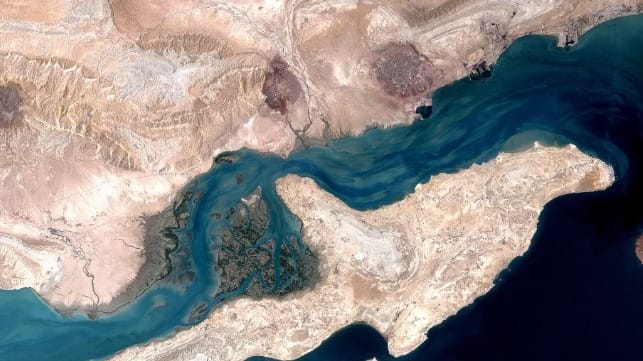
In response, U.S. forces bombed the island of Qeshm and the port of Bandar Abbas, officials have confirmed to Fox News.
"U.S. Central Command (CENTCOM) eliminated inbound threats and targeted Iranian military facilities responsible for attacking U.S. forces including missile and drone launch sites; command and control locations; and intelligence, surveillance and reconnaissance nodes," the command said in a statement.
The kinetic strikes were not a resumption of the full-scale conflict, nor a ceasefire violation, the U.S. officials said. "It's just a love tap," President Donald Trump confirmed to ABC's Rachel Scott. "The ceasefire is going. It's in effect."
The White House has so far declined to treat Iran's actions as a breach of the truce. On Monday and Tuesday, Iranian forces attacked two warships, multiple merchant ships and civilian energy infrastructure, impacting Emirati oil exports and injuring at least 11 foreign nationals - without formally breaching the ceasefire, according to the administration.
According to Fars, "commercial areas" of the Bahman Pier on Qeshm were targeted in the U.S. counterattack. Mehr News reports that additional blasts were heard along Iran's Strait of Hormuz coastline, in Minab, Gachin, Bandar e Khamir and Sirik.
The Iranian reaction to Thursday's events is still evolving. In a statement, the general staff of Iran's armed forces framed the U.S. attacks as a ceasefire violation, according to Iranian researcher Babak Vahdad.
Tasnim News initially attributed the strikes not to the U.S., but to the UAE, which has previously played a supporting role for U.S. forces but has generally refrained from frontline combat. “If this issue is confirmed, the UAE will pay the cost of its hostile action,” Tasnim stated.
 Stay on Top of the Daily Maritime News The maritime news
that matters mostGet the latest maritime news delivered to your inbox daily.
Antiaircraft fire seen over Iran’s capital, Tehran, a few moments ago. pic.twitter.com/wasn4eKTWs
— OSINTtechnical (@Osinttechnical) May 7, 2026
