
AI-Enabled ETA Management Could be the Key to Solving Port Congestion
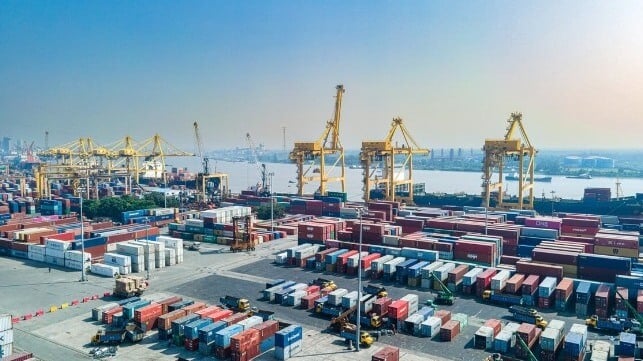
An expanding global fleet. Bigger ships. Growing trade volumes. Slower port turnarounds.
Port capacity is under increasing pressure and congestion is a significant challenge – raising operational costs for shippers, disrupting global supply chains and hitting economic activity. But AI-driven predictive ETA management can optimize port turnarounds to ease logistical impacts.
The smooth transit of 90% of global trade carried by sea remains hostage to port congestion stemming from supply-demand imbalances, operational inefficiencies and lagging investments in infrastructure. Weather also has an impact, along with labour issues and logistical constraints such as a lack of crane availability, yard space and inadequate landside transport connections.
Visibility is therefore key for vessel operators to avoid the ‘rush to wait’ at ports. This requires actionable data insights to determine accurate ETAs that can inform speed decisions to save fuel and optimize arrival times.
Counting cost of congestion
Congestion at ports can affect schedule reliability – adding days or weeks to transit times – as well as disrupt industrial production and push up freight rates due to a dearth of vessel capacity, while also increasing demurrage and detention charges. Consequently, carriers may be forced to reroute vessels or blank sailings.
As well as the negative costs and revenue impacts of port congestion, this can result in higher emissions from unplanned idle time at anchorage or suboptimal ETA management leading to higher than necessary speeds, while there are also safety concerns due to crowded waters.
Port congestion is compounded by the productivity demands of modern megaships – with ultra-large containerships discharging and loading 3000-5000 containers per call to extend berth times – that can put a strain on terminal capacity, especially if several such vessels arrive simultaneously.
Ports are also vulnerable to sudden demand surges caused by pre-holiday shipping rushes or global trade upheaval triggered by tariff changes that can lead to front-loading ahead of implementation to boost cargo shipments – causing delays, higher freight rates and congestion.
Port infrastructure issues
For example, berth waiting times can extend to several days during peak periods at Singapore – the world’s second-largest container port by TEU volume – while the European gateway ports of Antwerp and Rotterdam experience seasonal congestion, especially during the peak Q3/Q4 shipping season and when industrial action disrupts operations, according to research firm Kpler.
The biggest challenge is matching port capacity with shipping demand.
There is a lack of transparency about berthing slot availability in relation to expected ship traffic and arrival times, particularly in the container trade and possibly more so in bulkers and tankers. This means a slot may cease to be available for a waiting vessel if a port is working at full capacity, or available berths may not be used if expected vessels fail to arrive.
This leads to sub-optimal port utilization, putting intraport capacity utilization under pressure. Consequently, a port may develop port infrastructure that isn’t really needed. This also results in bottlenecks, slower vessel turnaround times and voyage delays.
Such bottlenecks – when the volume of ships calling at ports exceeds terminal capacity to efficiently process them – cause a domino effect where a delay due to congestion at one port ripples down to other ports on the route to hit entire trade lanes. Local congestion thus becomes global disruption.
S&P Global’s latest global port congestion analysis indicates a general decline in port efficiency globally with decreased port moves per hour, longer arrival processing times and increased average port hours at most ports across five regions – Northern Europe, North-East Asia, North America, South-East Asia and the Mediterranean.
Optimizing port traffic flows with AI
However, port traffic flows can be optimized by leveraging AI-driven intelligence used in smart voyage management that can enable predictive ETAs and earlier decisions on berth planning when there is a transparent flow of information between the port and shipping company.
Predictive ETA management uses AI analytics and advanced algorithms to forecast accurate arrival times based on a range of real-time data inputs – weather, vessel performance, traffic and navigational, and port and terminal operations.
This can enable more efficient planning of port calls through integration of port congestion insights, berth availability data, traffic events and analysis of avoidable waiting time.
Voyage intelligence, which combines meteorological, technical and operational data to predict ETAs, makes it possible to better navigate port call congestion when port information is included in the data stream.
Faster turnarounds, fuel savings
Real-time updates allow dynamic recalculation of optimal routes and speeds based on scenario analysis to determine the best route with the lowest fuel use and optimal arrival window.
One possible scenario is that a vessel could adjust speed 48 hours out to align with an open berth slot, thereby cutting waiting time from 18 hours to zero. It is all about facilitating the shift from a ‘rush to wait’ to just-in-time arrivals.
Ship operators are increasingly using cost-benefit analysis to vary speeds and save fuel within traditional contracts as part of intelligent routing, which can result in faster port turnarounds and savings of 5-8% in fuel and emissions, while also improving CII ratings. This is low-hanging fruit with minimal investment.
'Air traffic control system’ for ports
There is clearly also potential for wider application of smart ETA management to serve as an ‘air traffic control system’ for ports to allow more efficient berth allocation, improved resource coordination and enhanced capacity utilization.

that matters most
Get the latest maritime news delivered to your inbox daily.
This can provide visibility of all vessels sailing into a port for more precise scheduling of marine operation resources – such as pilots, shore labour and equipment – and better alignment with outbound logistics to avoid unnecessary costs.
Predictive ETA management can alleviate chronic port congestion to deliver measurable gains in shipping efficiency and sustainability – and dramatically improve the reliability of the global supply chain.
The opinions expressed herein are the author's and not necessarily those of The Maritime Executive.