

Interview: Bradley Kerr, Director of Sales & Marketing, Detyens Shipyards
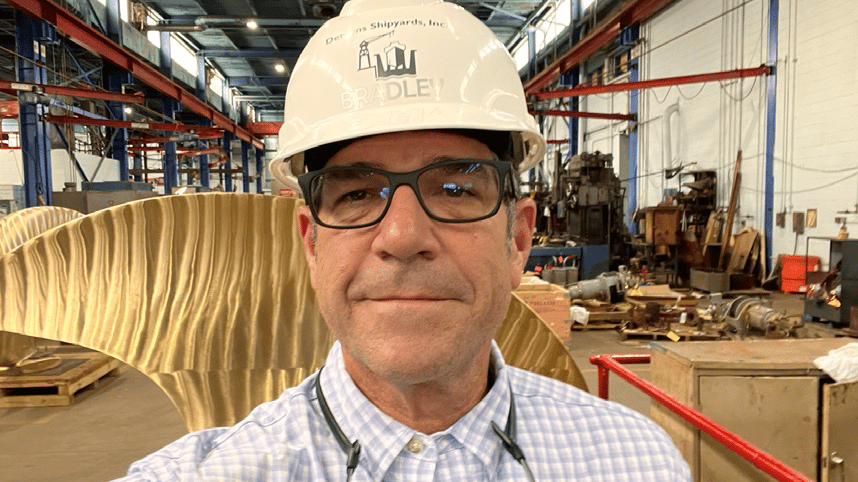
(Article originally published in Sept/Oct 2026 edition.)
Hi Brad, and welcome! Tell us about yourself – background and education.
I grew up in Charleston, South Carolina, the youngest of three boys. I attended school locally and then went to Wingate University, outside Charlotte, North Carolina, where I played soccer for four years and graduated with a degree in Communications.
I didn't initially pursue a maritime career. Every male member of my family was in sales, so sales was something I was exposed to from a very young age. In college, I thought I wanted a career in radio and interned at an AM radio station. I also sold advertising for the station, and my station manager suggested that instead of pursuing an on-air broadcasting career I should go into sales.
That's how my sales career began. Maritime wasn't on my radar yet, but a career in sales certainly was.
What sparked your interest in maritime?
It was the birth of our son Bailey, who currently works in our docking department! We had an old Jon boat in the garage that I needed to store somewhere else to make room for the car so we could pull it inside when it was raining and get the baby out.
Not knowing where to store the boat, I put together a business plan and went to Loy Stewart, Sr., who owned Detyens Shipyards, and pitched him on an idea to start a boat storage facility called Carolina Boatyard on some property at the old Detyens Shipyards location on Highway 41.
With Mr. Stewart's help, I formed Carolina Boatyard. We started with one boat and eventually grew to around 250 boats at our peak. That business was really my introduction to maritime.
What brought you to Detyens?
While I was building Carolina Boatyard, I apparently caught Mr. Stewart's eye as someone who might help with sales at the shipyard. Around 2003, he drove into the boatyard one day and said, "Bradley, we've got a salesman down in Jacksonville who's looking for some local help, and we couldn't think of anybody but you."
I told him, "Mr. Stewart, I don't know anything about ship repair."
He replied, "Bradley, we can teach you everything you need to know about ship repair, but what you know, we can't teach people."
That stuck with me, and in January 2004 I went to work for Dave Enman at Enman & Associates and became the on-site sales representative for Detyens Shipyards.
What a great story! Tell our readers about Detyens – its history, ownership and facilities.
Detyens Shipyards was founded by Bill Detyens in 1962 as a small family shipyard in Charleston, South Carolina and eventually grew into a large shipyard at its Highway 41 location. In 1985, the business transitioned to Loy Stewart, Sr. and his partner, Red Starkey.
When the Charleston Naval Shipyard closed, Mr. Stewart, by then the sole owner of Detyens Shipyards, partnered with two other members of the local maritime community to lease and ultimately purchase the property. In 2006, operations at the Highway 41 location closed and moved to the former Charleston Naval Shipyard, which remains our home today.
Detyens operates three large graving docks, including one of Panamax size, as well as a floating drydock and more than 8,000 feet of deep-water pier space. We have large machine shops, a hull and pipe shop, and essentially all the bells and whistles you would expect from a one-stop ship repair facility.
We have roughly 385 full-time Detyens employees along with approximately 15 to 20 service subcontracting groups located within the shipyard footprint. When you combine our employees with our subcontractor base, there are probably around 1,200 people working within the facility on a typical day.
We provide maintenance, repair and conversion services for oceangoing vessels. Our customers include the non-combatant U.S. naval fleet as well as a very broad commercial customer base.
If it floats, we fix it.
What types of vessels does Detyens handle?
We handle a very broad range of vessels. On the government side, that includes Military Sealift Command and MARAD vessels, the U.S. Coast Guard and the U.S. Army Corps of Engineers. Commercially, we work on harbor tugs, dredges, offshore support vessels, jackup rigs, cargo ships, container ships, bulk carriers and barges.
We work for both domestic and international companies. In fact, we probably do more foreign-flag vessel repair than just about any shipyard in the U.S.
What's the mix between military and commercial, repair work and newbuilds, and domestic and international customers?
We're not a newbuild shipyard. We're repair and conversion only. Our business is roughly 60 percent government and 40 percent commercial. Within our commercial business, I would estimate roughly 60 percent is foreign-flag and 40 percent domestic.
What is your role as Director of Sales & Marketing?
My role is to actively pursue technical managers and shipowners for drydock repair and conversion work. An important part of that is building long-term relationships and friendships with those technical managers and owners. This is a relationship business.
I also handle our print and digital marketing, coordinate our media purchases and work with HR on recruiting and hiring advertisements.
What's a typical day like for you? Are you on the road a lot?
A typical day involves fielding and answering emails and phone calls, working with our estimating department to get bids in and out, and talking with shipowners and technical managers about our quotes and negotiating the terms and conditions of contracts. And, of course, part of the job is making sure we get paid when the work is completed.
I'm also continually involved with our social media, print, and digital advertising, so there's a daily and weekly marketing component to the job.
COVID changed travel quite a bit. I don't travel nearly as much as I used to although I still attend international trade shows, the International Workboat Show in New Orleans, and travel as required. Today, a great deal of business can be handled through video calls, phone calls, emails and text messages.
What makes a good salesperson?
In my opinion, a good salesperson is someone who genuinely cares about the person he's selling to.
I continually remind myself that the person I'm dealing with may be responsible for a multimillion-dollar contract. He's putting his trust in me and in our shipyard to do the right thing, take care of his vessel and get that ship in and out on schedule.
You must understand the position that person is in and the responsibility he carries. Ultimately, he must trust you.
What do you like most about your job?
What I like most about working at Detyens Shipyards is the family atmosphere. I've known the current owner, Loy Stewart, Jr., for over 50 years, and being able to work alongside him and my other colleagues for the past 22 years has been an honor. It really is like going home every morning.
Tell us about the company's motto, "Customer before Company, Employee before Employer, Family before Self, Safety above All." Who came up with that?
Our former chairman, Loy Stewart Sr., came up with it, and there's really a simple reason behind every part of it.
Customer before Company: If it weren't for the customer, we wouldn't need a company.
Employee before Employer: If it weren't for the employees, there wouldn't be an employer.
Family before Self: You must take care of your family at home in order to be happy and successful in life.
Safety above All: We want everybody who comes to work here to go home every day with their ten toes and their ten fingers.
It's simple, but it says a lot about how this company operates.
What makes Detyens different?
Like I've said, Detyens is really like a family. It's a company that has taken care of me and my family for the past 22 years. We have an on-site medical center; we're compensated well for our industry, and it's a company where you can continually work, learn and grow.
Loy Stewart Sr. used to say that the best thing he ever did was create that medical center. I think that says a lot about the culture here and the importance the company places on taking care of its people.
What would you say to young people who are thinking of a career in maritime?
If I could say one thing to young people, it would be: Don't be ashamed of a career that lets you work with your hands and do physical labor. For too long, our society has pushed the idea that a four-year college is the only path. But the costs keep rising, and too often there's no job at the end of it.
The maritime trades offer real careers, good pay and a future you can build with pride.
Any final thoughts for our readers?
I've been a Maritime Executive reader for over 20 years, and it's been instrumental in shaping how we communicate the Detyens Shipyards story. Through both print and digital media, Maritime Executive has helped us get our message and our values in front of the right audience, and for that I'm sincerely grateful.

that matters most
Get the latest maritime news delivered to your inbox daily.
As I always say when I close a tour of the shipyard, I'm the salesman. If you have a ship, I'd like the opportunity to talk with you about how Detyens can repair your vessel.
Jack O'Connell is the magazine's Senior Editor.
The opinions expressed herein are the author's and not necessarily those of The Maritime Executive.