

The Drydock Overrun Starts Weeks Before the Ship Arrives

Ask a superintendent about the worst drydocking they ever ran, and the story rarely starts in the dock. It starts weeks earlier, with a stern-tube seal kit that was ready ex-works but never got a freight booking, steel renewal drawings sent too late for class to review before arrival, or a ballast tank that nobody arranged to clean and ventilate before the surveyor walked up the gangway. By the time the ship is on the blocks, those small gaps have turned into lost days.
I have seen this from both sides, first as a chief engineer getting ships ready for docking and now as a marine surveyor. In my experience, most owners can say how many days a docking overran and how far it went over budget. Fewer can say with confidence, a month before arrival, how ready the project actually is.
Not every overrun is a failure. When a close-up survey finds wastage nobody could have seen from outside the tank, extra days are the price of a sound ship, and undocking early would trade next year's reliability for this month's earnings. The useful question is not whether the docking was short, but whether the delay was avoidable.
Separating avoidable delay from necessary extra work becomes much easier when readiness is documented before arrival, in a form that can be reviewed afterward. Drydock checklists and planning software are widely used, and many managers run them well. What is often missing is a consistent, evidence-based measure of readiness that the owner, the yard and the supplier would all read the same way.
In 1996, the Construction Industry Institute in the United States introduced the Project Definition Rating Index, a weighted checklist that scores how completely a capital project is defined before detailed design begins. Its value was that the score could be tracked over time and was later tested against how completed projects performed.
So here is a proposal: a Dry-Docking Project Readiness Index, or DDPRI, used as a decision-support tool at fixed points before arrival, such as 90, 30 and seven days out. It covers eight areas: technical condition, scope and specification, class and regulatory preparation, procurement and logistics, schedule and resources, safety and environment, commercial arrangements, and coordination between the parties.
Each item is scored from zero to five against the evidence on file. Items that genuinely do not apply are left out, but only with a justification approved at the readiness review. Missing information or incomplete preparation is never treated as non-applicable, and mandatory requirements cannot be excluded to improve the score.
Within each area, the scores of the applicable items are added and divided by the maximum possible, giving a percentage. The eight percentages are then combined with weights into a score out of 100. If an entire area does not apply, it is dropped and the remaining weights are rescaled to total 100.
In my starting version, technical condition and class preparation carry 20 percent each, scope and procurement 15 percent each, schedule and safety 10 percent each, and commercial arrangements and coordination 5 percent each.
How each item is scored
| Score | What the evidence shows |
|---|---|
| 0 | No supporting evidence |
| 1 | Requirement identified; no owner or date |
| 2 | Preparation started; major constraints remain |
| 3 | Partly complete; corrective actions outstanding |
| 4 | Substantially ready; minor items outstanding |
| 5 | Complete and verified against the evidence |
Illustrative decision bands: below 70, significant deficiencies; 70 to below 85, targeted corrective action; 85 and above, high readiness. Failed safety, statutory or class gates override any score. These are proposals, not a validated standard.
The number matters less than two rules behind it. First, missing evidence scores zero. A part is not ready because someone says it is on order. Procurement readiness means documented delivery commitments, logistics arranged, the applicable certificates in hand, and confirmation that critical materials will arrive before they are needed.
Second, uncertainty is scored on preparation, not prediction. Some aspects of tailshaft and liner condition remain uncertain until the required examinations or dismantling are done. A project that has budgeted for renewal, pre-booked the specialist and agreed who can approve the extra work deserves full marks on that item, even though the outcome is still unknown.
The approach combines evidence-based scoring, constraint management and mandatory compliance gates in a single pre-docking governance process (Figure 1). The last two are what stop it from becoming box-ticking.
An overall score of 85 can hide the one item that stops work on day one. Every open item is therefore logged against the job it holds up, the person responsible for resolving it, the date by which it must be closed and the slack remaining in the schedule. This borrows from lean construction, where Glenn Ballard and Greg Howell argued that work should be released only once its prerequisites are in place.
The compliance gates matter most. Safety, statutory and class prerequisites sit outside the score as pass-or-fail gates, and no average can buy them out.
Section 10 of the ISM Code already makes the company responsible for maintaining the ship. The gates simply make existing obligations visible in the project plan, without touching the surveyor's independent judgment. The readiness reviews supplement, rather than replace, the longer advance-planning timelines that statutory and class rules already set.
Timing matters here. Before arrival, the gate checks only that tank cleaning, ventilation, atmosphere testing and entry have been arranged with competent people and agreed procedures. On the day, atmospheric testing, any required gas-free certification and a valid enclosed-space entry permit must still be completed under the applicable requirements and approved procedures before anyone goes in. No planning score replaces those safeguards.
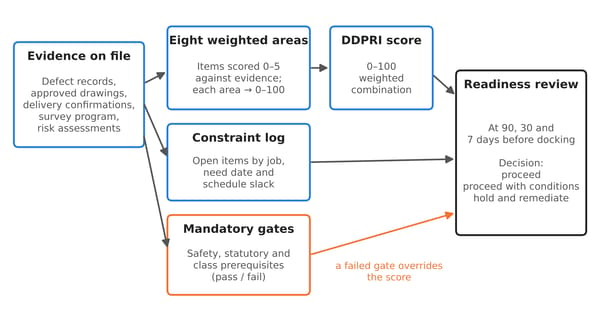
Figure 1. Pre-docking governance under the proposed Dry-Docking Project Readiness Index. Evidence feeds the weighted score, the constraint log and the mandatory gates in parallel, and all three inform readiness reviews at 90, 30 and seven days before docking. A failed mandatory gate overrides the numerical score. Weights and decision thresholds are illustrative and require validation. (Original figure by the author.)
To show how this works, take a hypothetical case. A 15-year-old bulk carrier is booked for an 18-day renewal-survey docking with a direct budget of $1.2 million. As a bulk carrier, she falls under IMO's Enhanced Survey Programme Code, as amended, which requires a survey program agreed with class well in advance, close-up surveys and thickness measurement by an approved firm.
Thirty days out, the index stands at 72, an assumed illustrative value built from the eight area scores. That sounds tolerable; the constraint log says otherwise.
Four of seven open items have two days of slack or less, and all of them affect work in the first three days: freight for the seal kit, class comments on the steel drawings, ballast tank access for the close-up survey, and customs clearance for owner-supplied spares. The survey gate cannot be passed. The right decision is to hold those items and fix them.
Seven days out, with the drawings approved, freight booked, the survey program agreed and all mandatory pre-arrival gates satisfied, the index reaches 91.5. Management authorizes the project to proceed with one recorded condition: the superintendent must appoint a coating inspector before hull blasting begins on day eight, with escalation to the technical manager if that slips. Activity-specific safeguards still apply on the day.
Any weighting scheme involves professional judgment. Sensitivity testing should therefore be part of developing the framework, to check whether reasonable changes in the weights would alter readiness classifications or management decisions. Only validation on real dockings can establish whether the index is reliable and predictive.
The money follows quickly. Assume each extra day costs about $30,000 in additional yard charges such as dock hire and services, plus $20,000 in lost net earnings or off-hire exposure, depending on the charter.
Counting each cost once, an avoidable day costs about $50,000, so $100,000 spent on extra superintendent time, expedited freight or a pre-docking inspection pays for itself if it prevents two days of delay. The figures are illustrative, not evidence of savings.
There is also a regional reason to take this seriously. Ships trading to Australia and across the Indo-Pacific often dock far from their technical offices, at the end of long supply chains for spares and service engineers.
Since June 15, 2022, Australia has required international vessels to answer biofouling management questions in their pre-arrival reports. That turns hull cleaning and coating decisions made in drydock into compliance decisions with consequences weeks later. Pooled, anonymized readiness records could eventually support voluntary benchmarking across the region, without a new certificate or regulator.
A word of caution. Donald Campbell's 1979 work on performance measurement offers a useful warning: once management rewards a numerical score, teams may concentrate on improving the number rather than the operation behind it. In drydocking, that could mean leaving necessary repairs off the list or closing open items too early. The readiness index must remain a planning tool, never a performance incentive.
The weights are a starting point, not a finding. The next step is to pilot the index on real dockings, check that two assessors reach the same score from the same evidence, and compare readiness at the gate with what happened in the dock. I would welcome owners, managers and yards willing to try it.
The cheapest day in drydock is the one you never need. Most of those days are won or lost long before the ship arrives.
Supplementary worked example
Area scores are assumed illustrative percentages for the hypothetical bulk carrier; they are not project data. The index is the sum of each area score multiplied by its weight, for example 0.20 × 75 + 0.20 × 60 + … + 0.05 × 70 = 72.0 at 30 days. The underlying item scores and evidence are not shown; the table demonstrates aggregation only.
| Readiness area | Weight | 30 days out | 7 days out |
|---|---|---|---|
| Technical condition | 20% | 75 | 90 |
| Class and regulatory preparation | 20% | 60 | 95 |
| Scope and specification | 15% | 70 | 90 |
| Procurement and logistics | 15% | 65 | 90 |
| Schedule and resources | 10% | 80 | 90 |
| Safety and environment | 10% | 90 | 95 |
| Commercial arrangements | 5% | 85 | 90 |
| Coordination between the parties | 5% | 70 | 90 |
| Weighted DDPRI | 100% | 72.0 | 91.5 |

that matters most
Get the latest maritime news delivered to your inbox daily.
Naeem Akhtar, CEng, CMarEng, is a chartered marine engineer and marine surveyor based in Seattle. A former chief engineer, he has more than 17 years of experience in ship operations, drydocking and classification surveys. He holds an MBA in business analytics. The views expressed are his own.
The opinions expressed herein are the author's and not necessarily those of The Maritime Executive.
The opinions expressed herein are the author's and not necessarily those of The Maritime Executive.