

Op-Ed: Rising Demand for Batteries Exposes Gaps in Shipping Regulations
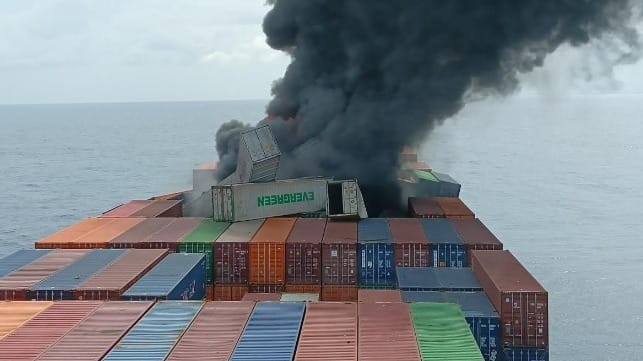
The growing presence of lithium-ion (Li-ion) batteries as cargo is reframing the risk profile of global cargo flows. As the demand for technologies powered by Li-ion batteries accelerates, McKinsey & Co. expects a global battery market size of 4.2 TWh in 2030 and 6.8 TWh by 2035, with more than 85 percent of this demand driven by Li-ion batteries. For carriers, insurers and logistics partners, this trend creates a clear challenge. As volumes rise, the safe stowage, segregation and transport of these cargoes must be supported by effective monitoring, clear emergency preparedness and a shared understanding of the risks involved.
The risk profile
The risks of these battery systems are well understood, with Li-ion batteries presenting two distinct challenges. The first is the speed and severity of a fire once one starts, and the second is the fact that under Special Provision 188 (SP 188) of the IMDG Code, large quantities of smaller cells and batteries can move through the transport chain without a dangerous goods declaration being required. Each of these issues is serious on its own, but together, they create a hazard that is hard to isolate, hard to extinguish, and nearly impossible to diagnose afterward.
Although Li-ion battery failures are relatively infrequent, when they do occur, the consequences can be out of all proportion to the size of the individual cell or battery. A cell that is damaged, defective, overcharged or exposed to heat can enter thermal runaway. This process denotes a self-accelerating reaction in which rising temperature drives further chemical decomposition, generating more heat.
Heat then has the potential to pass to neighboring cells, and in a densely packed box, one failure can create a domino effect throughout the ship’s cargo. Some cargo fires may provide warning in the form of smoke or a progressive rise in temperature; thermal runaway events, however, can develop rapidly and may be difficult to detect at an early stage.
Fighting thermal runaways poses distinct challenges because the fire is self-sustaining. Therefore, extinguishing the visible flames does not stop what is happening inside the battery, and re-ignition remains a risk. Effective cooling is therefore critical to limiting propagation, with water providing an important means of removing heat where it can be applied effectively.
The IMO's Sub-Committee on Ship Systems and Equipment (SSE 12) has finalized draft SOLAS amendments on portable infrared thermal imagers and water mist lances for containerships. These are welcome additions, but equipment alone is not enough. If the crew does not know that a container holds Li-ion batteries, or in what quantity, meaningful decisions on emergency response become much more difficult.
This is not only a containership problem. On vehicle carriers and Ro-Ros, the concern is not that electric vehicles (EVs) catch fire more often than conventional ones, but that thermal runaway, re-ignition and toxic gases make an incident far harder to manage, particularly with secondhand EVs whose battery condition is unclear. Batteries hidden in scrap cargo, mixed into scrap metal and e-waste on bulk carriers, can also be damaged during handling or compaction, creating severe firefighting challenges due to cargo volume, accessibility and ship stability.
A clear regulatory gap
The IMDG Code regulates Li-ion batteries as dangerous goods. SP 188 provides conditional relief from a number of the Code’s requirements for smaller cells and batteries (up to 20 Wh per cell and 100 Wh per battery), provided testing, packaging, marking and short-circuit protection criteria are met. When those conditions are satisfied, the cargo requires no dangerous goods declaration.
The difficulty is that SP 188’s safeguards apply only at cell, battery and package level. A joint submission to the IMO’s Sub-Committee on Carriage of Cargoes and Containers (CCC 12), backed by several flag states, international industry organizations and P&I clubs, put it plainly: “Whilst SP 188 contains package-level limits and safeguards, there is currently no equivalent limit on the total quantity of batteries that may be loaded within a single freight container.”
The Cargo Incident Notification System (CINS) has reached the same conclusion. In a recent recommendation paper, CINS stated that SP 188 no longer fully meets the safety and traceability needs of current maritime and port operations.
The point is not that every battery shipped under SP 188 is unsafe, but that compliance on its own does not provide carriers with the necessary information about the cumulative exposure. For instance, some 4,200 laptops, each with a 99 Wh battery, can be loaded into a single 40-foot container, as every battery qualifies for SP 188. Together, they hold around 416 kWh of stored energy, in a box that arrives at the quay with no declaration and no placard.
Closing the supply chain visibility gaps
The safe carriage of Li-ion batteries cannot be treated as a maritime issue alone. It depends on information flowing through the entire supply chain, from manufacture and booking to transport, terminal handling, warehousing and final delivery.
The gap is just as wide ashore. A recent white paper by UK P&I, TT Club and Brookes Bell, Warehouse Storage of Lithium-ion Batteries, found that there are no mandatory global standards governing how Li-ion batteries are stored. Processes rely on voluntary guidance, and liability is established via non-standardized contracts.
Regulation is adapting to address these inconsistencies. The joint submission to CCC 12 proposed consideration of a cargo transport unit (CTU) level threshold, based on gross mass or watt-hours, above which dangerous goods documentation and potentially placarding would apply.
However, any change will come through IMDG Code amendment cycle 44-28, which enters into force on a mandatory basis on January 1, 2030. That leaves more than three years in which the gap remains open. The most effective mitigation in the meantime is the voluntary adoption of the enhanced controls CINS has already set out.
For shippers, mitigation starts with complete honesty and transparency during the booking process. The presence and quantity of Li-ion batteries should be declared at booking even where SP 188 does not require it. The CINS guidelines treat this as a minimum. UN 38.3 test summaries should be available on request. Damaged or defective batteries must be handled in accordance with SP 376, while batteries transported for disposal or recycling are addressed under SP 377; neither category should be treated as an ordinary SP 188 shipment.
For carriers and terminals, cumulative battery content per container should be treated as a risk factor in its own right. CINS recommends capping SP 188 relief at a 20 kg gross battery-mass threshold per CTU (and requiring mandatory declarations even below that threshold). While that is an industry recommendation rather than an IMDG Code requirement, it provides a sensible benchmark until regulation catches up.
Vague or unusual cargo descriptions deserve closer scrutiny and know-your-shipper checks. Containers declared to hold batteries should be flagged on the load list so that stowage planning and emergency preparedness reflect the real hazard in cargo, supported by random tailgate inspections and thermal imaging before loading.
Ultimately, SP 188-exempt cargo should never be treated as low risk simply because it arrives without a declaration. Whether cargo sits in a warehouse, a terminal stack, or a ship’s hold, the underlying hazard is the same. Closing the visibility gap requires every party in the supply chain to assess exposure independently, with damaged or suspect units quarantined, temperatures monitored, and firefighting protocols clearly defined.
A shared responsibility across all industries
Closing these gaps is beyond the control of a single party, which is why collaboration across the supply chain is so important. Through the Safetytech Accelerator's Cargo Fire & Loss Innovation Initiative (CFLII), the UK P&I and TT Clubs are working with shipping lines and technical experts to evaluate earlier detection, from multi-sensor systems to infrared monitoring and fiber-optic heat detection.
However, prevention is better than the cure, making accurate information and identification critical at every stage. Even when incidents do occur, accurate cargo information supports an effective response, helps establish the root cause and strengthens any subsequent recovery.

that matters most
Get the latest maritime news delivered to your inbox daily.
Products and equipment containing Li-ion batteries are part of the fabric of our everyday lives, from personal devices to the infrastructure around us. As this continues, we need to make sure that these cargoes are carried and stored with the right information, appropriate safeguards and a level of preparedness to mitigate risks, wherever they are in the supply chain.
Akshat Arora is Regional Loss Prevention Director at UK P&I.
The opinions expressed herein are the author's and not necessarily those of The Maritime Executive.