


Yemeni War Intensifies with No Winner in Sight
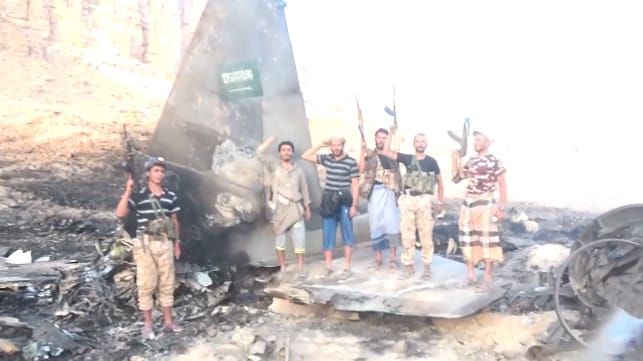
Fighting in Yemen is intensifying and spreading to Saudi Arabia as the Houthis seek to deter further Saudi support for Yemen’s Internationally Recognized Government (IRG). But conversely, the broadening of Houthi attacks appears to have strengthened the resolve of both the Saudis and the Yemeni populations of areas that the Houthis are trying to seize – which largely fall outside the traditional areas where the Houthis have commanded support from those with whom they share religious and tribal affinities.
Trustworthy information about what is happening on the ground in Yemen is difficult to find, the airwaves being dominated by propagandists and fake news. The most reliable source is @BashaReport, which has excellent access to local sources, checks reports out carefully, and only publishes verified information.
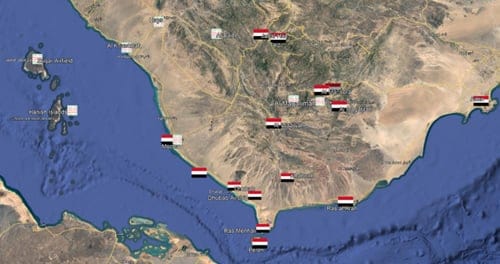
Houthi and Yemeni Government positions in SW Yemen as noted in reporting on October 8; the situation on the ground is settling into a stalemate and a prolonged war. (Google Earth/CJRC)
The IRG appears to have consolidated its hold on the SW coastal strip of Yemen, having retaken Perim Island and the Ras Menhali peninsula, overlooking the narrowest part of the southern Red Sea at its narrowest point, the Bab el Mandeb. This in itself is a major recovery gain for the IRG - and for the global maritime community, as it reduces the potential threat to shipping seen in the past from short-range weapons and from small craft.
But whereas the IRG had briefed several days ago that the goal of the IRG was to advance north to seize Hodeida, the Houthis’ principal trade window to the outside world, progress northwards appears to have ground to a halt. It is still not clear if the IRG has fully secured the port of Mocha, halfway to Hodeida, and instead the IRG is trying to secure more of the hilly territory to the east, which overlooks and dominates the coast and the Tihama Plain. The situation on the coastal strip is still far from settled.
Elsewhere, the Houthis are pressing hard to isolate and then capture Taiz, which, before the war, the Houthis had already surrounded on three sides. So far the Houthis have faced stiff resistance from a population with whom they have a long-standing adversarial relationship, both on tribal and religious grounds. But the Houthis have tightened their grip and may be able to impose a siege; again, the situation is very fluid, and the outcome is uncertain.
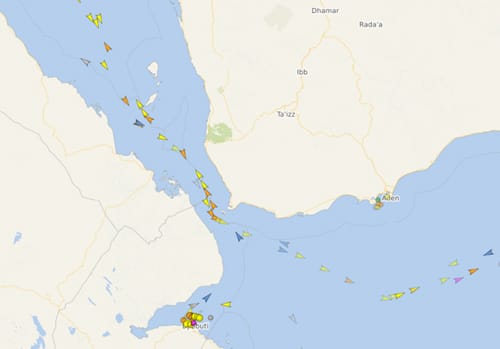
Traffic through the Bab el Mandeb early on October 8 looks as if it is slightly heavier than in recent days, but still reduced from levels seen on September 24 (VesselFinder).

that matters most
Get the latest maritime news delivered to your inbox daily.
Further afield and across all fronts, Saudi airstrikes are taking a toll on Houthi forces, and the Houthis have responded by increasing the intensity of their ballistic missile threats on Saudi Arabia and broadening the target set, and have also threatened to use more indiscriminate wide-area fragmentation warheads, which inevitably would increase civilian casualties.
Regrettably, for the maritime community, this intensification of the war threatens only an increased risk to shipping, with no end in sight. The Houthis are likely to try and increase pressure on the IRG, their Saudi backers, and a broader coalition now mobilizing to face the Houthis down. This is likely to translate into an increased risk to shipping in the Red Sea, and also to civil aviation using air corridors over Saudi Arabia.
