


Video: China Coast Guard Uses Water Cannon During Philippine Medevac
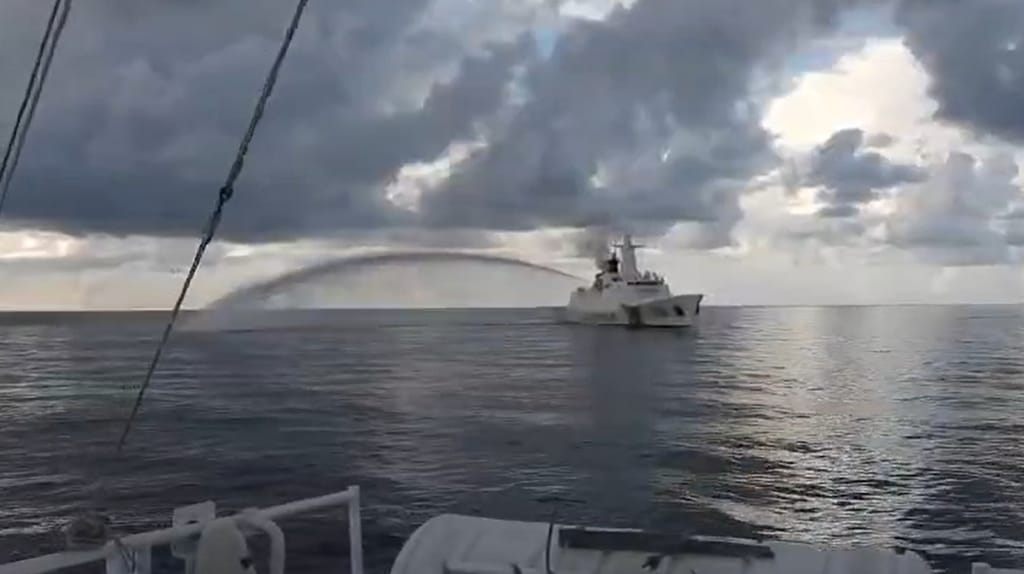
The Philippine Coast Guard has reported another dust-up at Second Thomas Shoal, where the Philippine Navy maintains an outpost aboard a deteriorating shipwreck in order to deter Chinese expansion within Manila's exclusive economic zone.
Second Thomas Shoal has been an on-again, off-again flashpoint for tensions between Philippine and Chinese forces in the Spratly Islands since at least 1999, when the Philippine Navy intentionally grounded the WWII-era landing ship BRP Sierra Madre on the reef to serve as a base. The service has maintained a small detachment of marines on board the wreck ever since, and the periodic resupply and rotation missions to and from the shoal are a recurring source of friction. In times of heightened diplomatic tension, the China Coast Guard has often attempted to prevent PCG personnel from reaching the station, periodically adopting forcible methods like aggressive maneuvering and water-cannoning.
The latest encounter occurred on October 8, according to PCG spokesman Jay Tarriela. A Navy servicemember aboard BRP Sierra Madre was in need of medical attention and required evacuation from the station, and the PCG was tasked with mounting a medevac mission. On Thursday morning, the patrol vessel BRP Cabra departed Lawak and got under way for Second Thomas Shoal. At about 0730 hours, Cabra arrived at a position about nine nautical miles away from the reef, where it encountered a familiar presence: China Coast Guard cutter CCG 5306. The CCG crew turned on their water cannon and closed the distance to Cabra, approaching to within 400 yards, Cabra's crew reported. The Chinese cutter's maneuvering prevented further progress towards the Philippine base.
In order to avoid getting hit by the water cannon, BRP Cabra stayed about 13 miles offshore and waited. The crew had hoped to conduct a rendezvous and transfer closer to the patient, but this was not possible because of the Chinese presence, Tarriela said.
By early afternoon, the situation had not changed. To adapt, Cabra's crew launched a team in its RIB boat, and the BRP Sierra Madre station dispatched two inflatable rubber boats with the patient and escort personnel. They met up about four nautical miles off the reef and transferred the patient between boats. Throughout the evolution, CCG small boats and cutters harassed the PCG boat crews, Tarriela said, using "dangerous" maneuvers. Other Chinese vessels involved or in the area included CCG cutters 5009 and 21585, plus the PLA Navy frigate Yongzhou (628) and one maritime militia fishing vessel.
After bringing the patient safely aboard, the Cabra's crew provided him with a checkup and with IV fluids, then got under way to deliver him to shore for a higher level of care.
According to the PCG, the CCG's interference delayed the medevac for hours and created danger for Philippine personnel and the patient. In a statement, Tarriela also highlighted the root of the longstanding sovereignty dispute: China claims a right to control navigation within the western Philippine EEZ, despite a 2016 international arbitral ruling to the contrary.
"When a life is at stake, there should be no water cannon, no obstruction, and no delay. Saving a sick or injured person at sea is a basic obligation that every coast guard in the world is expected to uphold. We call on the CCG to value and respect humanitarian missions moving forward, and to act in a manner consistent with international law and the professional standards expected of any coast guard," PCG Commandant Admiral Ronnie Gil Gavan said in a statement.

that matters most
Get the latest maritime news delivered to your inbox daily.
As in prior incidents, the China Coast Guard claimed that it had permitted PCG units to access Chinese territory within the Philippine EEZ.
"China on Thursday allowed the Philippine Coast Guard vessel 4409 to evacuate an injured person from a Philippine vessel illegally grounded at [Second Thomas Shoal], permitting a small-boat transfer on humanitarian grounds, and the China Coast Guard (CCG) handled the operation in accordance with the law and provided necessary assistance," CCG spokesperson Jiang Lue told state-owned Chinese outlet Global Times.
