
Ningbo-Zhoushan Tops Singapore as World’s Second Busiest Container Port
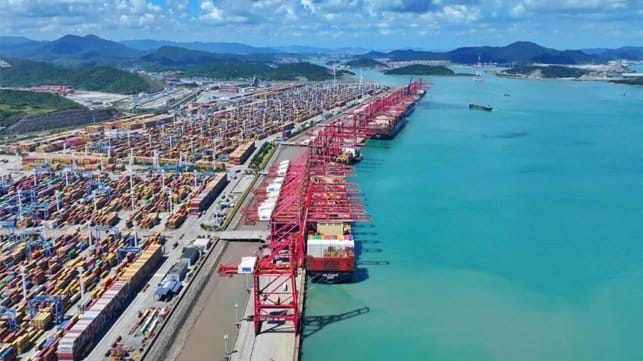
China’s ports are continuing to support the expansion of the country’s exports despite the Trump administration’s efforts at tariffs. China now has six of the top 10 ports by volume, according to Alphaliner’s latest rankings, and in a surprise move, the Ningbo-Zhoushan port complex edged out Singapore for the position of the world’s second busiest port.
Officials at the Zhejiang Provincial Seaport Group and Ningbo-Zhoushan Port Group highlighted that they had fully implemented their plans to strengthen work style and efficiency. The port complex has continued its rapid growth. It finished 2025 only about 800,000 TEU behind Singapore, and with the continued growth, it has now edged out Singapore and slipped into second position on Alphaliner’s Top-30 chart for global port throughput.
Ningbo-Zhoushan is growing at nearly twice the rate of Singapore, with the chart showing 8.8 percent growth for throughput in the first half of the year versus 4.7 percent for Singapore. Both ports showed slowing growth rates versus 2025, but still Ningbo-Zhoushan ended up ahead by 158,310 TEU.
The expectation is that the two ports will continue in a neck-and-neck race for the remainder of the year. However, China’s growth rates continue above those of most other countries.
Shanghai remains firmly atop the list at more than 28.7 million TEU, according to Alphaliner’s data. Last year, Shanghai broke the 55 million TEU mark for the first time, with officials pointing to the efficiency from the increasing levels of automation in the port. In July, recovering from the impact of a typhoon, Shanghai reported it smashed the record for a single-day volume, moving nearly 204,000 TEU.
China’s Shenzhen, Qingdao, Guangzhou, and Tianjin were also among the 10 busiest container ports in the first half of 2026. Tianjin also showed strong growth, helping it to edge out Busan by nearly 400,000 TEU over the six months to move up one spot, claiming number 7 on Alphaliner’s table.
Analyzing the changes, Alphaliner says the half-year data “shows the widespread impact of geopolitical trends on the global container market, as carriers adjusted their networks in reaction to the Middle East conflict and shippers responded to the US tariff policy.”
It highlights the most significant drops were in the Middle East, where the war and the closing of the Strait of Hormuz dramatically impacted the fortunes of Dubai’s Jebel Ali port and Abu Dhabi’s Khalifa Seaport. Jebel Ali’s volumes, they report, plummeted over 90 percent to just 374,000 TEU for the second quarter and 3.14 million TEU for the six months, which was down 23 percent.

that matters most
Get the latest maritime news delivered to your inbox daily.
As a result, Jebel Ali fell out of the top 30 ranking to 32nd place. Similarly, Khalifa Seaport fell from its previous position of 32nd out of the top 50 reports by Alphaliner. They note exact numbers have not been published, but they believe based on wider group results that Jebel Ali’s volumes fell at least 50 percent.
Most of the other global ports retained the order in the ranking or moved up or down one notch. Combined, the Port of Los Angeles and Long Beach came in again at number 9, handling just under 10 million TEU in the first half of the year. They are the only U.S. port to be in the top 10, with the Port of New York and New Jersey a distant second, falling one notch to 22 on the chart. It handled 4.4 million TEU, which was relatively stable compared to 2025.
