
Iran's Floating Oil Storage Shrinks to Five-Month Supply
Analyst and media commentary on Operation Economic Outcast, US Treasury Secretary Bessent’s plan to squeeze Iran financially, has focused on how long it will take for the effects of his squeeze to have a decisive impact on the Iranian political leadership. There is some skepticism abroad.
Much of the commentary has been speculative, and has focused on how complete a blockade on Iran would be. But the blockade and sanctions measures taken do not have to be 100% effective to exert decisive pressure. The watch on oil movements maintained by Kpler provides a basis for estimating when the Iranian regime will be forced to either escalate the war or come to terms; a point will come when it will no longer be possible to ignore the impact of Operation Economic Outcast.
The US naval blockade of the Strait of Hormuz is proving to be 100% effective. Iran is no longer able to load oil at Kharg Island, having run out of shipping capacity to hold the oil afloat, as tankers are unable to exit the Gulf. Only one VLCC tanker has loaded at Kharg during August. A similar story prevails for petrochemical biproducts and derivatives; without further storage space on product tankers, refineries in Iran will soon be forced to close down and lay off their workforces.
Exports to China, which traditionally has taken 90% of Iranian exports, now therefore need to be drawn from the Iranian stockpile built up before the war, a stockpile held afloat off Malaysia and China. According to Kpler, Iranian oil stocks afloat appear to have declined from 192 million barrels in mid-April to about 80 million barrels at the end of August. The fall in stocks is lower than previously predicted, because China has cut back its Iranian crude purchases, plus the amount of GCC oil leaving the Gulf and American production has increased, providing alternative sources to meet Chinese demand. Nonetheless Kpler analyst Homayoun Falakshahir reckons that at current discharge rates, and with cargos paid for two months after discharge, receipts from Iran’s export reserve afloat will dry up early in the New Year.
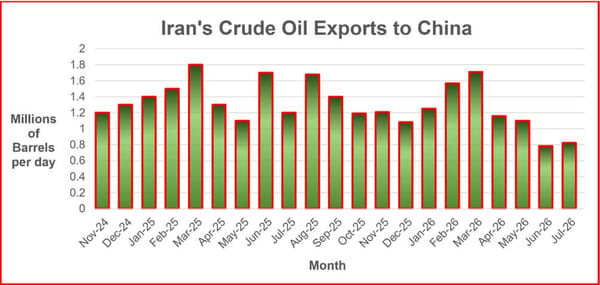
Chinese purchases in the last two months have fallen to the lowest level in many years and will drop sharply further in August, mostly bought from floating storage built up by Iran before the war (Kpler/CJRC data)
The US Administration appears to have accepted that it needs to live with the damage which will be done in the Mid Term Elections if it persists with the war – postal voting has in any case already started. But the longer the crisis goes on, the better able global markets will be able to adapt to life without Iranian production – or indeed Qatari LNG. Already, GCC exports are at 9mbd, about 65% of pre-war volumes, and this percentage will only rise as expansion to pipeline capacity avoiding the Strait comes on line.
To relieve the pressure, Iran can be expected to try and trade an opening of the Strait of Hormuz, on terms being negotiated between Oman and Iran bilaterally, against a lifting of the blockade on Iranian shipping. But that bargain has declining purchase, especially if Iran still seeks to limit who can use the Strait or tries to charge passage fees (as opposed to navigation dues). In any case, the United States is already facilitating ship movements through the Strait on its own terms.

that matters most
Get the latest maritime news delivered to your inbox daily.
Iran of course has tremendous expertise at avoiding sanctions and their effects. Already, the doomsday predicted for mid-year has been averted. But the sanctions and the blockade does not need to be complete to bring about a drastic shortage of the resources needed to keep the security state functioning and effective. With all trade and financial exchanges with the UAE supposedly ended - more likely curtailed - the remaining backdoor channels to Russia and China are long and exposed. Only limited trade can be switched to trucks crossing the Iraqi and Turkish borders – and those routes too vulnerable to interdiction.
It also seems unlikely that global support for Iran will grow – the ships of too many nations have been attacked by Iran, and Iran’s track record of destabilizing governments across the region is unlikely to have won many friends, especially when Secretary Bessent is advertising that he is compiling a target list to “tighten the noose and block every potential source of revenue that funds the IRGC and the Iranian regime.” Flights to Iran, ship registries hosting the Iranian dark fleet, those supporting ship-to-ship transfer operations and banks facilitating the transfer of funds to pay for cargoes, are all likely to be targeted, with cumulative effect. As the Kpler analysis concludes, Iran can carry on with the status quo for a short while. But as the pressure builds it will be forced either to escalate the conflict – and invite counter-attack – or consider its negotiating position, if the IRGC hardliners are to ensure their own survival.
The opinions expressed herein are the author's and not necessarily those of The Maritime Executive.
