

Huge Drone Raid on Ust-Luga Covered an Attack on Russian Corvette
The Russian oil and gas terminal at Ust-Luga was on the receiving end of a massive Ukrainian drone strike in the early hours of November 11. The port was targeted in a coordinated series of strikes in recent days that have also struck Russia's five biggest oil refineries at Omsk, Kirishi, Ryazan, Nizhny Novgorod and Yaroslavl, and two smaller refineries at Novokuybyshevsk and Saratov. These are all targets which have been attacked previously, and taken together, the wave of strikes will have a significant impact on the availability of petrol and diesel as the Russian winter closes in.
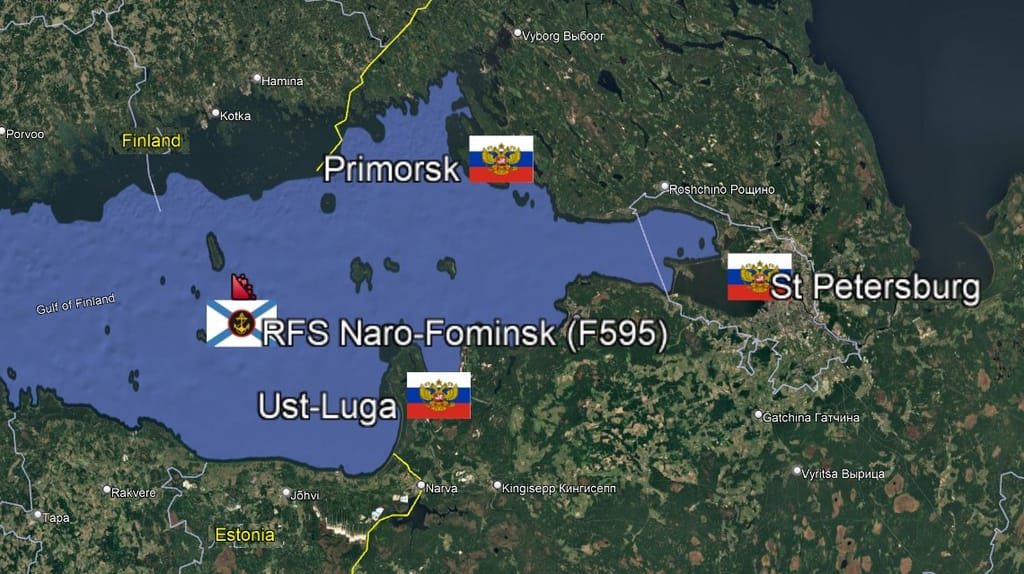
In what the Ukrainian General Staff said was a separate operation, but one which clearly exploited the engagement of Russian air defenses elsewhere, Ukraine's SBU intelligence service also attacked the Buyan-M-class corvette RFS Naro-Fominsk (F595) in Russian territorial waters south of the Russia-owned island of Suursaari. The attack took place 28 miles south of the Finnish coast. Estonian defense sources said after the attack smoke was seen coming from the corvette, which withdrew towards St. Petersburg.
Buyan-M-class corvettes are clearly deficient in close-in anti-drone air defenses, but they are equipped with Kalibr and Oniks long-range land-attack cruise missiles, against which the Ukrainians have few defenses. The Buyans are designed for coastal and shallow-draft operations, and can make their way through the Volga-Baltic Waterway, past Moscow, then through the Volga-Don Canal system to either the Caspian or the Black Sea. Hence the Ukrainians appear to have disabled a system which could have been used directly to attack targets in Ukraine.
Hence Buyan-M-class corvettes are attractive targets, and RFS Grad (F575) was attacked in the southern half of Lake Onega, midway between St. Petersburg and the White Sea, as it was making its way from the Baltic Fleet to join the Black Sea Fleet in early October last year.

that matters most
Get the latest maritime news delivered to your inbox daily.
Mounting an attack in the Gulf of Finland is fraught with political and diplomatic risks, but facing an onslaught of Russian missile attacks targeting electricity infrastructure in particular as winter closes in, the Ukrainians may have felt they had no choice. Finland has warned Ukraine not to attack targets in what is a busy shipping channel used by merchant ships from both Finland and Russia. The Gulf of Finland is also used by important internet and electricity interconnectors, important to Finnish national security and also that of the Baltic States.
The Estonians are somewhat more phlegmatic, acknowledging that a drone had intruded into their airspace, but that there had been too much risk of collateral damage to engage the drone and shoot it down. The Russians will seize upon the incident to suggest that NATO is actively complicit with Ukraine in its attacks on strategic targets in the Russian motherland.