

Russia Deepens its Attacks on Black Sea Shipping
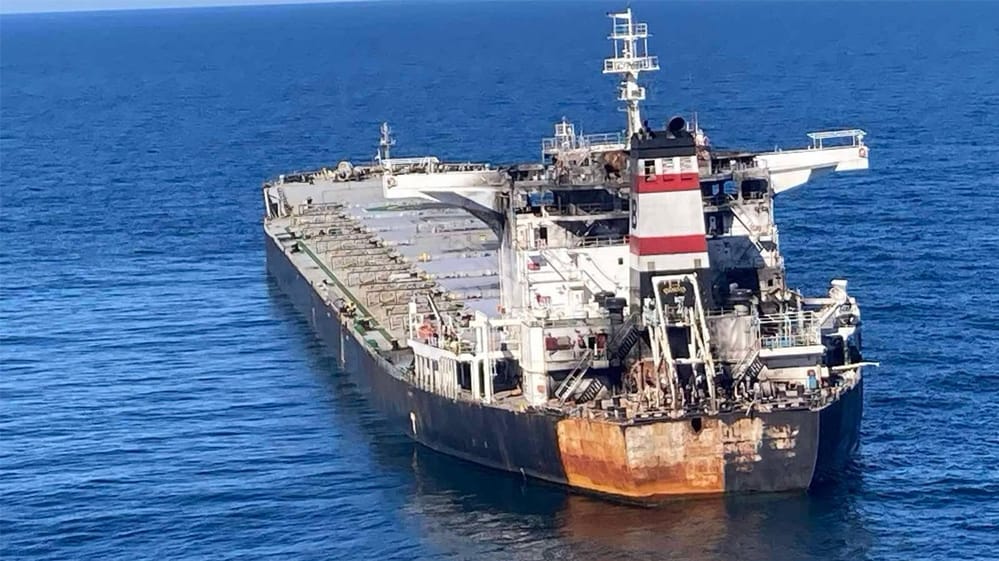
October was a bad month for Russian attacks on shipping hugging the western coast of the Black Sea. But November is beginning to look even worse.
Attribution of attacks is not an exact science. But excluding attacks on ships in Ukrainian territorial waters, and on port infrastructure in Ukraine, there were probably at least eight attacks carried out on shipping in the Romanian and Bulgarian territorial waters, and several more on ships within the two countries' exclusive economic zones (EEZs) during October.
Moreover, in comparison with strikes in the Strait of Hormuz area, there has been a much higher casualty rate on the targets in the Black Sea, with fatalities being caused in most attacks. Little attempt is apparently being made to disable ships, and the intent appears to be to destroy and sink ships rather than simply to deter.
The ships hit in these attacks in October include the San Marino-flagged chemical tanker Wine Trader (IMO 8808707), the Turkish-flagged cargo ship Royad Mammadov (IMO 9356969), the Comoros-flagged chemical/oil products tanker Yara J (IMO 9221803), the Marshall Islands-flagged bulk carrier Sea Destiny (IMO 9454175), the Guinea-Bissau-flagged HS Dignity (IMO 9545912), the Maltese-flagged Chelsea-3 (IMO 9361392), the Palau-flagged Able/AEL (IMO 9001136), the Togo-flagged Alpha Watan (IMO 7510884), and an unnamed Comoros-flagged ore and oil carrier. The Greek-owned containership Contship Jet (IMO 9348625) was sunk in Bulgarian waters on October 29, en route from Haifa to Bulgaria. On these vessels alone, 24 crew members were killed.
The attacks have ramped up in November. Attacked in the same waters just in the first half of this month have been the Palau-flagged Larissa 1 (IMO 9154268), the Greek-flagged Evia Petrol V (IMO 9358503), the St. Kitts & Nevis-flagged Marsol (IMO 9109512) and Ali Najafov (IMO 9175195), and the Somali-flagged Betul 8 (IMO 8817198), which was attacked on November 16 while carrying wheat from Romania to Egypt. On November 17, the Liberia-flagged LPG tanker Gas Husky (IMO 9507764) was sunk 55 nm off Varna while shipping LPG from Alexandria to Romania.
As the attacks increased in intensity, there has been some initial reluctance to identify the perpetrators responsible, on the calculation that this perhaps would inflame matters. But this has proven to be a false premise. Of late, as attacks have continued, Bulgarian and Romanian authorities have recovered drone and missile debris from ships proving Russian origin, and have also recognized that attacks were taking place within territorial waters – often against ships which were avoiding Ukrainian waters altogether and only visiting Bulgarian and Romanian ports.
Under the terms of the United Nations Convention on the Law of the Sea (UNCLOS), a coastal state has no security responsibility for the safe passage of a vessel through its EEZ, which falls instead to the flag nation. A coastal state exercises full sovereignty over its territorial waters, so an attack in territorial waters on a vessel conducting innocent passage is considered in the same light as an attack on the soil of the state. But at the same time, the littoral state is not required to defend such a vessel.
Although under UNCLOS this situation is ambiguous, a littoral state cannot in practice be obligated to take on the defense of ships traveling on innocent passage through its territorial waters when these ships have not needed to ask permission before entering those waters. However, when a ship is not on innocent passage and is visiting a port within the territorial waters of the sovereign state, this is a more flagrant and direct breach of sovereignty.
As yet, however, if either Romania or Bulgaria, or indeed NATO, has taken active countermeasures to foil these attacks, the Russians do not appear to have noticed, and certainly attacks have not been curtailed. NATO, and Romania in particular, have increased maritime surveillance and have launched combat air patrols to monitor the situation, but have not as yet engaged targets which appear to be threatening shipping either in the territorial or EEZ waters of NATO member states.
NATO has a preference for taking diplomatic countermeasures rather than active responses, and in the past the diplomatic approach has worked. However, there is no escaping the reality that Russian attacks in recent months are killing seafarers, often in territorial waters, and whatever the NATO response, it has not been effective.

that matters most
Get the latest maritime news delivered to your inbox daily.
One suspects that this will not be a matter raised in the forthcoming trilateral meeting of world leaders at the APEC summit in Shenzhen. Hence, Russian action is on balance likely to escalate rather than diminish, and the character of the NATO response is likely to embolden Russian direct action elsewhere – particularly now that the prestigious Kerch Bridge target has been successfully attacked, which will enrage the Russians.
This is also a matter for flag states, whose nationals and others sailing under the protection of the flag are being killed. Some of these flag states enjoy good relations with Russia, and are clearly keener on protecting these relations with Russia rather than protecting the lives of seafarers. Russia is proving adept at exploiting moral vacillation among many – but thankfully not all – of its adversaries.