


Neptune Robotics Expands Hull Cleaning Services to Ningbo and Zhoushan
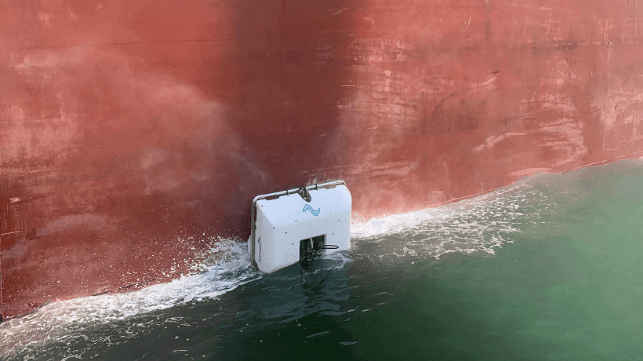
Neptune Robotics, founded in Hong Kong in 2018, is a world leader in robotic cleaning of ships hulls using advanced algorithms. Now based in Shenzhen, China’s leading technological hub and incubator of many successful technology companies, Neptune has rapidly risen from an R&D set utartup in 2018 to a well-established robotics company in 2022, with more than 60 in-house engineers and scientists. In the last two years, Neptune has cleaned over 150 ships in the ports and anchorages of Guangzhou, Yantian and Shekou. Early adoptors include CMA CGM, COSCO and international ship management companies, amongst others.
The company is well-funded by top venture capital investors and has now built enough hull cleaning marine robots to expand its services to the ports and anchorages of Ningbo and Zhoushan. The plan is to expand to all major ports and anchorages in China, then Europe and the US.
The timing of the expansion is no coincidence, as shipping is coming under increasing pressure to reduce greenhouse gases (GHG) through reductions in fossil fuel consumption. Keeping ships hulls and propellers clean is a basic necessity for all ships.
Shipowners and operators know that even a small amount of marine growth on the hull and propeller can easily result in a 10 percent loss of speed, due to increased friction, or, if speed is maintained, an increase in fuel consumption of 30 percent, the so called cubed root rule of speed and power.
Consider the case of a Capesize bulkcarrier with a clean hull and propeller operating at an economical speed of 12 knots for 300 days per year, averaging 40 tons per day of fuel, using 12,000 tons per year for propulsion. If an increase in friction, due to hull and propeller fouling, reduces speed by 10 percent, down to 10.8 knots, it reduces earning days by 33 per year. Alternatively, if the speed is to be maintained at 12 knots, this increases fuel consumption by about 4,000 tonnes. If the ship’s charter hire is $30,000 per day, the 33 lost sea days will cost $1 million per year. If speed is maintained, the extra 4000 tonnes of fuel needed to maintain 12 knots, at $900/tonne, will cost $3.6 million. Keeping vessels clean between dockings really saves money and is common sense.
There are two basic methods to remove the build-up of marine growth on the hull and propeller. One is to drydock earlier than planned and the second is to remove the bui-fouling while at berth or anchorage. The second method is far less expensive, and avoids lengthy offhire periods.
Conventional hull cleaning uses rotating brushes housed in a hydraulically powered cart steered by divers. There are significant drawbacks with this method. Maintaining even pressure on the hull is difficult and the brushes often remove a lot of antifouling paint, along with the marine growth, which reduces its lifetime. Also, divers can only work in calm clear water during daylight, which usually means the ship needs to go to a special location for cleaning, resulting in delays.
Neptune’s electric powered robots offer significant advantages as they use cavitational waterjets to remove the marine fouling, with minimal loss of antifouling paint. The robots use advanced artificial intelligence to self-steer along the hull sides and bottom, maintaining a constant distance between the cavitation waterjets and the hull. Other major advantages are its ability to clean hulls above the waterline and to work at night and at berth while ships are loading or discharging, avoiding any delays. Most impressively, the cleaning robots can clean hulls in the very muddy waters, like those frequently found in Chinese river ports, using sonar. The robots are fitted with powerful lights and cameras and stream the before and after cleaning performance to Neptune’s cloud platform, even when operating in very muddy waters. Clever AI interrogates the data to automatically produce a before-and-after cleaning report, providing details of the types of marine growth found on various areas of the hull.
Neptune Robotics was cofounded by three young entrepreneurs who have built the company from scratch to its present size and leadership in less than four years, using their strengths in advanced algorithms, AI and robotics. The Neptune team has the grit to build the best marine robot and best-trained operation team in the largest ports in the world.
This message is sponsored by Neptune Robotics.
The opinions expressed herein are the author's and not necessarily those of The Maritime Executive.
