


Op-Ed: The Navy Is America’s First Line of Economic Defense
When the container ship Ever Given grounded itself across the Suez Canal in 2021, the economic shock spread far beyond the Middle East. Auto plants in Europe slowed production, grain shipments backed up, and oil prices jumped. A single stuck vessel briefly disrupted nearly 12 percent of global trade. The episode was a reminder that the global economy depends on open sea lanes, and even small disruptions can reach American consumers with surprising speed.
While not the Navy’s sole mission, ensuring freedom of navigation is a foundational responsibility. It keeps sea lanes open, deters coercion, and reinforces the stability that underpins global security. When the oceans are stable, life at home feels normal. Goods arrive on time, businesses plan with confidence, and families follow their routines without worrying about what is unfolding beyond the horizon. Naval success is often measured by what does not happen, the price spikes that never materialize, the shortages that never emerge, and the security shocks that remain distant.
When maritime stability breaks down, the bill arrives quickly. Recent attacks on commercial shipping by the Houthis in the Red Sea forced vessels to reroute thousands of miles around Africa. Longer voyages meant higher fuel costs, weeks of delay, and insurance premiums that rose almost overnight. Those costs did not stay overseas. They appeared in freight rates, retail prices, and supply chain disruptions felt by American companies and households. A conflict half a world away became a line item in a family’s budget.
The vulnerabilities extend below the surface. More than 95 percent of international data, including banking transactions, financial trades, and the communications that keep markets functioning, moves through undersea cables. These cables are thin, exposed, and difficult to repair. A single break can disrupt financial systems in minutes and take weeks to fix. Protecting them is not about dramatic naval battles. It requires persistent presence, monitoring, and the ability to prevent coercion or sabotage before it becomes routine.
Nowhere is this system more concentrated or more vulnerable than in the Indo-Pacific. The region carries the bulk of global trade, energy shipments, and digital traffic. A major disruption there would not remain a regional problem. It would reach American ports, manufacturers, and households with a speed and scale far greater than anything seen in the Red Sea. Gas prices, electronics supply, food costs, and financial market stability all hinge on what happens in those waters.
America’s competitors understand this leverage. China has spent the past decade building naval ships at a pace unmatched in the modern era, supported by state-subsidized shipyards that blur the line between commercial and military production. The objective is not simply to match the United States ship for ship. It is to gain the ability to pressure neighbors, influence shipping routes, and shape market expectations without firing a shot. Harassing vessels, threatening chokepoints, or increasing risk to insurers can move markets long before it triggers headlines.
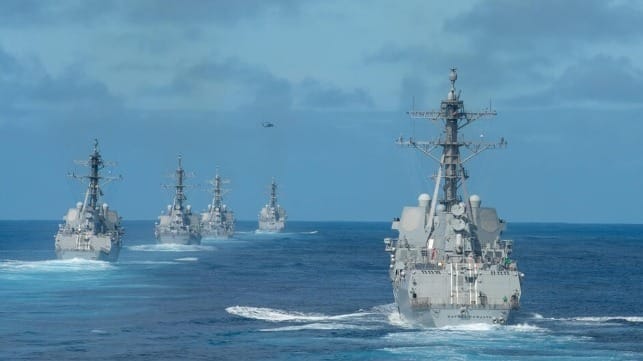
This reality explains why a strong, forward-deployed United States Navy remains essential. It is not a relic of another era or a discretionary luxury. It is the backbone of America’s economic security and the first line of homeland defense.
The newly-released National Military Strategy reinforces this point by emphasizing the importance of maritime stability, industrial resilience, and forward presence as essential to protecting the nation’s economic foundations. By being present early, before a crisis spirals, the Navy pushes risk away from America’s shores and buys time for diplomacy and crisis mitigation. It keeps sea lanes open, reassures allies, and preserves the predictability global markets depend on. In practical terms, it helps keep shipping routes shorter, insurance premiums lower, and supply chains steadier, while also keeping lethal threats far from home.
This also explains why shipbuilding deserves renewed attention. Modern frigates and large surface combatants are not symbols of vanity or militarism. They are the platforms that protect trade routes, safeguard undersea infrastructure, and deter adversaries. They anchor an industrial base of shipyards, welders, and engineers that cannot be regenerated quickly once allowed to decay. Having already lost too much capacity, further decline would leave the United States unable to build the Navy its strategy demands to keep America secure.
Some argue that America should pull back and focus inward. Distance no longer provides insulation. Maritime coercion, cyber operations, and long-range weapons compress time and space. Problems ignored abroad tend to arrive at home faster and at far greater cost. The price of inaction is not theoretical. It appears in shipping delays, volatile energy markets, higher insurance premiums, and the erosion of deterrence that invites further risk.

that matters most
Get the latest maritime news delivered to your inbox daily.
Americans do not wake up worrying about sea lanes or undersea cables. They worry about prices, jobs, and stability. Forward naval power is what keeps coercion abroad from becoming economic pain at home. When it is strong, disruptions stay distant and manageable. When it is weak or absent, Americans pay first at the checkout line and later in far more dangerous ways. Naval power is not a luxury. It is the difference between a global economy that works for Americans and one that works against them.
Capt. Patrick Molenda (USN, Ret.) is the former Director of Warfighting Assessment and Readiness at U.S. Pacific Fleet. He previously served as Commanding Officer of a Maritime Strike Helicopter Squadron, Chief of Staff for Expeditionary Strike Group Five, and Director of the Maritime Advanced Warfighting School at the Naval War College. The opinions expressed are the author’s alone and do not represent any agency or institution.
The opinions expressed herein are the author's and not necessarily those of The Maritime Executive.
