


Op-Ed: In the Strait of Hormuz, Free Transit Is No More
While Tehran has pledged to allow free passage for the next 60 days, the long-term future of the strait is under Iranian control
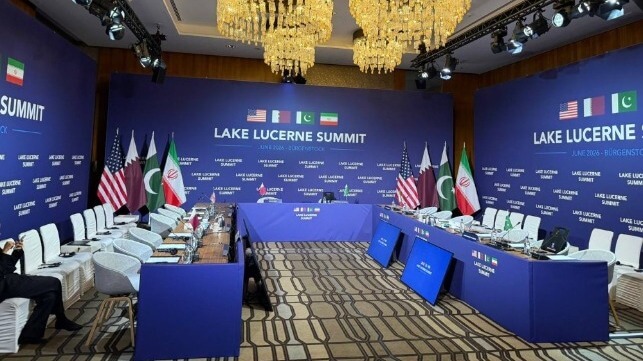
The Memorandum of Understanding (MoU) signed by the leaders of Iran and the United States last week sets the agenda for further negotiations, which, after some delays, have now commenced between the two parties, with Pakistan and Qatar present as intermediaries. The talks are taking place in the Qatari-owned mountainside resort of Bürgenstock in Switzerland.
Political commentators have gone into overdrive, seeking to paint the MoU as a victory or defeat for one side or another. Much remains to be resolved, with plenty of evidence that there is very little meeting of minds on a number of extremely contentious issues. The Iranian delegation is absolutely in no mood for compromise, and is buoyed up by what it sees as its political success so far.
There is a strong likelihood that the talks will break down, and that the negotiations are in effect only an elongation of the pre-existing ceasefire. President Trump clearly wants to walk away from the issue and leave his Vice President to clear up the mess, an impression strengthened by his description of the MoU negotiations in terms of their effect on domestic gasoline prices and inflation rather than on the future of the Middle East. But if President Trump is not engaged in the follow-through, both Israel and the Gulf States most certainly are. Neither is likely to want to allow Iranian hardline positions to prevail, and both have plenty of capacity to sabotage the negotiations in Switzerland if the talks look like threatening their future national security.
While there is a risk of a resumption of fighting, there are already conclusions to be drawn about the outcome of the war — practical realities that leaders and CEOs within the maritime community need to absorb as they shape their business plans.
Free transit through the Strait of Hormuz is no more. Just possibly, a deal will be done in the negotiations whereby fees described as navigation dues will be charged at acceptable levels. Shipowners may not mind, because these are costs that can be passed on; but ministers of business, economy and finance are likely to be very wary of any charges that have the overall effect of increasing prices and reducing the Gulf's competitive advantages.
Much more concerning, though, is the reality that, if current circumstances prevail, Iran will in the future be able to close the Strait again whenever it wants to, on a political whim, as it has demonstrated it can do. It is already trying to ensure that traffic through the Strait uses its own "Persian Gulf Strait Authority" route rather than the internationally recognized Traffic Separation Scheme, so that it may hereafter be able to exert political control over shipping transits. This will force all the GCC states to radically redesign their logistics and communications infrastructure, although some of the alternative routes out of the Gulf carry risks of their own. Also badly affected will be the confidence of foreign direct investors, particularly in Bahrain, Kuwait and Qatar, which have no alternative routes out of the Gulf.
The Houthis have not succumbed to pressure from the IRGC to disrupt traffic in the Red Sea, having their eye at present on the hope of a life-saving financial deal with the Saudis to help rescue the economy of northern Yemen. But the recent war has demonstrated that it would be easy to close the Bab el-Mandeb, and the Houthis have shown themselves to be a resilient enemy; hence the risk of closure, not so far realized, is very real, and would probably have consequences on a similar scale to the disruption caused in the Strait of Hormuz.
The question of the IRGC curbing its regional expansionist program is not even on the agenda at Bürgenstock. Moreover, in the discussions surrounding the negotiation of the MoU, the IRGC made it clear that it would press on with this program. This is immediately evident in Lebanon, where the IRGC has not given up on Hezbollah. But it is also evident in Iraq, where the IRGC appears to be reorganizing to avoid coming under pressure from the new Iraqi government – which is itself under regional and American pressure to curb the obviously Iranian-controlled PMF militias. The IRGC's subversive model, bringing disruption to political stability across the Middle East, has been battered by Israel in particular over the last 12 months. But although damaged, it is still intact; the IRGC's intent remains, and with an influx of money released by the lifting of sanctions, it will flourish again and take on new targets.
Another permanent threat to peace and stability is the survival of a critical mass of the IRGC Aerospace Force's drone and missile capability. A comparison of known drone and missile storage and launch sites against the facilities known to have been attacked in 2025-26 suggests that very few of these sites were left untouched; it is not as if the Iranians had successfully kept their sites hidden. But they were built in expectation of attack, well dispersed, with multiple exits. The speed with which some sites have been repaired suggests that recovery plans and resources had been pre-positioned for just such an eventuality. Moreover, if any funds are released to the Iranians by way of sanctions relief, further repair and enhancement of the more than 40 sites spread across the country will be accorded high priority.
To a degree, the survival of the IRGC Aerospace Force's operational capability can be countered by increased spending by GCC states on air defenses; but the brutal fact is that the capability remains intact and is a continuing threat that the IRGC has demonstrated it will have no compunction about using, either directly or through its proxies. It is now understood, moreover, that the Iranians have access to timely and accurate information for targeting both US military and GCC infrastructure, supplied courtesy of the joint Russian/Iranian Khayyam/Kanopus-V satellite constellation. This makes the residual drone and missile threat even more potent.
Finally, the mood of the GCC states must be considered. All, to a greater or lesser degree, attempted to conciliate with Iran before the war. All, even Oman, have been attacked by Iran nonetheless. There is now a stark recognition that Iran is determined to achieve regional dominance, which threatens the future of all the Gulf monarchies. The GCC countries may still smile at the Iranians, but they all know they have an implacable enemy, and will be looking for ways to get the better of Tehran.

that matters most
Get the latest maritime news delivered to your inbox daily.
In summary, if war does not resume and the negotiations in Bürgenstock continue in the same vein as they have so far, then the Middle East can look forward to greater Iranian dominance, driven by the prevailing IRGC-Paydari hardliners. Logistics in the Gulf will remain difficult and threatened, alleviated only when major capital investment projects to broaden contingency options come to fruition.
Even if these problems can be overcome, the Gulf region will for many years be far less stable than it was when it enjoyed the benefits of Pax Americana — a product seemingly now being withdrawn.
The opinions expressed herein are the author's and not necessarily those of The Maritime Executive.
