


Op-Ed: Congress Should Let Foreign Shipbuilders Help Strengthen U.S. Navy
"Congress must urgently amend outdated laws, including the Jones Act, the Buy American Act, and the Byrnes-Tollefson Amendment."
[By CDR Chase E. Harding, USN]
The balance of power in the Indo-Pacific is shifting rapidly as China's shipbuilding hegemony endures. With the U.S. shipbuilding base in decline, the United States must take bold action to remain a credible maritime power and uphold the rules-based order that has underpinned peace and prosperity in Asia for decades. This order could be strengthened by a trilateral collaboration that unites the United States, Japan, and South Korea in co-developing and mass-producing a new class of fast-attack missile corvettes. From the outset, these vessels would be designed with a clear value proposition for the high-end fight, while also being tailored for maritime domain awareness and maritime security. They would bolster allied naval capacity and serve as an exportable platform to support ASEAN partners on the frontlines of illicit activity, maritime coercion, grey zone warfare, and great power competition.
To realize this initiative, the United States must reform outdated laws, attract foreign direct investment into dormant shipyards, and fully leverage the industrial strength of its allies. Congressional action, including targeted exemptions from the Jones Act, Buy American Act, and the Byrnes-Tollefson amendment, will be essential to unlock collaboration at speed and scale. This bold strategy will counter the People's Liberation Army Navy's quantitative edge with a qualitatively superior, coalition-driven maritime force, restoring American sea power while promoting Indo-Pacific stability.
The Collapse of American Maritime Power
Since the conclusion of World War II, the United States has embarked on a mission to protect global supply lines, project power abroad, and strengthen a rules-based order that would drive massive growth in the global economy —a feat not seen in human history. This dominance was mainly at sea through the efforts of the U.S. Navy, which ensured freedom of the seas and adherence to this newfound order. Eight decades later, this dominance is being challenged as the Navy sails listlessly, if not rudderless, due to shrinking budgets, failed platforms, and floundering shipyards. During World War II, the Navy had almost 1,300 ships in service; by 2003, it had less than 300.
As fleet numbers dwindled due to the peace dividend, so did America's shipyards. Since the late 1950s, U.S. shipbuilding output has declined by more than 85%, and the number of shipyards capable of producing large commercial vessels has decreased by over 80%. The U.S. has gone from building almost 5% of the world's ocean-going ships in the 1970s to just 0.1% today. For comparison, the People's Republic of China, Japan, and South Korea make up almost 90% of global shipbuilding, with the PRC building the majority.
The end of the Cold War marked the beginning of a sustained decline in America's defense shipbuilding capacity. During the Cold War, the United States operated 11 shipyards dedicated to building naval combatants, but by 2005, seven shipyards were closed, and a once proud 70,000-strong workforce reduced to less than 30,000 workers (2012 estimate). U.S. shipyards continued to decline well into the 1990s and early 2000s as subsidies ceased, the labor market shrunk, geopolitical priorities shifted, and there was a significant lack of infrastructure investment. Currently, investment is so poor that there are not enough drydocks in the U.S. to support naval expansion. For example, one of the last publicly owned shipyards, Norfolk Naval Shipyard's drydock number one, has been in use since before the Civil War. The newest publicly owned dry dock for the Navy was completed in 1962. When examining shipbuilding through a monetary investment lens, the US is woefully behind most nations, especially its primary strategic competitor. From 2010 to 2018, the PRC invested $132 billion in its shipbuilding capability, whereas the U.S. invested less than $80 million.
Shipbuilding, shipyard infrastructure, and overall investment are not the only explanations for the Navy's decline since the Cold War. The fault also lies with naval design and a failure of leadership to determine what the future Navy should look like. Programs like the Zumwalt class-guided missile destroyer and the Littoral Combat Ship (LCS) program proved to be a heavy burden to the Navy and some would say were simply the wrong ships for the wrong time. Both programs were a product of the post-Cold War shift toward power projection immediately faced significant challenges.
The Zumwalt, initially envisioned to replace the Ticonderoga-class cruiser, had cost overruns that ballooned exponentially to $8 billion per ship as the program was truncated to only three ships (for reference, a Ford-class carrier costs $13.3 billion). Additionally, the Zumwalt weapons systems, notably the 155mm Advanced Gun System (AGS) projectiles, cost $800,000 per round. The LCS program was designed to be a "multi-mission jack of all trades" platform at a relatively affordable price. This affordability was more than $28 billion for 35 ships, with the Government Accountability Office (GAO) estimating that the cost of operating and maintaining the fleet throughout its lifespan would be upwards of $60 billion. Like the Zumwalt weapon system, the LCS's combat effectiveness was inadequate. The Anti-Submarine Warfare package was canceled, and the Mine Hunting mission package was declared operational in 2023, 15 years after its development and a $700 million investment. Many high-profile incidents at sea have plagued the LCS program as a whole, leading to many being decommissioned early; a notable example is USS SIOUX CITY (LCS 11), which was transferred to Foreign Military Sales (FMS) after just five years in service.
In 2017, naval leaders shifted their focus back to building traditional guided missile frigates (FFGs) to keep pace with rising threats, notably from the PRC. The Navy opted to use the FREMM frigate design currently employed by the Italian and French Navies. With almost 85 percent similarities, the FREMM offered the U.S. Navy a reliable platform with established supply chains and interoperability with European partners. Unfortunately, shaping the FREMM design to meet Navy survivability and growth margin requirements required extensive modification. The result was a design that accounts for barely 15 percent of the original. The former Assistant Secretary for Research, Development, and Acquisition Nickolas Guertin remarked, "Sometimes, you are just better off designing a new ship. It turns out modifying someone else's design is a lot harder than it seems." Workforce shortages at U.S. shipyards and a lack of design maturity have compounded the Constellation class frigate's challenges. The lead ship was not expected to enter naval service until 2029, almost three years late, and at a cost of $1.4 billion. Meanwhile, America's strategic competitor continues to grow the world's largest Navy.
The Rise of PRC Shipbuilding Hegemony
The PRC's ascent as a shipbuilding hegemon is a testament to its meteoric rise as an economic powerhouse. China's defense industrial base, notably shipyards, has undergone an unprecedented transformation, making China the world's premier shipbuilder. With dual-use (civilian-military) shipyards, the PRC has 230 times the shipbuilding capacity of the United States, meaning it could produce 23 million tons of vessels compared to less than 100,000 tons in the U.S. The People's Liberation Army Navy (PLAN) has been one of the greatest beneficiaries of this transformation. Since the end of the Cold War, the PLAN has rapidly evolved from a mere coastal defense force to the world's largest blue water Navy.
Since 2010, the PLAN has undergone significant modernization, with over 70 percent of its fleet comprising newly commissioned vessels, including corvettes, frigates, destroyers, cruisers, submarines, and aircraft carriers. This rapid pace is evident in the larger shipbuilding apparatus, with China launching more ships than any other country in recent memory. While the PLAN's aircraft carrier program has garnered significant attention, the more critical observation is its rapid production of multiple surface combatants with advanced anti-ship missile capabilities. The Type 055 Renhai-class cruisers, Type 052D Luyang III Destroyers, the Type 054B Jiangkai III-class frigates, and the Type 056 Jiangdao Corvette represent formidable additions to China's naval arsenal. The Renhai-class, in particular, is equipped with 112 vertical launch system (VLS) cells capable of firing a variety of missies, including long-range anti-ship cruise and ballistic missiles such as the YJ-18 and YJ-21.
The type 054B represents a significant upgrade from the PLAN's Jiangkai series workhorse FFGs, each having a VLS of 32 cells and eight dedicated launchers for anti-ship cruise missiles such as the YJ-83. The smaller Jiangdao corvette, meanwhile, tailored for Anti-Submarine Warfare (ASW) operations is capable of disrupting U.S. undersea dominance in addition to "punching above its weight" when equipped with YJ-83 anti-ship cruise missiles is cause for concern.
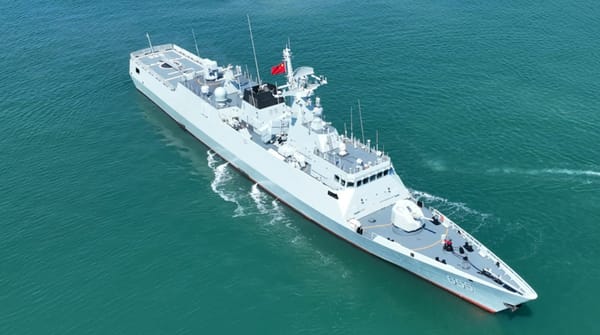
PLA Navy Type 056A corvette Huangshi (Hull 655) during a maritime training exercise in May 2025. (Photo via eng.chinamil.com.cn/by Wang Guangjie)
While it is clear that American shipbuilding capacity is at a numerical disadvantaged, a common argument persists that the U.S. has far superior quality in terms of overall ship size (measured in tonnage) and can employ far more missiles than the PLAN. While the aggregate displacement of PLAN ships is a little more than a third of the U.S. Navy, and with approximately 9,900 vertical launch system (VLS) cells compared to China's 4,200, the U.S. holds a slight "advantage." However, this gap is narrowing at an alarming rate. Beyond a VLS numbers game, the PLAN has already surpassed the U.S. fleet size, boasting over 370 ships as of 2024 compared to America's 296 ships as of 2025, and is projected to reach 475 battleforce ships by 2035. This quantitative advantage cannot be dismissed, as history has shown that numerical superiority often proves decisive in combat. In an analysis of naval engagements ranging from the Peloponnesian Wars to the Cold War, only three out of a possible 28 engagements have seen a lesser force with superior technology overcome a fleet with superior numbers.
The notion that quality will inevitably triumph over quantity is both naïve and dangerous. In some critical areas, such as anti-ship missiles, the United States is already behind: the U.S. surface fleet largely relies on the SM-6 with a range of 150 nautical miles, while the PLAN fields the YJ-18 (300 nm) and the YJ-21 hypersonic missile (est. 540-810 nm), not to mention Chinas large arsenal of anti-ship ballistic missiles. As the PRC continues to expand the worlds largest fleet while narrowing or surpassing the U.S. in key technologies, the United States must reassess its naval strategy. This begins with partnering with allies Japan and South Korea and leveraging the full weight of the trilateral alliance to co-develop and field fast-attack missile corvettes.
A Collaborative Approach
The challenges facing the United States and the shifting balance of power in the Indo-Pacific demand a fundamental reassessment of current maritime strategy. The U.S. can continue claiming it is the dominant maritime force only if it speaks historically. With declining shipbuilding capacity, failed platforms, and the PLAN's continuing naval growth, a bold new maritime strategy fostering collaboration and innovation is needed. Continuing on the current course risks ceding further power and influence to the PRC, undermining regional stability and American interests. This collaborative approach must leverage the strength and quality of our premier Asian allies, Japan and South Korea. These nations possess innate shipbuilding expertise and share a vested interest in countering the PRC's coercive and aggressive behavior.
Undeniably, the PRC has established itself as the global leader in merchant shipbuilding. In 2022, the PRC produced 1,794 ships. By 2024, it had 61.4 percent of the worldwide market, including 55 percent of backlog orders, equating to approximately 2,539 ships, positioning itself well for future shipbuilding initiatives. While Japan currently accounts for only 15 percent of the global market, it was still able to secure and fulfill orders for 587 large commercial vessels at the end of 2022. The Japanese Maritime Self-Defense Force (JMSDF) was able to procure multiple naval surface and subsurface combatants through the combined efforts of Mitsubishi Heavy Industries (MHI), Kawasaki Heavy Industries (KHI), and Japan Marine United Corporation (JMU). South Korea meanwhile accounts for 28 percent of the global market and produced 734 large commercial ships by the end of 2022. The combined efforts of both Hyundai Heavy Industries (HHI) and Hanwha Ocean enabled the South Korean Navy to procure upwards of ten naval surface vessels per year, in addition to providing a corvette/frigate export variant to the Philippines on budget and five months ahead of schedule. Meanwhile, Japan has taken a similar export approach with the inking of a deal to provide 11 Mogami class frigates to the Australian Navy. The first three will be built by Mitsubishi Heavy Industries in Japan, while the remaining eight will be homegrown by Austal in Western Australia with the first frigate expected in 2029.
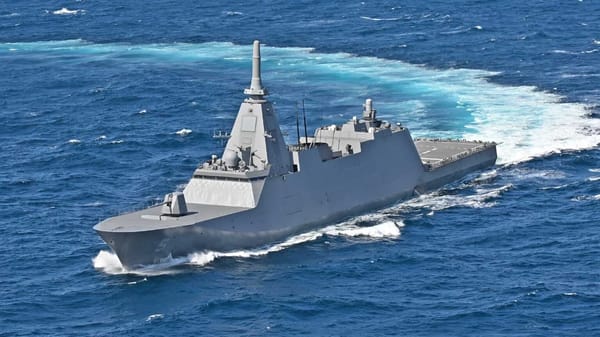
The Japan Maritime Self-Defense Force Mogami-class frigate JS Yahagi. (Photo by Japan Maritime Self-Defense Force)
Combined with U.S. production at just 0.1 percent, the tri-lateral accounts for 43.1 percent of the worldwide market. With Japanese and South Korean FDI and a renewed U.S. commitment to shipbuilding through Congressional action, the tri-lateral global market share could reach as high as 53 percent. Collaboration between industry-leading Japanese and South Korean shipyards, such as MHI and HDHI, with renewed investment in declining American shipyards, offers a rare opportunity to disrupt Chinese shipbuilding hegemony and global influence.
The Tri-Lateral Solution: A Corvette for Asia
Collaboration in shipbuilding is no easy venture for any country, let alone three. It demands a compelling vision of what future conflict will entail, what type of naval combatant is required to prevail in said conflict, and the necessary resources to build at speed and scale. The United States, in particular, is running up against the clock, resource-constrained, and recovering from programs such as the LCS, Zumwalt, and the cancelled Constellation-class frigate.
Collaborative shipbuilding presents a strategic opportunity to act as we move increasingly closer to the "Davidson window" in which the U.S., Japan, and South Korea can accelerate naval production before the PLAN consolidates its quantitative and qualitative edge. Tri-lateral collaborative shipbuilding presents a common sense approach regarding ship design, procurement, and deployment. The idea of collaborative shipbuilding utilizing the tri-lateral alliance is not unique across the literature. Varying journal articles have advocated for a "JROKUS" architecture, in which Japan and South Korea assist the United States in building ships, notably a vessel based on the Arleigh Burke-class destroyer. The U.S. provided Japan and South Korea with the fundamental design for the U.S. workhorse, the Arleigh Burke, which both countries adapted and built to meet their respective requirements. For instance, the Japanese Maritime Self-Defense Force has fielded the Maya class DDG. In contrast, the ROK Navy has developed the Sejong the Great class, which utilizes both the Aegis Combat System and an American Mk 41 Vertical Launch System (VLS) design.
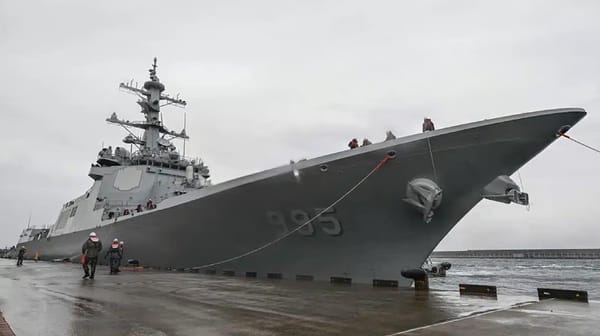
The ROK Navy Sejong the Great-class guided-missile destroyer ROKS Jeongjo the Great at Jeju Naval Base. (ROK Navy photo)
While building a class of vessels with a standard blueprint is valid, it negates cost, time, classified technology, and other special considerations. If the U.S. Navy aims to "put more players on the field," smaller, cost-effective corvettes built at scale are viable. When built in the United States, the average cost of an Arleigh Burke destroyer is upwards of $3 billion. Even if Japan or South Korea could halve those costs to $1.5 billion or less and get the ship off the assembly line more quickly, the pace of production may still be eclipsed by China's and not make a meaningful difference in the regional naval balance.
One possible design consideration is to use the Russian Steregushchiy III class as a template for a hybrid corvette design between the U.S., Japan, and South Korea. The Steregushchiy balances firepower, maneuverability, survivability, and a shallow draft within a small displacement, employing a 12-cell Redut VLS for medium-range surface-to-air missiles, anti-ship missile launchers, and layered defensive systems. Japan and South Korea could blend elements of the Steregushchiy with Japan's Mogami-class and South Korea's FFX Batch III program, integrated with the Mk 41 Vertical Launching System (VLS). The Mogami-class contributes stealth and advanced sensor capabilities, while the FFX Batch III provides survivability and flexibility to accommodate evolving mission requirements, such as maritime domain awareness systems and unmanned aerial or surface vehicles. Integration of a 24-32 cell Mk 41 VLS would provide multiple options to employ long-range surface-to-air, anti-ship, and anti-submarine missiles carried by destroyers without sacrificing the cost. Furthermore, a VLS-equipped corvette introduces a capability the PLAN does not possess at this weight class.
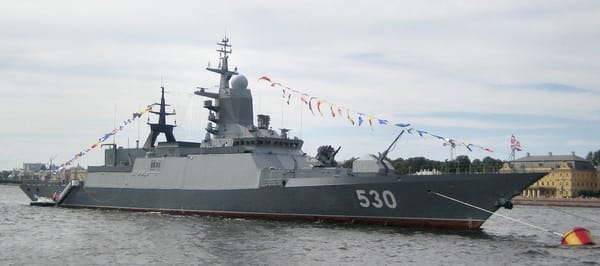
The Russian Federation Navy corvette Steregushchiy on Navy Day 2009 in the Neva River in St. Petersburg. (Photo via Wikimedia Commons)
Mass-producing such corvettes would not only distribute significant naval fires across the first island chain but would also directly expand the U.S. and allied VLS inventory at scale. Finally, each new corvette's ability to mask loadouts introduces operational uncertainty further complicating PLAN operations throughout Asia.
Pursuing a new collaborative ship design based on the input of Japan, South Korea, and regional partners does not have to be an arduous process. The European Union, specifically Italy, France, Spain, Greece, and Norway, have all agreed on a design for a European Patrol Corvette or "EPC" in which each country will utilize its supply chains, shipbuilding technologies, and common procurement strategies to build and outfit the vessel in multiple European shipyards. The seriousness of building a ship based on a new design is critical, especially given the challenges of the Constellation class, in which significant costs were incurred in design modifications.
In estimating the cost, size, and production timeline of a trilateral VLS-capable corvette, the European Patrol Corvette (EPC) provides a useful benchmark. EU member states anticipate a prototype by 2026–2027 after the critical design review was completed in 2025, with operational units expected to enter service around 2030. Projected costs, based on 2021 figures, range from €250–300 million per vessel. If the United States, Japan, and South Korea pursued a joint program leveraging Japan's Mogami-class design and South Korea's FFX Batch III program, the path from design maturity to fleet operations could reasonably fall within a 5–10 year window, depending on the agreed production scale. A target of 10–12 hulls is realistic, given Japan's current ability to deliver two Mogami-class ships annually and Hyundai Heavy Industries' steady pace of delivery for both the ROK Navy and export customers. Assuming a 10-year horizon and costs in the range of $275–325 million per ship, the trilateral initiative could field 10–12 corvettes by year twelve, with the potential for even greater output if dormant U.S. shipyards were reactivated. The projected timeline would include 0–4 years for collaboration and design, with lead ships arriving in years 4–6 (consistent with EPC estimates), followed by serial production ramping up from year six onward.
The tri-lateral alliance is strategically positioned to provide corvettes to the Association of Southeast Asian Nations (ASEAN), leveraging Asia-based shipbuilding to optimize procurement efficiency, supply chain management, and a "built-in Asia for Asia" mindset. This approach could reduce delivery times and promote collaboration amongst ASEAN nations in the corvette design process. Japan and South Korea, meanwhile, stand to gain significant strategic influence within ASEAN and the broader Indo-Pacific through this initiative. Simultaneously, U.S. participation in the tri-lateral Corvette design offers its Asian allies greater strategic flexibility while reaffirming America's commitment to ASEAN and the broader Indo-Pacific region.
Congressional and Legal Hurdles
Multiple bills have been introduced regarding the use of foreign shipyards and foreign investment, notably the bipartisan SHIPS Act sponsored by Sens. Mark Kelly (D-Arizona), Todd Young (R-Indiana), and Reps. John Garamendi (D-California) and Trent Kelly (R-Mississippi). The second bill introduced by Senator Mike Lee (R-Utah) and Senator John Curtis (R-Utah) seeks to implement the "Ensuring Naval Readiness Act." Both sets of bills introduced in 2024 and 2025 have substantial merit in providing ships for the United States. The SHIPS Act seeks to rejuvenate America's declining shipyard infrastructure amidst the rise of the PRC's posture. Specifically, the bill calls for a Strategic Commercial Fleet of 250 US-flagged commercial ships to support international commerce and supply U.S. and allied forces during times of war. During this buildup, the SHIPS Act allows for interim foreign-built vessels within this strategic fleet until US-built vessels can relieve them.
Additionally, the act will expand the U.S. shipyard industrial base for civilian-military dual-use operations (perfected by the PRC) by establishing a 25 percent tax credit for shipyard investments and financial incentives to support innovative approaches to U.S. domestic shipbuilding capabilities. The Ensuring Naval Readiness Act is more specific to the construction of U.S. combatants abroad. The bill states that to achieve a 381-ship Navy, Congress must allow the option to construct vessels, components, or modules in shipyards of Indo-Pacific nations with which the U.S. has mutual defense agreements.
While both bills have considerable merit, especially regarding the possibility of building a common fast-attack corvette among the Tri-Lateral partners, there are still significant hurdles that Congress must continue to overcome. Should the SHIPS Act and the Ensuring Naval Readiness Act be codified into law, other federal interlocking statutes remain in place that can quickly dampen any shipbuilding revolution. Notably, the Jones Act of 1920, the Buy American Act of 1933, the Defense Production Act of 1950, and the Berry Amendment. While the Ensuring Naval Readiness Act amends United States Code (USC) Title 10 section 8679 to "allow" for naval ships to be built abroad, it lacks significant substance concerning multiple federal laws. The Jones Act of 1920 requires that any ship sailing between U.S. ports be built in the United States and owned and operated by U.S. citizens or permanent residents, which complicates the goal of a strategic commercial fleet.
The Buy American Act (concerning naval combatants) requires that significant components and funds allocated to naval vessels can only be used for fabrication within the U.S. This act alone directly contradicts the Ensuring Naval Readiness Act, allowing the construction of naval combatants in foreign shipyards. Finally, the Defense Production Act of 1950 could hinder the building of ships overseas. While not explicitly limiting the construction of naval combatants abroad, it does focus significantly on strengthening the domestic industrial base, which could discourage overseas efforts in shipbuilding. Additionally, the Berry Amendment (preference given to domestically produced goods) and a 100% "Made in America" by 2033 clause within the NDAA have imposed restrictions on foreign-made components from allied nations, complicating a collaborative shipbuilding approach. Furthermore, the Byrnes-Tollefson Amendment prohibits foreign companies from constructing hulls or superstructures for navy ships, causing another detrimental hurdle to a U.S. shipbuilding revolution.
Conclusion
The strategic imperatives facing the United States, Japan, and South Korea demand immediate, decisive action to secure enduring maritime security across the Indo-Pacific. Trilateral collaboration in naval shipbuilding is no longer optional, it is necessary. Together, the alliance has a once-in-a-generation opportunity to counter China's expanding naval power, restore American shipbuilding strength, and ensure a free and open Indo-Pacific for decades to come. By pooling resources, expertise, and industrial capacity, the alliance can design and produce a fast-attack missile corvette tailored to the region's urgent needs: maritime domain awareness, deterrence, and enhanced interoperability among allies and partners. A corvette fleet, built with Asian shipyards and American innovation, will empower ASEAN partners on the frontlines of maritime coercion, illegal activities, grey-zone conflict, and Great Power Competition.
Swift legislative action must accompany this vision. Congress must urgently amend outdated laws, including the Jones Act, the Buy American Act, and the Byrnes-Tollefson Amendment, to unlock foreign direct investment, reactivate dormant U.S. shipyards, and reestablish American leadership in global shipbuilding. Streamlining procurement processes and embracing trilateral trade rules can significantly reduce costs, expedite production timelines, and position the new fleet for phased deployment before China's projected military advantage reaches its apex later this decade. This strategy offers more than ships. It redistributes burden-sharing among allies, strengthens alliance unity under the 2023 Camp David Accords, and demonstrates a clear commitment to defend freedom in the Indo-Pacific. It also signals that the United States and its allies have learned from past naval procurement failures — and are now prepared to innovate, adapt, and lead once again.
Restoring sea power through this trilateral initiative is both an opportunity and a strategic necessity. Success will reaffirm U.S., Japanese, and South Korean leadership in safeguarding the maritime commons, strengthening the global rules-based order, and securing American interests throughout the twenty-first century.

that matters most
Get the latest maritime news delivered to your inbox daily.
Chase Harding is a Strategic Planner at United States Forces Japan and a former Political-Military Master's Scholar at the Fletcher School of Law and Diplomacy at Tufts University. The views expressed herein are those of the author and do not necessarily reflect the official policy or position of the Department of the Navy, Department of War, or the U.S. Government.
This article appears courtesy of CIMSEC and may be found in its original form here, including extensive footnotes.
The opinions expressed herein are the author's and not necessarily those of The Maritime Executive.
