


Carrying the Risk: What Protects Seafarers in a War Zone?

Every year for the past two decades, the world has celebrated June 25 as the Day of the Seafarer. This year’s theme, “Carrying world trade - Carrying the risks,” captures a stark truth: people moving global commerce often do so in increasingly dangerous conditions. Honoring their sacrifice matters. But so does empowering seafarers with rights and protections, especially in war zones.
This year, shipping disruptions in the Strait of Hormuz have imposed heavy economic costs, but the gravest toll is human. Since escalations began in late February 2026, more than 1,500 ships and roughly 20,000 seafarers have been trapped in the region. Between early March and early-June 2026, 46 confirmed incidents damaged merchant ships, killing fourteen seafarers, injuring seventeen, and leaving one missing.
Global Response
Within a month of the crisis erupting, the international community moved. The UN Security Council adopted Resolution 2817 (2026), reinforced by the International Maritime Organization (IMO), which convened an extraordinary meeting on the situation in the Strait of Hormuz and adopted a further resolution for the region’s marine environmental protection. The International Labour Organization (ILO) intervened through the Special Tripartite Committee established under the Maritime Labour Convention, 2006 (MLC) urging States to designate seafarers as key workers and ease their safe movement, including shore leave, repatriation, crew changes, and medical care ashore. A dedicated UN task force was established to design humanitarian mechanisms for the Strait.
These responses affirm that interfering with lawful navigation through the Strait of Hormuz is no longer a regional matter but a threat to international peace and security; commercial vessels’ right of passage must be respected, and states may lawfully defend their ships where it is violated. The IMO has determined that attacks on commercial shipping infrastructure violates international law, endangering seafarers and the region’s marine ecosystems. Coordinated action is called to deliver food, water, and supplies to stranded ships, enable crew changes, and protect seafarers’ health and welfare—accounting for fatigue, the master’s authority, and the dangers of navigating waters where satellite positioning is jammed and spoofed. While an early IMO voluntary plan for a temporary safe maritime corridor along an existing traffic separation scheme's eastbound lane was stalled, the recent US-Iran MoU enables the IMO to advance its plan to evacuate 11,000 stranded seafarers within a 30-day demining window via alternate Omani and northern corridors. Yet, profound legal and operational uncertainties remain.
What Labor Rights Survive a War Zone?
Condemnation of attacks on merchant ships has been swift and near universal. Unfortunately, condemnation alone has kept no one safe. The real question remains: what protections travel with a seafarer on a ship bound for or stranded in a war zone? Two bodies of law answer it: one governing who may be attacked, the other how seafarers must be treated.
On the first, the San Remo Manual—an expert restatement of the law governing armed conflict at sea—offers guidance. Neutral merchant ships are generally protected from attack unless they directly assist a belligerent or breach blockade and contraband rules after warning, and even then, force is constrained by humanitarian law. Belligerents must respect the rights of neutral states, including freedom of navigation through international straits. The Fourth Geneva Convention of 1949 protects civilians in wartime—including seafarers not participating in hostilities—against violence to life and person: murder, torture, cruel treatment, hostage-taking, and assaults on dignity. A seafarer cannot be criminalised arbitrarily; any charge must follow fair process. But the protection is not absolute: nationals of non-party states, or those whose home state maintains normal diplomatic relations with the state holding them, remain excluded.
That gap is where the MLC becomes vital. Known as the “Seafarers’ Bill of Rights,” the MLC binds 112 parties representing 96.5 percent of global shipping tonnage—and its protections apply in full even during war. One caveat matters: the provisions specific to war zone-bound ships sit in MLC’s Guidelines as recommendations rather than as binding rules. The International Convention on Standards of Training, Certification and Watchkeeping for Seafarers complements it with minimum safety and welfare training and competence standards. The core protections that survive a war zone are as under:
Existing labor rights don’t disappear: A war zone does not suspend the MLC. Even on a stranded ship, seafarers keep their rights to fair pay; quality food and drinking water; free medical care; welfare, communication and recreational facilities adapted to the special needs in war zones, including internet access; ten hours daily and 77 hours weekly minimum rest for watchkeepers; and personal protective equipment. Where sickness, injury, or death arises from the ship-board job—war zone included—the shipowner must cover all medical care until recovery, and, in death, burial costs. Belongings left aboard must be safeguarded and returned. Mandatory insurance further secures these rights.
The right to refuse sail into a war zone and return home: The MLC guides that seafarers who do not consent to sail into a war zone be treated either as a case of justified termination of the employment agreement or as a situation where they can no longer be expected to perform the contract. In both cases, the flag state must ensure the seafarer is repatriated. In the unfortunate event of a seafarer’s death onboard, the shipowner must arrange the return of the body or ashes in accordance with the wishes of the seafarer or their next of kin, with relevant coastal State facilitating such repatriation. Seafarers cannot be charged for repatriation, whether up front or by later deduction.
Financial Protection against abandonment: If a shipowner abandons the crew in a war zone—failing to cover repatriation costs or pay wages for at least two months, or leaving them without food, water, fuel, or medical care—the seafarers can draw directly from MLC’s mandatory financial security covering up to four months of unpaid wages, repatriation costs, and essential needs until reaching home. Where a shipowner defaults, the relevant recruitment and placement service must cover.
Meaning of war zone: The MLC leaves the definition of a “war zone” to national law and seafarers’ employment agreements, which often reference a collective bargaining agreement (CBA). The CBA may define the war zone areas with specific seafarer protections. For example, the International Transport Workers Federation (ITF) and International Bargaining Forum (IBF) designate the Strait of Hormuz as a warlike operations area, entitling seafarer a basic wage equivalent bonus (5 days minimum and per day if longer), doubled compensation for death and disability, the right to refuse sailing into the area with repatriation at company cost plus two months’ basic wage, and a heightened security equivalent to level 3 under the International Ship and Port Facility Security Code.
Even non-party ships are covered: MLC standards can still be enforced on a ship flying a non-MLC country’s flag when it enters an MLC Member State’s port, through MLC’s “No More Favourable Treatment” clause.
Flag State is the legal anchor: The flag State has the primary responsibility for enforcing maritime labour standards and seafarer protections on ships registered under its flag. Among the 46 incidents in the middle-east region so far, the ships flagged under Flags of Convenience (FOCs) or open registries like Panama, Marshall Islands, Liberia dominate. Per the ITF, FOCs prioritize their commercial interests over seafarers’ welfare, undermining accountability, weakening enforcement and limiting seafarers’ remedies. The flag state is the gatekeeper of seafarer protection, and seafarers must check the type of registry the ship’s flag operates under, especially if it is a FOC, prior to accepting assignment, as this becomes the strongest determinant of easy access to remedies in war zones.
Turning Rights into Action
Rights mean little without enforcement. The MLC does not make seafarers wait until they are home to report violations. Whether ashore, aboard, or transiting hostile waters, the crew has immediate levers:
Onboard complaints: Seafarers can lodge complaints on board, accompanied or represented, and MLC parties must prohibit and penalize any kind of victimization for doing so. Seafarers must be given a copy of their employment agreement, the onboard complaint procedure, contact details for the flag state authority, and the name of someone aboard who can offer confidential advice.
Onshore complaints: Complaints can also go to an authorised port officer, in confidence. That officer must investigate, may encourage an onboard resolution, and—where conditions are unsafe, or the breach is serious or repeated—can prevent the ship from sailing until the problems are resolved or a credible corrective plan is accepted. The flag state and shipowners’ and seafarers’ organisations in the port state must be notified.
Reporting to the ILO: If still unresolved, the officer reports it to the Director-General of the ILO.
War Zone Geography Matters
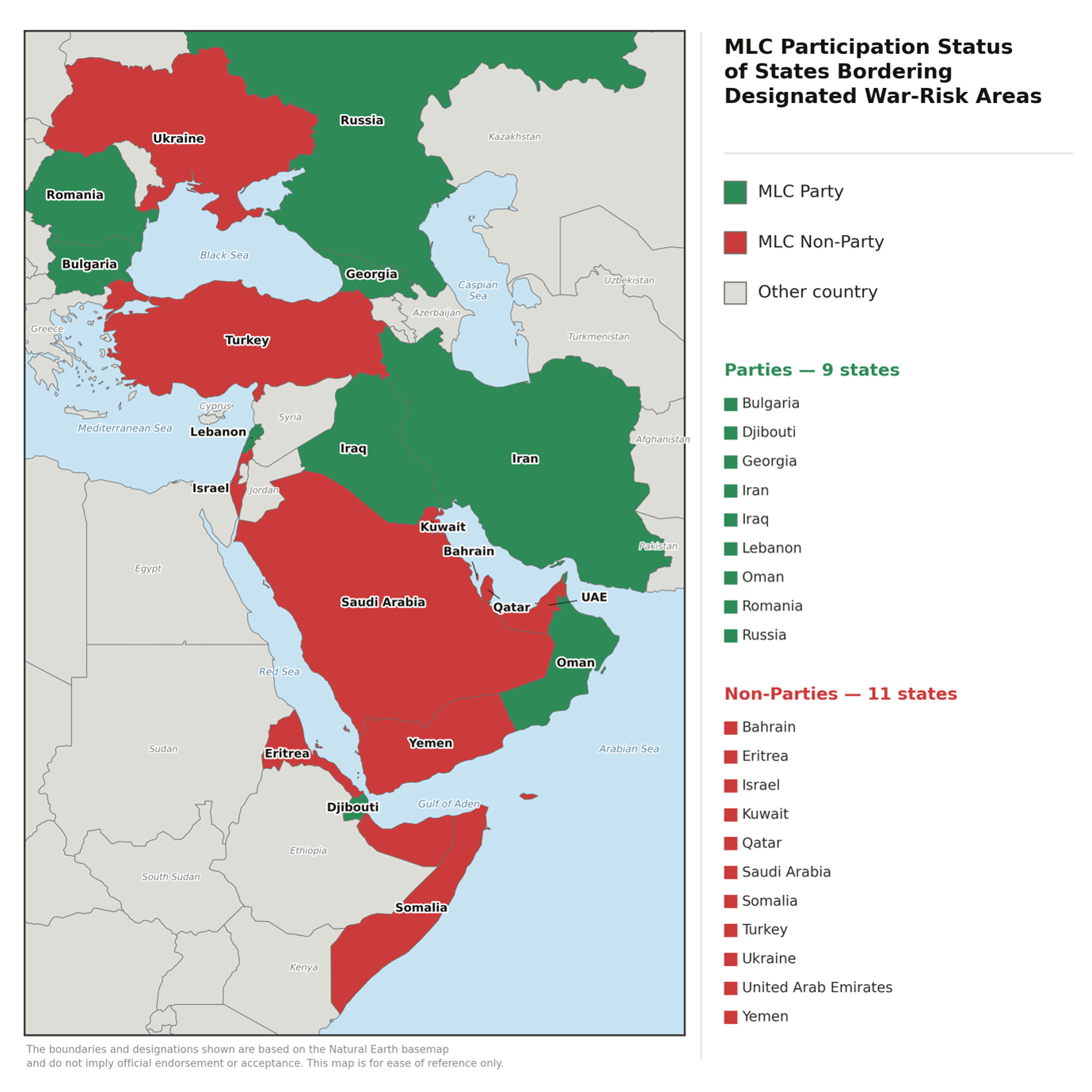
MLC protection depends on State participation, and for enforcing its standards in a war zone, the map matters. A crew sailing on a ship flagged in an MLC State Party, say Panama or Liberia, through the Strait of Hormuz retains MLC protections, enforceable at the next port of call in an MLC State Party. However, where a voyage of a non-MLC State Party ship operates solely between non-party ports, enforcement thins, leaving seafarers dependent on the flag State’s willingness to uphold equivalent labour standards.
The ITF and IBG designate the following seven global war-risk areas: waters within 12 nautical miles of mainland Yemen; the Persian Gulf, Strait of Hormuz, and Gulf of Oman; the southern Red Sea and Gulf of Aden, from the Yemeni coast across to Eritrea and encompassing the Bab el-Mandeb Strait; the Sea of Azov and the Strait of Kerch; the wider Black Sea; all Ukrainian ports; and Israeli Mediterranean and Lebanese ports. Among the 20 coastal States bordering these war zones, only nine are MLC parties—a split the figure below captures to help seafarers assess enforcement risks:
A Promise Worth Making Binding
Seafarers are widely celebrated as “key workers”, yet that status is far from an enforceable obligation. The most vital protections for those sailing into war zones—the very provisions tested daily in the Strait—sit in MLC’s Guidelines, which states are merely encouraged to follow. A safe evacuation corridor for stranded crews was proposed, endorsed, and then left to wither, because nothing compelled States to honour it.
This needs to change. The MLC is a living instrument, amended before to meet new realities: mandatory protections in case of seafarer abandonment and seafarer captivity in piracy and armed robbery became binding standards when the world recognised the need. War zone protections deserve the same treatment. The right to refuse transit into conflict areas, guaranteed pay, welfare for stranded crews, and a duty to establish evacuation pathways should be written into the MLC as obligations that cannot be quietly ignored.
The Day of the Seafarer asks the world to close the gap between remembrance and an honest tribute. Honouring seafarers means more than marking a date on the calendar. It means ensuring their human rights carry a binding force of law.

that matters most
Get the latest maritime news delivered to your inbox daily.
Sindhura Polepalli is a Graduate Research Assistant and PhD student at the Rosenstiel School of Marine, Atmospheric, and Earth Science & the Abess Center for Ecosystem Science and Policy at the University of Miami (UM). Her research focuses on ocean governance and equity. Before joining UM, she served as the Maritime Legal Consultant to the Directorate General of Shipping in the Ministry of Ports, Shipping and Waterways, Government of India.
Rehana Dhawade is an Advocate & Maritime Legal Consultant at the Directorate General of Shipping, MoPSW, Government of India.
The opinions expressed herein are the author's and not necessarily those of The Maritime Executive.
