
Setting Course for User-Friendly Ship Control
By Dr Richard Stephens
Picture this: the world's largest ship would be longer than the Eiffel Tower or the Empire State Building if it was laid on its side. Now imagine trying to manoeuvre a vessel of this size in the rolling seas with high wind conditions. Not an easy task.
In fact, many of today’s ships are the size of several football fields combined. The central control room is crammed with consoles which constantly monitor and transmit data from every corner of the ship. Understanding, analyzing and ultimately manipulating this data to operate the ship is challenging for even the most experienced mariners.
Dynamic positioning (DP) should be the mariner’s best friend. This technology enables a vessel to maintain a predetermined course, fixed or moving, counteracting the effects of displacing forces such as wind, current, and wave action. DP is one of the most sophisticated and important parts of the ship’s operation.
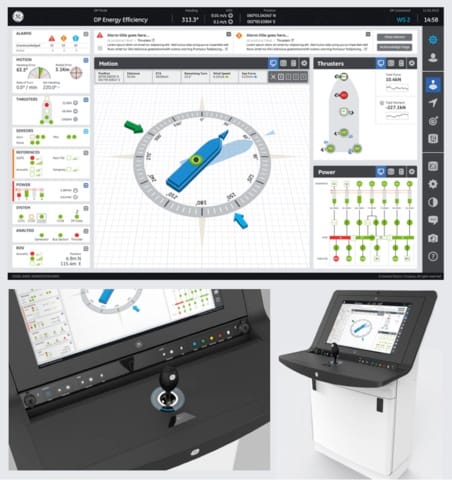
Crucial as it is, DP has become increasingly complex. It has typically evolved based on a legacy of incumbent technologies, which, when combined, has made the system increasingly complex to handle. Without a holistic view of what he really needed to know and see, this complexity has been reflected in the way information is displayed to the operator, and in the way they interact with the equipment. Consequently, the information gets cluttered and confusing and become difficult for DP operators to focus on the primary task of controlling the ship itself, as their attention is absorbed in managing the computer. What was needed was a radical change to the user-interface, to give control back to the operator.
Through observing and speaking to a number of operators, captains, trainers and field engineers, as well as analysing vessels’ log files, GE got to grips with the frustrations with existing DP systems on the market. The team used this in-depth knowledge to tackle the challenge from the user’s perspective. They then set out on a journey to explore design alternatives. The objective was simple: keep the boat safe, keep the operation efficient and simplify the mariner’s task.
To fulfil this need, GE Power Conversion partnered with User Experience (UX) experts from GE’s Design & Experience Center of Excellence and Connected Experience Labs. Together they developed the latest SeaStreamTM DP system.
The new SeaStreamTM DP system breathes life into the shipping industry. It puts the mariner back in control of the vessel. User research suggests that a ten minute familiarization session is all that’s needed for operators to get used to the radically different design.
At the end of the day, it is people who stand behind the giant machines navigating and manipulating equipment so they should be the start point for all design solutions, no matter how daunting the scale of the task . I hope we’ve helped to set them on the right course.
Dr Richard Stephens is now Principal Engineer for Control and Automation at GE Power Conversion and a Fellow of the Institution of Engineering and Technology.
Editor’s Note: The opinions expressed herein are the author’s and not necessarily those of The Maritime Executive.
The products and services herein described in this press release are not endorsed by The Maritime Executive.
