


Chagos Islanders Return Home as UK Weighs Their Fate
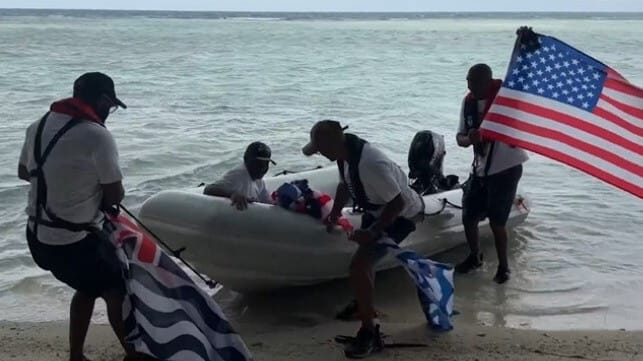
As the UK debates the fate of the Chagos Archipelago deal which transfers sovereignty of the Chagos Archipelago to Mauritius, a party of Chagos Islanders has returned to their homeland and re-established residence on the Île de Coin.
Diego Garcia, the home of the US Naval Support Facility, lies approximately 117 nautical miles south of the Île de Coin, at a distance which cannot feasibly interrupt or threaten activities on the joint US-UK base. Nonetheless, under the terms of the US-UK agreement governing the use of Diego Garcia, the United Kingdom authorities are obliged to keep the outer islands of the British Indian Ocean Territory free of inhabitants. The Chagossians on the island have so far refused to leave, and have said that more Chagossians are on the way.
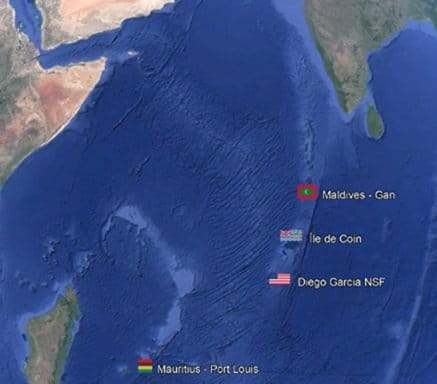
Île de Coin lies approximately 117 nm north of Diego Garcia, 286nm south of the Maldives, and 1,500 nm from Mauritius. (Google Earth/CJRC).
The Île de Coin is the main island in the atoll of Peros Banhos, and was the last island in the British Indian Ocean Territories to be cleared of Chagossians in 1971. More than 300 Chagossians still living were born on the Île de Coin, which has a church with 150 graves. The Peros Banhos atoll previously was run as a coconut plantation, with the Île de Coin its main settlement and port. The father of the elected First Minister of the Chagos, Misley Mandarin, was born on Île de Coin, and both are in the party which on February 17 re-established the settlement.
The legislation which brings the agreement between Mauritius and the United Kingdom into force has not yet completed its passage through the House of Lords, and its return for further discussion in the House of Lords has not yet been timetabled.
The British Prime Minister Sir Kier Starmer is known to be having second thoughts on the wisdom of the deal with Mauritius, but is being pressured by a group of international human rights lawyers to whom he is personally closely allied to continue with the legislation to completion. If he tries to do so, he may face another revolt either in the House of Lords or from within his own party, which could be the final chapter in a succession of political reverses which threatens his position as Prime Minister, and those of Lord Hermer and Jonathan Powell who are the biggest supporters of the deal within 10 Downing Street.
It now also appears that the British parliament was misled when ministers briefed that an imminent international legal ruling posed an immediate threat to operations to the base. Under UNCLOS Article 298, the United Kingdom can invoke a military exemption, and therefore no imminent legal threat exists.
The re-establishment of a permanent civilian Chagossian presence in the British Indian Ocean Territories looks set to be a continuing irritant for the British government, without threatening the continued smooth operations of the US Naval Support Facility on Diego Garcia. Observers believe there are many alternative political arrangements which could allow the maintenance in some form of the current status quo but allowing the return of Chagossians to the outer islands of the Archipelago, particularly as the primary motivation of the Mauritius government in pressing the issue has been to secure a financial return against the continued operation of the Diego Garcia base.
Besides the lack of international legal threat to Diego Garcia, the proposed deal still has three fundamental flaws.
Once sovereignty of the Chagos Archipelago is transferred to Mauritius, there is no mechanism for recovering sovereignty and rights should Mauritius renege on aspects of the agreement at some time in the future. As the UK discovered in Hong Kong, even when safeguards are codified in an international treaty, the sovereign power can in effect do what it wants. In this regard, Mauritius’ close relationship with China poses a real threat, so there is a substantive risk that Mauritius could grant another nation basing rights on one of the other islands of the Archipelago, rendering the utility of the base on Diego Garcia much reduced.

that matters most
Get the latest maritime news delivered to your inbox daily.
Secondly, even without bad faith on the part of the Mauritian government, it is unlikely to be able to effectively police the 58 islands and 250,000 square miles of territorial waters making up the Chagos Archipelago, when it has no navy and lies more than 1,500 miles from Mauritius. While the British Indian Ocean Territory remains in being, this is a responsibility shouldered effectively by British vessels and Royal Marines.
Finally, the utility of the base would be restricted. Mauritian government sources have said that once sovereignty is transferred they will impose the 1996 Pelindaba Treaty on Diego Garcia, which bans nuclear weapons from the African continent. The terms of the deal also require advanced notice prior to the launch of offensive operations from Diego Garcia.
The opinions expressed herein are the author's and not necessarily those of The Maritime Executive.
