


Report: Iran Nears Deal to Buy Supersonic Antiship Missiles From China
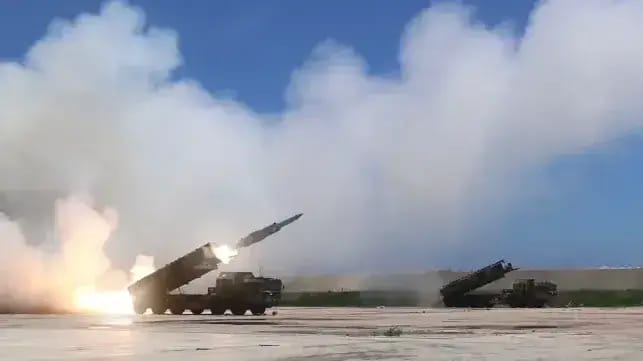
Iran may be closing on a deal to buy supersonic antiship missiles from China, which would complicate planning for the U.S. Navy in waters of the Persian Gulf, Strait of Hormuz and Gulf of Oman.
According to Reuters, the Iranian government is close to a purchase of the Chinese CM-302 missile system, based on China's YJ-12. While not the most modern type in the swiftly-evolving Chinese inventory, it is considered a capable antiship cruise missile. The CM-302 is the export variant of the design, and has a warhead payload of up to 550 pounds and a range of about 150 nutical miles. The original version can attain speeds somewhere in excess of Mach 2, potentially as high as Mach 4. The YJ-12 has reportedly been deployed in shore-battery configuration at China's giant bases in the Spratly Islands. Pakistan's navy currently fields the ship-launched export variant of the missile.
The missile's high speed in the terminal phase reduces the amount of time that the target vessel has to react and defend itself. It is expected that in Chinese service, the YJ-12 would be air-launched in large volleys for a saturation effect, but even one supersonic YJ-12 missile - programmed to conduct spiral evasive maneuvers as it closes in - would pose a stress test for an advanced warship's defenses.
Six Iranian government officials confirmed the talks to Reuters, and said that negotiations have been under way for the past two years.
"It’s a complete gamechanger if Iran has supersonic capability to attack ships in the area," Iran expert Danny Citrinowicz of Israel’s Institute for National Security Studies told New York Post. "These missiles are very difficult to intercept."
Other possible elements of the deal could include man-portable surface to air missiles (MANPADS), a threat to low-flying aircraft and helicopters. Per the report, the negotiations could extend to anti-ballistic missile systems or antisatellite missiles - some of the most technically-advanced weapons on earth. Approval of such a transfer would signify a high level of trust in Iran's ability to keep the technology secret.

that matters most
Get the latest maritime news delivered to your inbox daily.
No word of the deal's completion has emerged yet; even if terms are agreed, it would take time for China to deliver the equipment and provide the adequate training to enable its use. The U.S. is already gearing up for potential military action in Iran, and discussions of a possible limited strike have been widely reported.
Separately, Iran has reportedly signed a deal with Russia for the transfer of $590 million worth of man-portable antiaircraft missiles, according to the Financial Times. The arrangement covers 500 launch units and 2,500 missiles for the Verba MANPADS system, a modern guided missile launcher weighing just 38 pounds. Iran's weapons exports to Russia - like long-range attack drones used against Ukraine - may cover the cost of the transaction. For Navy aviators, Verba would be an unwelcome nuisance at altitudes up to 15,000 feet, the highest altitude lock range of any known MANPADS device. It is designed to be resistant to modern infrared countermeasures.
