


Trump Say US Conducted Mission to Brings Ships Out of Persian Gulf
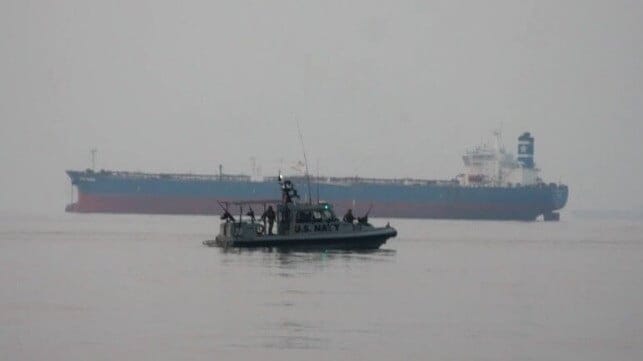
With tensions running high in the region and increased rhetoric coming from both the United States and Iran, it is unclear when the Strait of Hormuz will reopen to normal traffic.
Donald Trump seems to think this may occur within days. Noises from the Iranian negotiating team are also sounding more optimistic. But we have been there before, with no good result; the loss of a U.S. Apache helicopter this week and U.S. counterattacks, once again, have provided reason for further delays. In any case, there are plenty of hardliners who would seek to sabotage any agreement, and others who have critical requirements that might not be addressed if a settlement does not re-establish free and innocent passage, as has existed since the IMO Traffic Separation Scheme was agreed upon in 1968, until Iran began blocking traffic in March this year. The course of events is very difficult to predict with any confidence.
But in recent weeks, it has become clear that ships are already traveling through the Strait, and that exfiltrations are increasing. This is despite the Iranian imposition of restrictions on transits, applied through its Persian Gulf Regulatory Authority (PGRA), and the U.S. blockade on Iranian ships and ports. Ship owners inevitably are being discreet and are not advertising the names of their breakout ships.
Donald Trump announced in a social media posting on Wednesday afternoon, June 10, that he had ordered the U.S. to execute a secret mission to support oil tankers and other commercial ships through the Strait of Hormuz. "Today, I am pleased to announce that this effort has resulted in more than 100 million barrels of oil making its way through the Strait, and into the open market. More than 200 commercial ships have safely traveled through the Strait. This wildly successful effort is because the United States of America controls the Strait of Hormuz — not Iran."
Vessels getting through the Strait are using one of two routes:
The Larak Island route, used by those who are cleared for transit by the PGRA, and who plot a course around Larak Island on the PGRA-approved route. Some of these ships will have paid for the privilege, thereby contravening U.S. sanctions on the PGRA. Others may have been on the cleared list as a consequence of agreements made politically with the Iranians, without having had to pay a fee.
The Oman Coastal route, used by others who leave the Gulf, hugging the Omani Musandam coast to lessen the risk of interdiction, and do so either having liaised with U.S. naval authorities to receive guidance on safe routing, or who take the route independently, trusting their own judgement of the prevailing risk. In both cases, it would be foolhardy to attempt such a transit without advising the Omani naval authorities responsible for controlling traffic in the Omani segment of the Strait, but some are taking this route anyway. About 15 vessels per day are using this route, and more are being encouraged to do so.
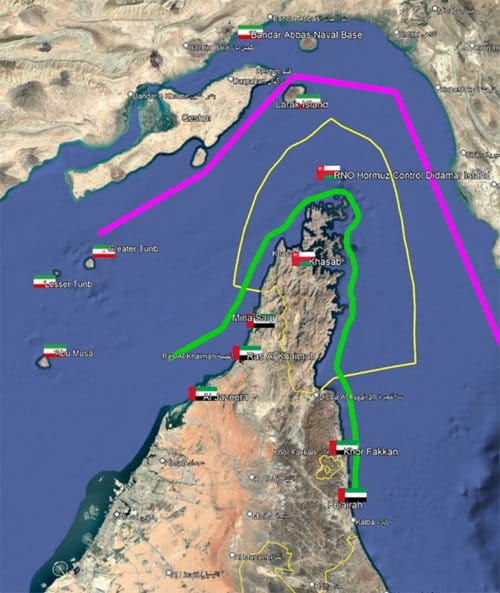
Limit of Omani territorial waters (yellow), the PGSA Larak Island route (pink) and the Omani Coastal route (green) (Google Earth/CJRC)
Whereas the Iranians will attempt to interdict any vessel not complying with their PGRA control regime, U.S. naval authorities are only interested in Iranian ships, those seeking to dock at Iranian ports, or anyone who breaches OFAC sanctions by transacting with the PGRA and handing over any toll fee. Hence, foreign-flagged ships using the Larak Island route may not be contravening the U.S. naval blockade, provided they are neither visiting Iranian ports nor paying the PGRA any money.
So whether using the Larak Island or the Omani Coastal route, ships are getting out, and the numbers are rising.
Lloyds List identified 17 specialist vehicle carrier vessels that became trapped inside the Gulf at the beginning of the war. The first, Marshall Island-flagged Jiuyang Bonanza (IMO 9330616), left using the Larak Island route on April 11, broadcasting on AIS that it had a Chinese crew. Of the remaining 16, two Chinese Anji Cosco ships, An Ji 23 (IMO 9776858) and Anji Phoenix (IMO 9190858), are now in Singapore, and a third, Xiang Jiang Kou (IMO 9985394), is in Brisbane. Hence, all the Chinese vessels carrying SAIC vehicles have now left, using the Larak Island route.
Five Japanese-interest vehicle carriers are still stuck in the Gulf - Antares Leader (IMO 9539169), Capetown Highway (IMO 9565558), Dream Diamond (IMO 9325788), Jana Murni (IMO 9206023, Taurus Leader (IMO 9700550) - while Lotus Leader (IMO 9202883) and Positive Pioneer (IMO 9304514) for some reason are now supposedly loitering in the Gulf of Guinea, and Grand Diamond (IMO 9303223) is in Mundra, India. Of the remaining four vessels on the original Lloyds List, European and Korean interests both have one ship still stuck in the Gulf, and one that has escaped. In total, therefore, of the original 17 ships stuck inside the Gulf, seven remain, and ten have escaped, including all four Chinese-interest ships.
On the LNG tanker front, The Maritime Executive knows of six tankers which have loaded Emirati LNG at Das Island since February 28 and which are now outside the Gulf, with four - Marigold (IMO 9230062), Umm al Ashtan (IMO 9074652), Mraweh (IMO 9074638) and Mubaraz (IMO 9074626) having delivered to terminals in Japan, India and China in the last three weeks. Six tankers similarly have loaded at Qatar’s Ras Lafan LNG terminal, with four – Al Kharaitiyat (IMO 9397327), Mihzem (IMO 9986635), Fuwairit (IMO 9256200), and Al Rayyan (IMO 9086734) delivering to LNG import terminals in Pakistan, and a fifth - Al Daayen (IMO 9325702) – is due in China on July 6.
All these LNG tankers have made passage through the Strait since both the Iranian and U.S. restrictions have been imposed. Chinese vessels and those delivering LNG to Pakistan are likely to have used the Larak Island route, with politically negotiated permission, rather than having paid a fee. On balance, the Emirati LNG shipments are likely to have taken the Oman Coastal route, given relations between Iran and the UAE. The substantial number of Japanese ships still stuck in the Gulf suggests that they were neither willing to brave the Oman Coastal route, nor to pay the PGRA for the privilege of departing.

that matters most
Get the latest maritime news delivered to your inbox daily.
U.S. naval authorities are likely to have a much longer and more accurate list, with a better understanding of who may have committed breaches. No doubt OFAC will be taking action against anyone known to be on the naughty list. A vessel that appears to have been in breach was the unladen, false-flagged tanker Marivex (IMO 9464156), which was disabled with a shot into the engine room off Masirah on June 8. The Palau-flagged product tanker Settebello (IMO 9162916), which was struck early on June 10 off Sohar, may also have been in breach.
In the meantime, IMO Secretary-General Arsenio Dominguez issued a statement on June 9, urging ship owners to give the highest priority to the safety and lives of seafarers, saying that “they must not be exposed to conditions where the risks are known, significant, and clearly beyond mitigation.” His statement is no doubt prompted by concerns that this is precisely what is happening.
