

USS Theodore Roosevelt CSG Arrives in the Gulf
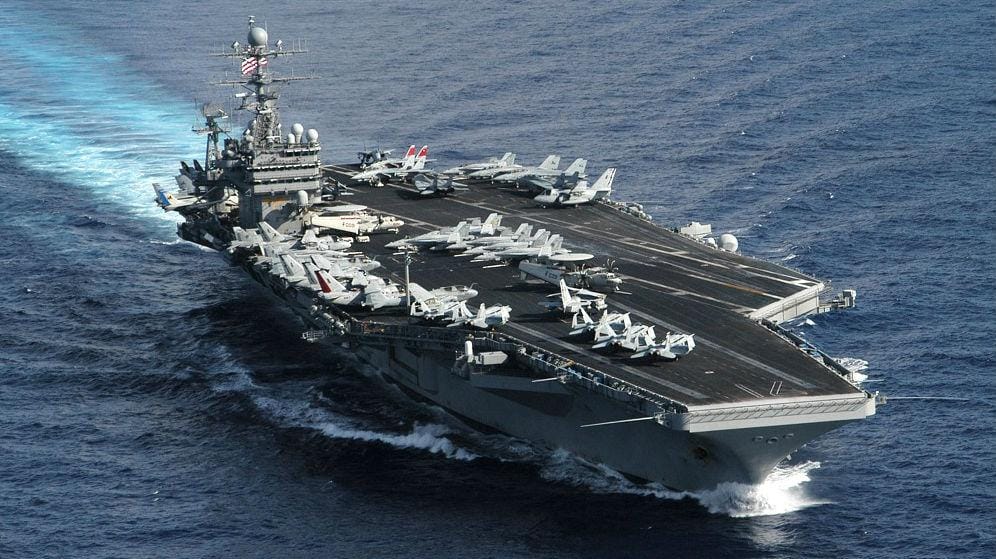
The USS Theodore Roosevelt (CVN-71), flagship of Carrier Strike Group CSG9, has arrived in the CENTCOM operational area, having completed the transit from Singapore in an impressive eight days. The carrier deployed from San Diego on September 27 and, just a week ago, was tracked departing Singapore.
The CSG is made up of the Ticonderoga Class guided missile cruiser USS Chosin (CG-65) and the Arleigh Burke guided missile destroyers USS Paul Hamilton (DDG-60) and USS Decatur (DDG-73).
There is no word yet that the due-to-be-relieved USS George Washington CSG has withdrawn from the region, and hence for the moment CSGs USS Theodore Roosevelt, USS George Washington, and USS George HW Bush are all operational and under CENTCOM command. This remarkable concentration of firepower and strike capability illustrates the virtue of carrier strike group influence, leaving potential enemies uncertain of what U.S. intentions might be.
Hardliners within the Paydari-IRGC faction currently in the ascendancy in Tehran are posturing at present, believing that the United States is weakened and that by provoking an American resumption of hostilities Iran will be able to achieve its long-term political goals of establishing itself as the regional hegemon and as a global superpower in its own right. They also appear to believe that they have the bargaining power and the tacit support of China, Russia and North Korea, united as the CRINK group of autocracies and committed to pushing back the influence of Western liberal democracies. The recent IRGC attempts to mount drone attacks on Bahrain are best interpreted in this context.

that matters most
Get the latest maritime news delivered to your inbox daily.
Simultaneously, the U.S. naval blockade of Iranian ships and ports remains tight, and economic pressure is mounting on the Iranian regime. As of early November, CENTCOM said that since July, U.S. forces have redirected 147 commercial vessels that complied with the blockade, while five merchant ships that refused to comply were disabled.
The IRGC is likely to continue to increase the tempo of its attacks on shipping in the Strait of Hormuz, the success or otherwise of which is difficult to judge. However, as time goes on, alternative routes to transiting the Strait of Hormuz develop and expand, lessening the impact of IRGC actions, while the blockade of the Strait itself remains tight. The IRGC focus for the present is therefore to break this impasse. For the moment, neither Israel nor the United States sees any need to respond to IRGC provocations, because slowly but surely the blockade is having the desired effect and, in time, will provoke the only form of regime change in Iran that is viable - reform from within.