

US Forces Still Poised in the Arabian Gulf Area
With an uneasy ceasefire having held now for some three days, which is something of a local record in recent times, there appears to be a determination shared by both Iran and the United States that there should be no further interruptions to the negotiation process, which has now switched to Doha and which is well behind schedule.
Nonetheless, the diplomatic and political climate remains tense, particularly among parties whose interests are not being directly represented by those conducting the actual negotiations in Qatar.
In Iran, a split in the ruling political elite, in which Paydari and IRGC hardliners seem to have the support of the hologram Supreme Leader Mojtaba Khamenei, has spilled into the open. There is open criticism of President Masoud Pezeshkian, Foreign Minister Abbas Araghchi, and the lead negotiator Mohammad Bagher Ghalibaf for being willing to conciliate, even though the Supreme National Security Council has given the go-ahead for negotiations to proceed. This has not stopped the hardliners, who contend that Iran has established an ascendant position following the war, from using their influence within media organizations to drip vitriol on their domestic political opponents and to press for the Islamic Republic to exploit its advantages by further developing its regional dominance. Moreover, the Iranian negotiating team has been accorded very little flexibility, which means that the talks in Qatar are in danger of collapse as soon as substantive issues come up for discussion. For the moment, while the week-long funeral of the late Supreme Leader proceeds, divisions may be put to one side, but may emerge once again in the coming days, along possibly with a first public appearance by Ali Khamenei’s elusive son Mojtaba.
There are also divisions on the other side of the Gulf. Some GCC states, notably Qatar and Oman, believe that the reality of Iran as it is today needs to be lived with. At the other end of the scale, the UAE sees the logical end-goal of Iranian ambitions as the dismemberment of the Gulf monarchies and the establishment of Iran as a regional super-power, displacing all outside influences and by implication the embedded positions of GCC countries in the global economy. In the middle, other regional countries profoundly distrust Iran, no longer have any doubts about its malign intentions, but want somehow to avoid any nastiness in the short-term. The lack of a unified position amongst Iran’s counter-parties is again a recipe for massive instability, which Commander Central Command was evidently seeking to redress when on July 2 a conference in Bahrain assembled military commanders from Bahrain, Egypt, Jordan, Kuwait, Lebanon, Oman, Qatar, Saudi Arabia, Syria, the United Arab Emirates, and Yemen to discuss the current regional security situation and coordinate protective measures particularly in regard to air defense.
If this was not enough, Israel regards the take-down of the Islamic regime in Iran as unfinished business, and the potential threat posed by an IRGC nuclear weapons program, the IRGC’s missiles and drones, and the evident ambition to rebuild the military capabilities of its regional proxies, all of which are regarded as a long-term threat to Israel’s survival. For the moment, Israel is happy to concentrate on achieving a potential solution to the instability on its northern border. But this diversion from tackling the long-term threat posed by Iran is likely to be only temporary if the US-Iranian negotiations do not produce a permanent solution.
In these circumstances, it is no surprise to see that CENTCOM is maintaining a high readiness posture.
Some forces have been withdrawn. Notably B-52 aircraft have been pulled back from RAF Fairford, and F-16 aircraft deployed to Saudi Arabia have returned to Aviano in Italy. F-15Es and F-35As from the 48th Fighter Wing are returning to RAF Lakenheath. A-10C Warthogs have staged home to Moody Air Force Base to Georgia through RAF Lakenheath. All these aircraft could return to the Middle East very quickly, save for the Warthogs which could only re-deploy at a more sedate pace as befits their tactical flight profile.
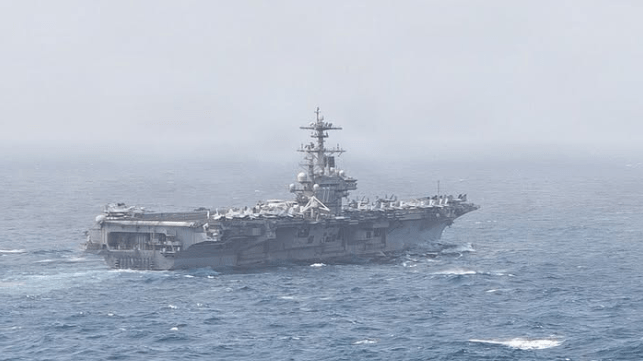
In the meantime, should conflict erupt once again, the element of the CENTCOM force that provides the forward screen and quick reaction force remains in place, providing Commander CENTCOM with the means to respond while reinforcements are brought back into theatre. This force in place consists principally of ground-based air defenses and assets afloat. CENTCOM for obvious reasons is not posting a daily order of battle, but two carrier strike groups remain in theatre, flag-shipped by USS Abraham Lincoln (CVN-72) and USS George H. W. Bush (CVN-77); in current circumstances, only one of these two CSGs is likely to be held forward, with the duties of the forward screen in the Gulf of Oman scaled back to reflect the lifting of the blockade on Iranian shipping and ports.
USS Boxer (LHD 4), USS Portland (LPD 27) and USS Comstock (LSD 45) with 11th Marine Expeditionary Unit are now in theatre, which suggests that the Boxer Amphibious Ready Group may now be taking over front line duties from USS Tripoli (LHA 7), USS San Diego (LPD-22) and USS New Orleans (LPD-18) with F-35Bs, tactical helicopters and the 31st Marine Expeditionary Unit embarked.

that matters most
Get the latest maritime news delivered to your inbox daily.
A key component of the continuing CENTCOM readiness posture appears to the presence of Apache helicopters over the Strait of Hormuz, protecting and covering the movement of shipping through the Strait, particularly those moving through the southern channel who continue to use the Omani coastal route. Maintaining the free flow of commerce through the Strait of Hormuz is a key CENTCOM objective at present, and also maintenance of the capacity to respond instantaneously should there be any attempts to interdict traffic.
In summary, while US forces are being both withdrawn from the theatre and rotated within the theatre to give front-line units opportunities for rest, resupply, and recuperation, a forward posture is being maintained so that there can be an immediate response to any Iranian breaches of the ceasefire, in particular in the Strait of Hormuz.