

Trump Administration Invests in Philippines' Defenses in S. China Sea
The Trump administration plans to spend $400 million on improving the Philippines' military capability in the South China Sea, plus another $2 billion in lending assistance to buy American-made equipment. The deal includes a promise to improve military access to islands in the strategic Strait of Luzon, the White House announced last week.
During a state visit to Manila, President Donald Trump signed a package of trade, finance and defense agreements with his Philippine counterpart, President Ferdinand Marcos, Jr. These proposals include substantial support for the Philippine military, and would augment U.S. power-projection capability and improve access in the event of a conflict with China.
The deals include $400 million in direct financing to improve the Philippines' reach and deterrence capabilities in the South China Sea, where China regularly pushes up against the boundaries of Philippine sovereignty. The funding will provide for "long-range fires, command and control, critical infrastructure, and multi-domain drones." The Armed Forces of the Philippines and the Philippine Coast Guard are routinely challenged by their Chinese counterparts in the Spratly Islands and the waters around Scarborough Shoal, even though these regions are within the Philippine EEZ and hundreds of miles away from China. Long range ISR capabilities are a key part of the Philippine effort to contest China's foothold in the area.

that matters most
Get the latest maritime news delivered to your inbox daily.
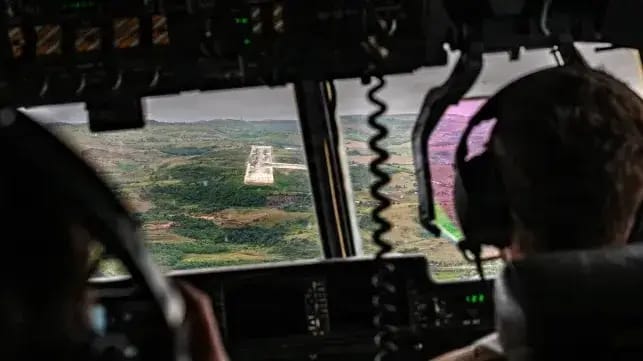
A second deal provides U.S. foreign military financing loan terms for a package of $2 billion in defense equipment, to be built and supplied by American contractors. Manila will also modernize Basco Airport on Batan Island, at the center point of the Strait of Luzon, to "improve U.S.-Philippine operational access, disaster response, and commercial supply chains."
The strait is a key line of communication through the First Island Chain, and would be hotly contested in any conflict over the future of Taiwan. The U.S. Marine Corps has practiced deploying to the island outposts in the strait in order to prepare for dispersed, hard-to-hit shore battery operations - the service's planned role in the event of a war with China.
As part of the overall package, local company Subic Grain will also build a new $40 million fuel storage depot at Subic Bay, which will be available to support U.S. military needs. Subic was once the largest overseas U.S. naval base; though the American footprint there is much smaller now than it was during the Cold War, the strategic harbor remains an asset for operations in the South China Sea, and it is attracting new foreign investors.