


The NSMV Program and the Rise of the Vessel Construction Manager Model
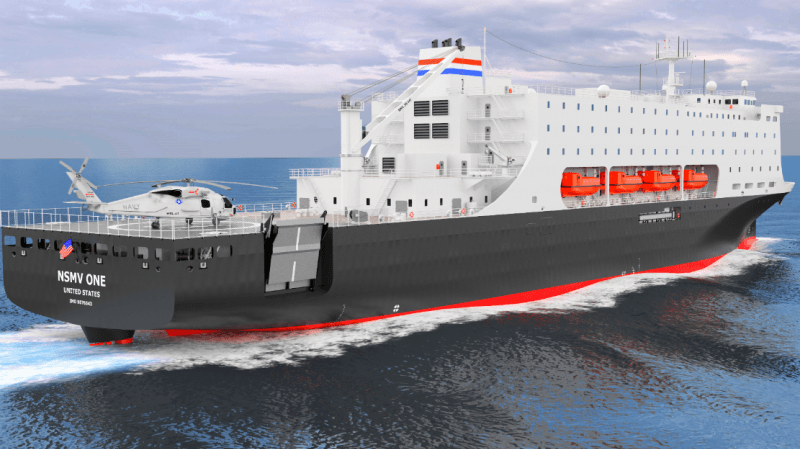
The National Security Multi-Mission Vessel (NSMV) program represents a significant innovation in American maritime policy, maritime education, shipbuilding, and government procurement. What began as an effort to replace an aging fleet of training vessels at the nation's State Maritime Academies (SMAs) evolved into a broader national investment with implications extending well beyond the education of future merchant mariners. The program created a new class of purpose-built ships designed to support both maritime training and national emergency response while also introducing an alternative model for the acquisition of government vessels. At the center of this innovation is the Vessel Construction Manager (VCM) model, which separates the government's role as owner and customer from many of the complex responsibilities traditionally associated with managing ship design and construction.
Background
The need for the NSMV program emerged from a growing crisis within the State Maritime Academies. The six federally recognized academies in California, Maine, Massachusetts, Michigan, New York, and Texas play an essential role in producing licensed deck and engineering officers for the U.S.-flag merchant fleet. Collectively, they produce more than 70 percent of these officers, making them critical to both the nation's commercial economy and national security. Historically, however, the federal government supplied the academies with surplus naval or commercial vessels that were converted for training purposes. By 2013, this long-standing approach was becoming increasingly unsustainable. The current training ships were between 23 and 51 years old, expensive to maintain, and equipped with outdated propulsion, navigation, and engineering systems that no longer reflected the technology found aboard modern commercial vessels.
At the same time, the use of SMA training vessels following Hurricanes Katrina, Sandy, and Maria demonstrated that these ships could serve a broader national purpose. During these disasters, these vessels provided housing and food services for federal emergency personnel. These experiences helped reshape the concept for a replacement training ship. Rather than simply constructing a new vessel for cadet education, planners developed the idea of a multi-mission ship capable of functioning as both an advanced maritime training platform and a national asset for humanitarian assistance and disaster response. This broader mission strengthened the case for federal investment by connecting maritime education to national resilience and emergency preparedness.
Funding the NSMV program required a sustained and coordinated effort. A critical development was the formation of the Consortium of State Maritime Academies in 2004. Instead of competing individually for federal resources, the academies worked collectively to advocate for replacement vessels. This unified approach allowed them to present the modernization of the training fleet as a national priority. After years of advocacy, Congress appropriated $300 million for the construction of the lead ship in the Consolidated Appropriations Act for Fiscal Year 2018. Additional annual appropriations followed, and between 2018 and 2022 Congress appropriated more than $1.37 billion for the construction of five NSMVs. The scale of this investment made the program the largest federal investment in maritime training infrastructure in American history.
A New Government Vessel Acquisition Model
While the ships themselves are an important accomplishment, perhaps the program's most significant long-term impact may be the introduction and validation of the Vessel Construction Manager model for government ship acquisition. Traditionally, a government agency procuring ships may take on substantial responsibility for managing design, contracting, construction oversight, supply chains, testing, and delivery. The NSMV program used a different approach. Congress directed MARAD, through the National Defense Authorization Act for Fiscal Year 2017, to use an outside entity to oversee the NSMV shipbuilding process.
In 2019, MARAD selected TOTE Services as the NSMV program's Vessel Construction Manager. TOTE assumed responsibility for supervising detailed design, overseeing construction, coordinating the supply chain, and managing testing and delivery. TOTE then contracted with Philly Shipyard, now Hanwha Philly Shipyard, for the construction of the first two vessels in 2020. This arrangement allowed MARAD to retain its role as the federal agency responsible for the program while relying on a private-sector organization with specialized shipbuilding and vessel-management expertise to manage the highly complex construction process.
The VCM model is particularly important because it offers an alternative to traditional government acquisition processes for vessels that do not require highly specialized combat systems. The NSMV program suggests that logistics, training, support, and other noncombatant vessels may benefit from a procurement structure that combines government funding and mission requirements with private-sector project management and commercial shipbuilding practices. By assigning an experienced construction manager responsibility for coordinating design and construction, the government can potentially reduce administrative complexity while gaining access to specialized expertise and more direct coordination with shipyards and suppliers.
The success of the NSMV program has already influenced subsequent government shipbuilding initiatives. MARAD has announced plans to construct two Missile Range Instrumentation Vessels using the proven NSMV hull form and the VCM model, again with TOTE Services managing construction and delivery and Hanwha Philly Shipyard building the vessels. In addition, the U.S. Navy awarded TOTE Services a $2.2 billion contract to serve as the Vessel Construction Manager for the Marine Corps' Landing Ship Medium program. These developments demonstrate that the VCM concept is no longer limited to the NSMV program. Instead, it is emerging as a potentially important model for future government ship acquisition.
Impacts of the NSMV Program
The NSMV program has also produced broader benefits for American maritime infrastructure. The new vessels modernize maritime education by providing cadets with training platforms equipped with systems that more closely resemble those found aboard contemporary commercial vessels. The ships have also generated increased visibility and interest in maritime careers, with academies reporting growth in student inquiries, applications, and enrollment following announcements of the new vessels.
Equally important, the construction program contributed to the revitalization of American shipbuilding. The NSMV contracts enabled Philly Shipyard to expand its workforce and operations and helped position the facility for future growth. The program also contributed to the decision by Hanwha Systems and Hanwha Ocean to acquire and invest heavily in the Philadelphia shipyard. Thus, federal investment in maritime education also generated industrial benefits by supporting domestic shipbuilding capacity and workforce development.
In conclusion, the NSMV program demonstrates how a clearly defined national need can produce benefits across multiple sectors when supported by sustained collaboration, long-term investment, and innovative management. The program replaced an aging and increasingly obsolete training fleet, strengthened the nation's capacity to educate future merchant mariners, created new disaster response capabilities, and supported the revitalization of an important American shipyard. Most significantly, however, the program demonstrated the potential value of the Vessel Construction Manager model as an alternative approach to government ship acquisition. As the VCM model is adopted for additional federal shipbuilding programs, the legacy of the NSMV initiative may extend far beyond the five ships themselves. It may ultimately help reshape how the United States acquires an important category of government vessels, combining public oversight and funding with private-sector expertise to strengthen both the nation's maritime capabilities and its domestic shipbuilding industry.
About the author:

that matters most
Get the latest maritime news delivered to your inbox daily.
Michael Alfultis is the retired president of the SUNY Maritime College in New York. He retired after 10 years leading the college and with 21 years of experience as a faculty member and 23 years of experience as a higher education administrator.
The opinions expressed herein are the author's and not necessarily those of The Maritime Executive.
