


Tanker Caroline Bezengi Intact and Still Leaking Crude Oil
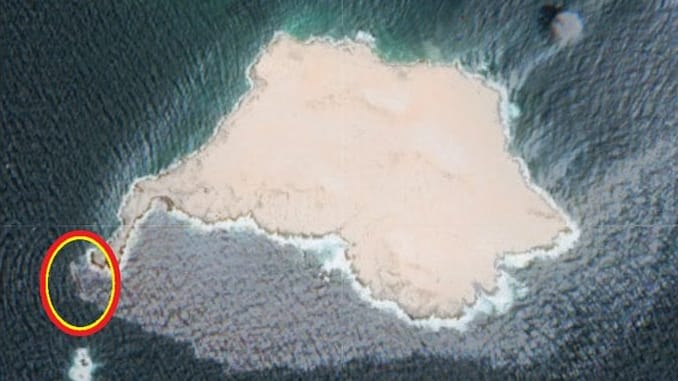
The latest imagery, taken on August 27, shows that the wreck of the VLCC Caroline Bezengi remains intact. The tanker is still leaking oil, but the leakage appears to be no worse than it was when last seen in imagery on August 22. The Caroline Bezengi has been beached on rocks off the southwest tip of Jazirat Al Qibliyyah, one of the Hallaniyat Islands off the coast of Dhofar in the southwest of Oman, since about June 23.
On August 22, imagery was taken when seas were high and the top surface of the tanker deck was covered by waves. The latest imagery shows no deformation of the hull, but the tanker is likely to have settled deeper in the water.
Ambrey, who is coordinating the salvage effort, has not released a press statement since the first issued on August 13, and there has been no coverage of the state of the wreck from the Oman News Agency, suggesting that for the moment there is no immediate crisis or fear that the tanker will break up.
The Oman Meteorology weather forecast for the area is showing Khareef conditions still set in, with rough seas, wave heights from 2 to 4 meters, and southwesterly wind speeds of about 25m/s (55 mph). There is no sign yet of a break in the weather, and indeed, according to forecasts, wave conditions are likely to worsen from September 3 onwards. Rough seas and strong winds will help with the dispersal of the leaking oil, a plume from which is still visible on surface water, spreading towards the North East.

The oil plume evidently from the Caroline Bezengi, August 27 (Google Earth/Copernicus/©CJRC)
In these conditions therefore, it is not surprising to see no sign of salvage activity either around the stricken tanker itself, or of Ambrey establishing its forward base on the island of Halliniyat, some 20nm to the west, where there is a tactical 1300m runway and a small protected harbor. Better conditions, more favorable for lightering operations and a potential refloat of the tanker, can be expected towards the end of September.
The Caroline Bezengi was hit by an explosion on June 8 while off the coast of Oman. The tanker had completed a transit of the Suez Canal on May 30 and had left the Maritime Security Transit Corridor when the explosion occurred. The crew was taken off without injury some four days later. The tanker was laden with oil taken on board at Novorossiysk and was destined for Gujarat, India. The tanker is sanctioned by the EU, UK, and US (OFAC), and has a past association with Russian state shipowner Sovcomflot.

that matters most
Get the latest maritime news delivered to your inbox daily.
Ambrey has been called in to coordinate the salvage operation, to lighter off the cargo if feasible, and also to refloat and recover the tanker if its condition allows. Ambrey is also setting up an oil clear-up operation, to activate if this becomes necessary in the event of the tanker breaking up.
Although Ambrey has formally been certified as a full member of the International Salvage Union only since May this year, it was responsible for the hugely challenging recovery of the Greek-registered Panamax Sounion (IMO 9312145), which was the subject of a sustained attack in the Red Sea by the Houthis in August 2024. After the crew of the Sounion had been evacuated by units from the EU’s Operation Aspides, the Houthis subsequently raided the tanker and set off fires using explosive charges. The Ambrey-coordinated operation landed a salvage crew back on the Sounion while it was still on fire and under Houthi threat, took the tanker under tow northwards, and managed to recover most of the cargo, thereby saving not only its value for the insurers but also averting an environmental catastrophe in the Red Sea. Ambrey therefore has the credentials and confidence to take on a complex and difficult salvage operation, which the recovery of the Caroline Bezengi is certainly proving to be.
