


Scrap Metal Fire in UK Highlights Growing Risk of Contaminated Cargoes
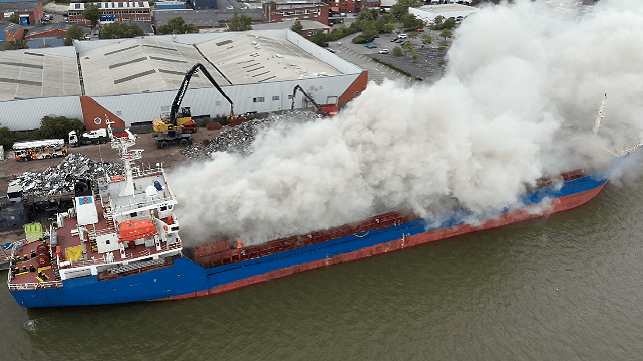
Scrap metal is among the most notorious cargoes for fire risk, not because of its inherent properties but because it is often contaminated with flammable debris and ready-made sources of ignition, like damaged lithium-ion batteries. A recent blaze at the port of Hull, UK illustrated the continuing danger to shipping, port facilities and public health from scrap-related fires.
On June 27, 2025, the freighter Altay was alongside a scrap yard at Albert Dock in Hull, England to take on a cargo for export. At about 0945 hours, the master spotted smoke coming from the newly-loaded cargo in the hold. The captain sounded the general alarm to muster the crew for firefighting duty, and called on the shoreside stevedoring team to begin discharging the hold with a grab in order to help expose the seat of the fire.
The crew responded quickly, and two fire teams were in place and ready within 10 minutes. Meanwhile, their crewmates cleaned out the rails on the coamings to make ready to close the hatches if needed.
At about 1030 hours, shoreside fire teams arrived on scene and took over the job on board, allowing the crew to evacuate to the pier. The master and chief officer remained on scene to keep an eye on the vessel's stability as the shore teams added more water into the hold. The fire put out large quantities of noxious smoke, forcing the authorities to issue a shelter-in-place order to local residents and businesses. Two roads had to be closed to traffic and several businesses had to temporarily shut down because of risks related to air pollution.
The blaze continued to burn until early in the morning of June 28. The accumulated firefighting water was deemed too dirty to discharge into the Albert Dock, so it was pumped off into tank trucks for specialized treatment. No injuries were reported, but the steel structure of the ship's after hold showed signs of fire damage; the ship had to wait for regulatory surveys, then departed to Turkey for shipyard repairs. The cargo stayed behind on the pier and was carefully scrutinized by investigators.
In a preliminary conclusion released last week, MAIB found that the fire likely started from an undischarged battery (a common cause of scrap fires) or from another source of a spark. Once ignited, the agency asserted, there was enough flammable material present to sustain a fire. "The scrap cargo contained hazardous impurities, including batteries, oil drums, and oily residues, which posed a fire risk," MAIB reported.
According to MAIB, the scrapyard at Hull was in the practice of applying a visual check to incoming metal shipments that passed through its gates, but did not have a facility for sorting and screening to remove contaminants. Instead, the yard relied upon its suppliers to screen their own recyclables, and it classified the resulting mixed product as a Group C nonhazardous cargo - in short, a clean cargo, according to MAIB.

that matters most
Get the latest maritime news delivered to your inbox daily.
Leading marine insurer Gard has noticed an unwanted trend of increasing risk of scrap metal fires, and has suggested that the Group C definition may need to be adjusted to account for current industry realities in the metal recycling trade.
"It is . . . apparent from several serious scrap metal fires involving Group C declarations that the cargoes contained quantities of combustible and/or potentially hazardous foreign materials, such as batteries, rubber, plastics, wood, foam, oils/greases, gas bottles and rags," Gard recently observed. "In one accident report an experienced representative of the scrap facility highlighted to investigators the fire dangers associated with lithium-ion batteries and their increasingly prolific use: 'It’s becoming more of a problem every month, every year in our industry.'"
