
Rotterdam Demonstration Marks Milestone in Autonomous Inland Shipping
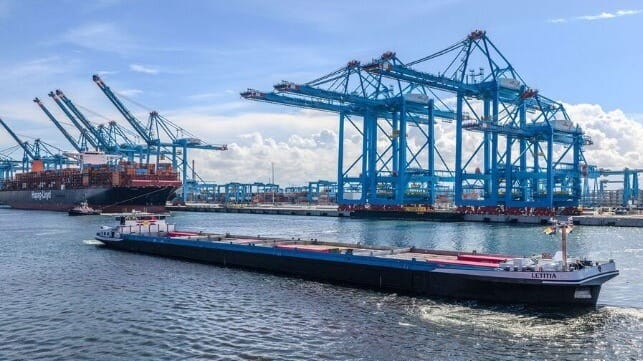
A new milestone was marked in the ongoing development of autonomous shipping with an inland container vessel successfully navigating through the Port of Rotterdam. It was part of an European innovation project aimed at accelerating the transition to climate-neutral ports.
The Letitia, a 135-meter (443-foot) container vessel built in 2024, was selected for the demonstration project. Flagged in the Netherlands and operated by the HTS Group, it is typical of the critical fleet of inland vessels that regularly move containers and cargo from Rotterdam and other key European seaports inland to the hinterlands. The vessel carries up to 610 TEU.
During the demonstration, the Letitia sailed from Amaliahaven on the Maasvlakte via Europoort and the Nieuwe Waterweg to Waalhaven in Rotterdam, navigating safely among regular maritime traffic. Port officials said it showed how an inland vessel can sail independently from one terminal to another in a busy port.
The vessel was able to perform maneuvers such as undocking, sailing through the port and along the river, as well as docking independently. At the same time, the system continuously monitored its surroundings, detecting other vessels and safely avoiding them where necessary, taking the environment into account.
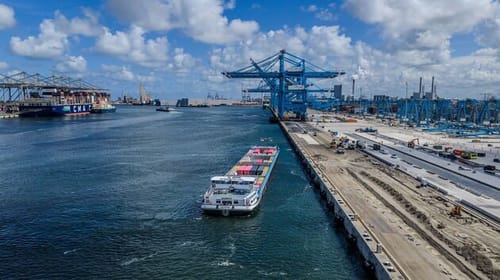
The vessel docked and undocked as well as maneuvered through the busy shipping traffic (Port of Rotterdam)
“Autonomous sailing enables new logistics concepts that improve the flexibility, efficiency, and reliability of inland shipping, which is an important hinterland transport modality for the Port of Rotterdam,” said Oscar van Veen, Director of Innovation at the Port of Rotterdam Authority. “Containers, bulk, and liquids transported via inland waterway reduce pressure on the road network and are moved more energy-efficiently than by road. With the growth in freight throughput, it is essential that inland shipping maintains and expands its share of freight transport. Autonomous sailing could play a role in this.”

that matters most
Get the latest maritime news delivered to your inbox daily.
The demonstration was part of the European MAGPIE project (sMArt Green Ports as Integrated Efficient multimodal hubs), which aims at accelerating the transition to climate-neutral ports. Coordinated by the Port of Rotterdam and co-funded by the European Union, MAGPIE brings together 45 partners to develop, test and scale innovations in clean energy, digitalization, and sustainable logistics. Autonomous shipping is one of the ten demonstration projects within MAGPIE.
Project partners Alphatron Marine, Argonics, and Argonav report that they will integrate elements of the demonstration into their assistance products for inland vessels. argoPositionPilot is now available for vessels with a fixed propeller and rudder, while argoRadarPilot can display intentions and will feature collision detection. The skipper remains ultimately responsible and can intervene at any moment, while the system provides support for the navigation and decision-making.
