

First Seaspan-Hapag Boxship Completes Dual-Fuel Methanol Conversion
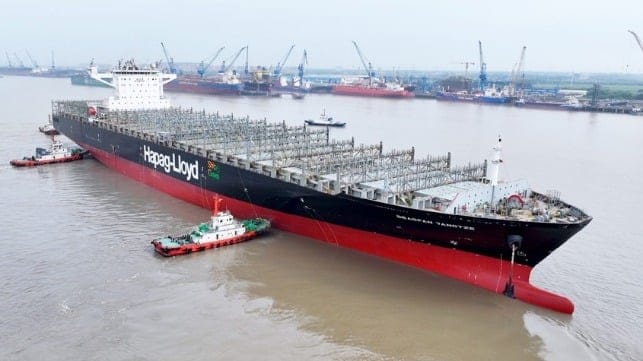
The first of five planned conversions of conventionally powered containerships owned by Seaspan to dual-fuel methanol capabilities has been completed in China. The Seaspan Yangtze, which operates under a long-term charter to Hapag-Lloyd, was officially handed back to her owners on June 1 after a conversion lasting nearly three months.
COSCO Shipping Heavy Industry’s yard in Shanghai completed the conversion of the vessel, which was built in 2014 in China and had previously operated for Hanjin. The ship is 337 meters (1,105 feet) in length and 115,318 dwt. It was equipped with a conventional fuel MAN S90 engine.
Seaspan and Hapag announced in 2024 a plan to convert five of the 10,100 TEU vessels starting in the first quarter of 2026. The companies reported they would invest approximately $120 million in the project, which included the Seaspan vessels, Amazon, Ganges, Thames, Yangtze, and Zamberzi.
CSI-Shanghai highlights that the extensive project involves modifications to the main and auxiliary engines as well as the integration of the fuel system and piping. They also had to add methanol fuel tanks and took the opportunity to also upgrade the engine room command and control systems to improve the vessel’s operating efficiency.
The entire process required approximately 18 months, but the first 15 months were used to develop the equipment and prepare for the ship’s arrival. The Seaspan Yangtze reached at the yard in March, and the conversion and upgrades were completed ahead of schedule. The yard highlights that it was able to minimize the out-of-service period for the vessel through this approach.
The ship recently completed sea trials after the conversion. The yard reports strong improvements were achieved for the vessel’s Energy Efficiency Design Index (EEDI). The ships, however, give up approximately 1.5 to 2 percent of their container capacity to accommodate the addition of specialized methanol fuel tanks.
Hapag’s schedule shows the Seaspan Yangtze will resume sailing, departing from Ningbo on June 10. It will make stops in China before proceeding to New York and Norfolk.
The owners are proceeding with the conversion project, while the industry’s push toward methanol has slowed. Concerns over supply and the infrastructure, as well as uncertainty over environmental regulations, continue to impact the drive to adopt alternative fuels.
COSCO highlights that this was the third conversion project and fifth vessel, expanding its range in conversions. The first projects were completed for COSCO Shipping in 2025, first with the COSCO Libra (20,000 TEU) and her sistership, COSCO Gemini. The second project was for two 13,300 TEU vessels, COSCO Peony and COSCO Jasmine, which were completed in 2026.

that matters most
Get the latest maritime news delivered to your inbox daily.
Maersk pioneered the methanol conversion process in 2024 with the Maersk Halifax. The company announced the project, saying it planned to convert an additional 10 ships in the class as they reached the age for the special surveys. CMA CGM has also contracted for its first conversion project, which will start later this year and involves up to six 9,300 TEU vessels.
DNV’s Alternative Fuel Insight database shows that there are just over 100 vessels in service with methanol fuel capabilities, with the largest group among containerships. Despite the slowing of the overall adoption of methanol-fueled vessels, it highlights over 200 ships with methanol capabilities on order due for delivery by 2030. Recently, several companies, including Maersk and X-Press Feeders, have also begun exploring ethanol as a fuel alternative, noting that the methanol systems are well-suited for the alternative.