


Report: Iran Begins Laying Mines in Strait of Hormuz
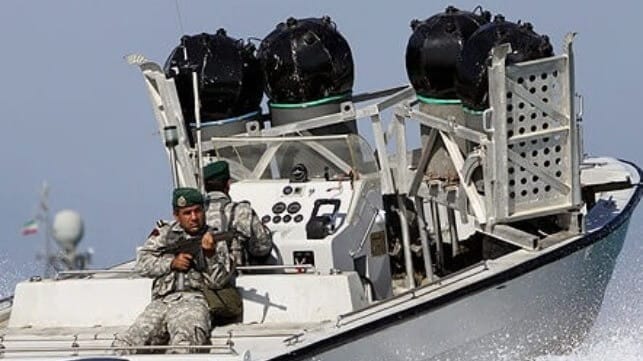
The U.S. intelligence community believes that Iran has begun to set in motion a long-expected plan to mine the Strait of Hormuz, CBS reports. Minefields would effectively render the waterway off-limits for commercial shipping for days or weeks.
According to CNN, Iran is laying an initial tranche of just a few dozen mines out of its vast inventory. About 90 percent of its minelayers are believed to have survived initial U.S.-Israeli strikes, officials told the outlet.
Oil prices immediately rebounded by $10 per barrel on news of the nascent mine threat, reversing a steady downward trend driven by U.S. signals of possible willingness to withdraw from the conflict.
"If for any reason mines were placed, and they are not removed forthwith, the military consequences to Iran will be at a level never seen before," President Donald Trump said in a social media post Tuesday. "If, on the other hand, they remove what may have been placed, it will be a giant step in the right direction."
Mining is often viewed as a last-resort strategy for a Hormuz closure because of its equal effectiveness on Iran's own shipping. Until now, Iran's shadow fleet has quietly continued exports to China through the narrow route, without incident; meanwhile, the Islamic Revolutionary Guard Corps keeps it shut for most Western tonnage using the threat of missile, bomb-boat and drone strikes. This differential access for different fleets would likely end the moment that mines are deployed, and Iran's petroleum exports - essential for long-term regime survival - would cease.
If Iran does decide to move ahead at scale, estimates suggest that it has at least 2,000 mines in its inventory, along with the means to deploy them. The U.S. military is actively working on destroying all Iranian minelayers, Joint Chiefs Chairman Gen. Dan Caine said Tuesday, and U.S. Central Command reported the destruction of 16 mine-capable vessels over the course of the day.
U.S. forces eliminated multiple Iranian naval vessels, March 10, including 16 minelayers near the Strait of Hormuz. pic.twitter.com/371unKYiJs
— U.S. Central Command (@CENTCOM) March 10, 2026
Enforcement may be a challenge. The explosive devices can be launched from small craft and midget subs, not just the vessels of Iran's naval register (now largely destroyed). Interdicting this flotilla along the rugged coastline of the Gulf of Oman and Persian Gulf could prove challenging. Multiple analysts have noted that the threat need not be confined to the Strait of Hormuz: though this choke point is uniquely vulnerable, other adjacent sea lanes, anchorages and loading terminals could also be targeted using low-infrastructure, low-cost munitions.

that matters most
Get the latest maritime news delivered to your inbox daily.
The U.S. recently decommissioned its dedicated Arabian Gulf mine-countermeasures platform, the Avenger-class; four hulls previously stationed in Bahrain arrived in Philadelphia on Monday for storage and later disposal. The purpose-built, wooden-hulled boats have been replaced by Independence-class Littoral Combat Ships equipped with a minesweeping mission package.
Merchant vessel Seaway Hawk transporting decommissioned U.S. Navy Avenger-class Mine Countermeasures Ships USS Devastator, USS Dextrous, USS Gladiator and USS Sentry in the Delaware Bay to unload in Philadelphia tomorrow - March 9, 2026 SRC: FB- Delaware River Shipping / Andy… pic.twitter.com/at2J3Lu2Nd
— WarshipCam (@WarshipCam) March 10, 2026
